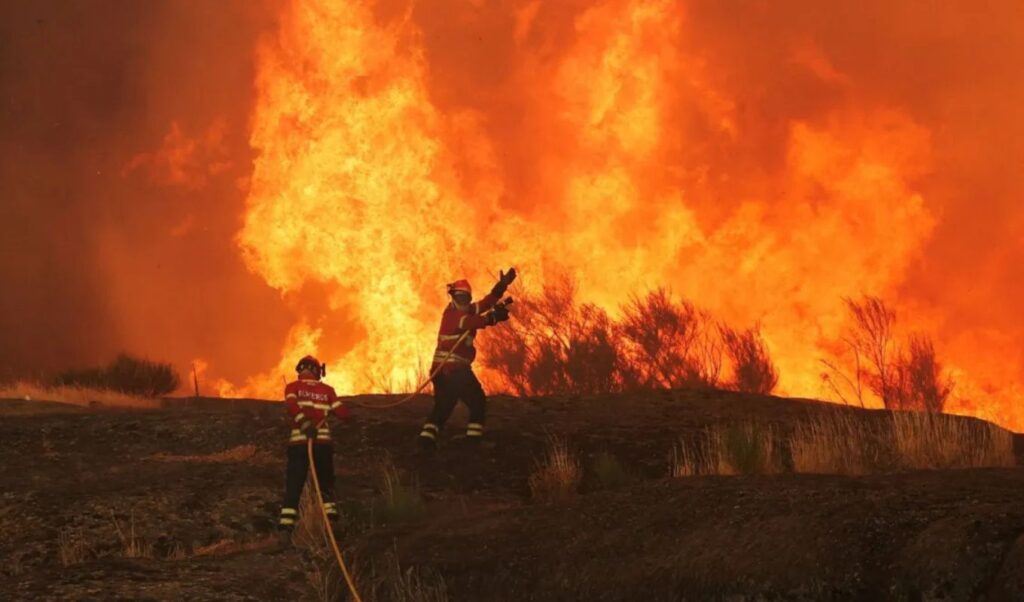
The climate crisis is here, and this year’s wildfires across Europe and the floods that struck during the winter serve as yet another stark reminder. According to a Reuters analysis, someone will have to bear the cost of the damage — and the core problem is that climate-related disasters are becoming ever more frequent.
Read also: France: Up to €15 billion in costs from this year’s heatwaves
Pressure on budgets earmarked for other spending
This year’s wildfires in southwestern Europe and the severe floods that struck Spain in 2024 — as well as Germany and its neighboring countries in 2021 — illustrate how climate-related damage is adding to a growing list of pressures on European public finances, which already include rising defense spending and the escalating costs associated with an aging population.
“The problem is that they are becoming more and more frequent,” said Federico Barriga-Salazar, head of Western European sovereign ratings at Fitch, referring to disasters that have until now largely been treated as costly one-off budget charges rather than recurring expenditures. “If a government is already in a fiscally tight position, it means that some policy trade-offs are being created,” he added, referring to the pressure such financial losses place on other spending allocations.
€822 billion in economic damage
While the current scale of the fiscal hit is admittedly still relatively modest, there is a growing consensus that it will only get larger in a region that is the world’s fastest-warming continent. Extreme weather and climate events caused economic losses of approximately €822 billion ($953 billion) in the European Union between 1980 and 2024, according to the European Environment Agency — with one quarter of those losses occurring in just the last four years.
Public deficits across the eurozone already average around 3% of GDP. Barriga-Salazar cited estimates suggesting that the 2024 floods in Spain — the worst flooding event in Europe in five decades — imply reconstruction costs equivalent to 0.7 percentage points of GDP between 2024 and 2026.
The insurance coverage gap
Furthermore, only one quarter of climate-related disaster losses are insured in the EU, with coverage in some countries falling below 5%, according to EU estimates. Some experts fear that insurance coverage will decline even further as a share of total costs, as extreme weather events occur with increasing frequency.
“I think it simply means that the more these risks grow, the less they will be insured,” said David Zahn, head of European fixed income at Franklin Templeton. “This is a serious issue that will affect some countries by 1% to 2% of GDP.”
The economic think tank Bruegel calculated that while most of the damage from the 2021 floods was covered by insurance in Belgium, Germany’s low insurance penetration meant that €30 billion in public funds had to be mobilized to cover the bulk of the losses.
How Greece is affected
With the European Union expected to publish proposals this autumn on climate resilience and risk management, attention is turning to potential solutions.
Greece, whose economy is heavily dependent on tourism and is particularly exposed to the risk of heatwaves and wildfires, is exploring ways to strengthen insurance coverage while simultaneously reinforcing water and energy infrastructure in tourist centers.
Following the massive floods in early 2026, Portugal announced plans to introduce mandatory home insurance, backed by a natural disaster and earthquake fund as well as a solidarity mechanism guaranteeing universal access.
What are “catastrophe bonds”?
One possible interim measure for some governments could be turning to so-called “catastrophe bonds,” under which investors can earn significant returns but also stand to lose part or all of their principal if a predefined event — such as a hurricane or earthquake — occurs.
Franklin Templeton’s Zahn noted that for governments, this could represent a costly gamble: “If the event happens, the payoff is immediate. But you could also go five years without any gains, while having already paid 8% annually.”
The regulatory frameworks European governments need to establish
Heather Grabbe, senior research fellow at Bruegel, said governments need to put in place more systematic arrangements than one-off emergency spending, which risks creating a perverse incentive for households and businesses to forgo insurance. “All governments across Europe need to assess their exposure and develop comprehensive plans to reduce future damage through adaptation investments, as well as through cross-border risk sharing,” she said.
Multiple studies highlight how early investments in strengthening economic resilience to climate change can, over time, generate significant savings — and help avoid what a 2025 University of Oxford study described as an “adaptation investment trap,” in which recurring climate disasters drive up debt and therefore leave fewer resources available for protective measures.
Spanish Prime Minister Pedro Sánchez has argued that green investments worth 0.1% of GDP could prevent economic losses totaling eight times that amount, while also avoiding tax revenue losses equivalent to three times the initial investment.
The ECB’s joint reinsurance program
The European Central Bank has proposed a joint EU public-private reinsurance scheme that would pool private natural disaster risks, backed by an EU fund for public disaster financing.
The key question, however, is whether this summer’s heatwaves will generate the political will to absorb part of the upfront cost of such action — both at the national government level and at the EU level.
A European Commission spokesperson stated that the Commission is examining ways to address the climate insurance coverage gap, as part of a package of measures expected to be adopted by the end of the year.