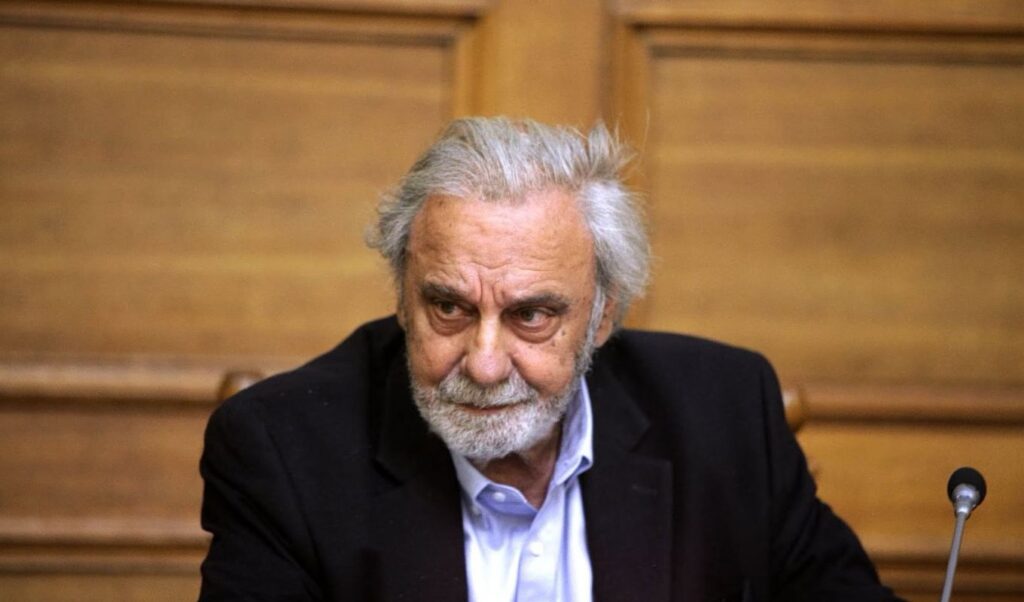
Grief swept through Greek political and intellectual circles following the death of academic Konstantinos Tsoukalas, who passed away in the early hours of Tuesday (18/08) at the age of 89. Greece’s political world united in mourning the sociologist and public intellectual, with tributes focusing on his lasting imprint on Greek sociology and his enduring presence in the major political and ideological debates of recent decades.
President Tassoulas offers condolences on the death of Konstantinos Tsoukalas
President of the Republic Konstantinos Tassoulas expressed his condolences on the death of Konstantinos Tsoukalas, praising the academic and sociologist as one of the most important Greek sociologists and thinkers of our time. He underlined Tsoukalas’s decisive contribution to understanding modern Greek history and the structure of the Greek state. “With clarity and sharp insight, his work illuminated the structure of Greek society and the state, and offered profound analyses of our modern historical journey,” Tassoulas noted. The President extended his heartfelt condolences to the family of the deceased as well as to the academic community.
Συλλυπητήρια δήλωση του Προέδρου της Δημοκρατίας Κωνσταντίνου Αν. Τασούλα για την εκδημία του Κωνσταντίνου Τσουκαλάhttps://t.co/dtvfQatLRD pic.twitter.com/vLmr4CLndD
— President GR (@PresidencyGR) August 18, 2026
Kaklamanis: “His contribution to public life was multidimensional”
Speaker of the Hellenic Parliament Nikitas Kaklamanis also offered his condolences, describing Tsoukalas as one of the country’s “foremost intellectuals and academics.” He stated that Tsoukalas “left his mark on modern Greek sociology and political thought through his sharp intellect, his scientific rigor, and his body of written work,” characterizing his contribution to public life, research, and culture as multidimensional.
Mendoni on Konstantinos Tsoukalas: “A co-founder of sociology in Greece”
Culture Minister Lina Mendoni described Konstantinos Tsoukalas as “a co-founder of the discipline of sociology in Greece” and one of the most distinguished contemporary intellectuals.
Mendoni highlighted in particular his ability to bridge theoretical knowledge with the study of real-world conditions, as well as his sustained public presence. “Konstantinos Tsoukalas was not only a great traveler, but a navigator himself in the world of ideas,” she noted, recalling his journey from the years of resistance against the military dictatorship to his presence in the Hellenic Parliament.
Alexis Tsipras bids farewell to Konstantinos Tsoukalas
Former Prime Minister Alexis Tsipras took to social media to express his sincere condolences on the death of academic Konstantinos Tsoukalas, noting that he was “one of the most important thinkers our country has produced.”
“With deep sorrow I bid farewell to one of the most important thinkers of our country, a wonderfully kind human being — Konstantinos Tsoukalas,” he wrote, extending his condolences to Tsoukalas’s wife, Fotini Tsalikoglou, and to his loved ones.
Με βαθιά θλίψη αποχαιρετώ έναν από τους σημαντικότερους διανοητές του τόπου μας, έναν γλυκύτατο άνθρωπο, τον Κωνσταντίνο Τσουκαλά.
Στη Φωτεινή και τους οικείους του εκφράζω τα ειλικρινή μου συλλυπητήρια. pic.twitter.com/NRGHMapUsH
— Αλέξης Τσίπρας – Alexis Tsipras (@atsipras) August 18, 2026
Papandreou: “A great void in Greek intellectual life”
Former Prime Minister George Papandreou also paid tribute to Konstantinos Tsoukalas, describing him as “a leading sociologist and intellectual with international standing.” As he noted, Tsoukalas “was never an academic detached from reality,” but instead linked knowledge to democracy, social justice, and inequality.
“His loss leaves a great void in Greek intellectual life,” he said, adding that Tsoukalas’s work and ideas would continue to inspire public debate.
Evangelos Venizelos’s moving farewell to Konstantinos Tsoukalas
In a deeply personal tribute, Evangelos Venizelos bid farewell to the eminent academic. He recalled that the two had shared an office at the Thessaloniki Law School and had even shared the same academic gown. “He managed to always remain young,” Venizelos wrote of Tsoukalas, adding that he was saying goodbye to “his brilliant mind, the elegance of his words, his unique style, the modesty that defined him at his core, the grace with which he handled political disagreements, and his capacity for intellectual revision.”
“Konstantinos Tsoukalas managed to always remain young, constantly seeking new interpretive frameworks, while those he had introduced more than fifty years ago as tools for understanding Greek society have long since become widely accepted.
I bid farewell with great sorrow and affection to my officemate at the Thessaloniki Law School, to the wearer of the same gown — the gown that had belonged to my childhood friend and mentor Dimitris Tsatsos.
I bid farewell to his brilliant mind, the elegance of his words, his unique style, the modesty that defined him at his core, the grace with which he handled political disagreements, his capacity for revision. Fotini, who lit up his life, is now called upon to safeguard a great legacy,” Venizelos wrote in his moving tribute.
PASOK’s condolences
PASOK, in a statement of condolences issued by party spokesperson Kostas Tsoukalas, noted that the late academic “opened new pathways in the understanding of the Greek social formation” and left “an indelible mark on sociology and on the country’s academic life.”
“We bid him farewell with respect and gratitude for his contribution to the intellectual enrichment of Greek thought,” the statement read.
SYRIZA: “He never confined himself to the university lecture hall”
SYRIZA focused its tribute on the connection between Tsoukalas’s academic career and his political and public engagement, recalling his decision to lead the party’s national list in the January 2015 elections.
“Konstantinos Tsoukalas never confined himself within the walls of the university lecture hall,” the party stated, describing him as an active public intellectual “with a constant presence in the great ideological and political debates of his era.”
SYRIZA bid him farewell as “a great teacher, a profoundly political intellectual, and a man who connected knowledge with critical thinking and public engagement,” noting that the Greek Left and the social sciences are now the poorer for his passing.
Konstantinos Tsoukalas: his life and work
Konstantinos Tsoukalas was born in Athens in 1937, into a family with deep roots in legal scholarship and politics. He was the grandson of Konstantinos Tsoukalas, a professor of criminal law at the Athens Law School, and the son of Angelos Tsoukalas, a lawyer and politician who had served as a member of parliament for Athens with the Liberal Party, as Mayor of Athens with the support of EDA, and as Minister of Justice from 1970 to 1973, during the military dictatorship.
After completing his studies at the Athens University Law School, he pursued postgraduate degrees in Philosophy of Law and Sociology at the universities of Heidelberg, Munich, Paris, and Yale. In 1974 he was awarded a doctorate in Letters and Humanities from the University of Paris.
At the outset of his career he practiced law in Athens (1961–1968), while simultaneously working as a researcher at the Athens Centre of Social Research and the French National Centre for Scientific Research (CNRS).
His academic career was distinguished:
1968–1985: Full Professor of Sociology at the University of Paris.
1985 onwards: Full Professor of Sociology in the Department of Political Science at the University of Athens.
1981–1989: Scientific Director of the National Centre for Social Research (EKKE).
1993–1996: Chairman of the Board of Directors of EKKE.
He also served as President of the Association of Greek Sociologists, member of the Supreme Council for Research and Technology, and visiting professor at universities in Greece, France, the United States, and Mexico.
He simultaneously took on key institutional and cultural responsibilities. He led the Greek delegation to the United Nations World Summit for Social Development (1994–1996), and served as a member of the Board of Directors of the Foundation of the Hellenic World, President of the National Museum of Contemporary Art (EMST), member of the Cultural Olympiad, and member of the research council of the Olympic Museum in Lausanne. From 2000 to 2014 he served as a full member of the National Bioethics Committee.
In 2025