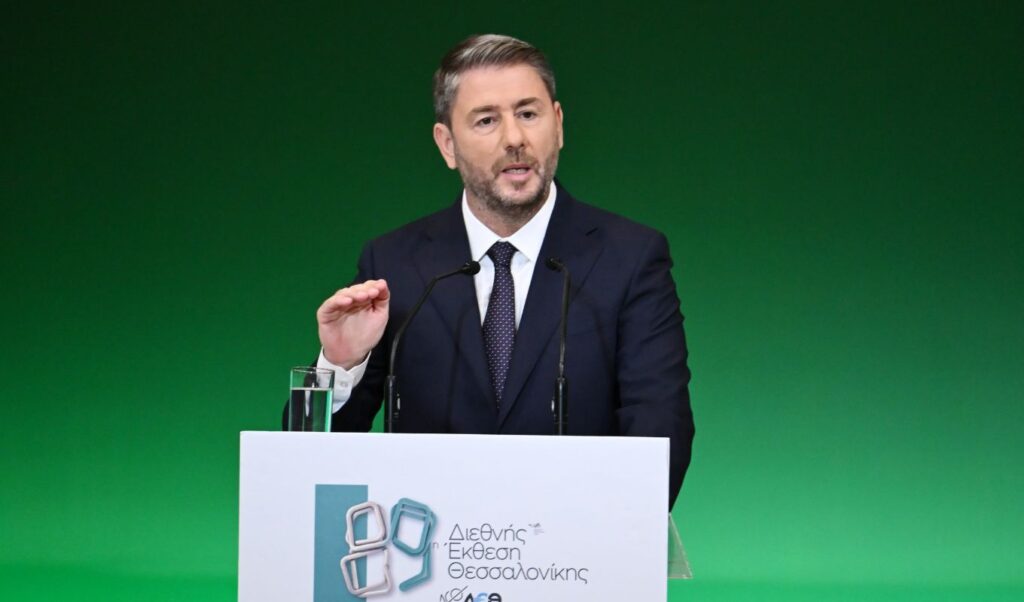
Nikos Androulakis will arrive at the Thessaloniki International Fair with an institutional, policy-driven profile — his sights set on the social majority of 7 in 10 voters who, according to polls, want political change but currently feel unrepresented by any party.
His recent rhetoric suggests his speech will be two-pronged. Rather than directing criticism solely at the government — as is customary for the leader of the official opposition — Androulakis will also set his sights on Alexis Tsipras, in addition to Prime Minister Kyriakos Mitsotakis. Since this year’s Thessaloniki International Fair will be the last before the next general election — whenever that may be — and since PASOK’s leadership at Harilaou Trikoupi believe the party’s key advantage over rival opposition parties lies in its policy proposals, the bulk of Androulakis’ speech is expected to focus precisely on those proposals.
PASOK: Where Nikos Androulakis will focus his attention
The cost of living, household incomes, and corruption will form the sharp edge of PASOK’s policy platform, as it will be presented by the party leader over the two-day period of September 12 and 13. Nikos Androulakis aims to elevate everyday social hardships to the central political issue in his confrontation with the government, betting that he can convince dissatisfied voters that PASOK offers a concrete alternative governing programme — one that includes workable solutions to the country’s most pressing problems.
Proposals to tackle the cost of living crisis
On the cost of living, PASOK’s Harilaou Trikoupi headquarters is pushing for stronger market oversight, a crackdown on price gouging, and direct interventions in the prices of basic goods and energy — while continuing to promise a reduction in the Special Consumption Tax. On incomes, the party is calling for “real increases” in wages and pensions, pledging to boost purchasing power and restore collective bargaining agreements.
Proposals to combat corruption
On anti-corruption measures, the party has already outlined commitments to institutional safeguards, transparency in state operations, and tighter control over public spending and accountability. Further specific proposals are also expected, including strengthening the Supreme Council for Civil Personnel Selection (ASEP) and digitally restructuring the public sector. Promises of solutions will be on offer for all, with Androulakis having asked the heads of PASOK’s Policy Circles to update the party’s programme proposals — incorporating ideas gathered during recent grassroots outreach by party officials with citizens.
The goal
The aim is to present these proposals as policies co-shaped with society, positioning PASOK’s governing programme as fresh and genuinely citizen-driven. In doing so, the PASOK leader hopes to win over centre-left voters who are also drawn to Alexis Tsipras’ SYRIZA proposal for a “New Social Contract” — built around the slogan “from society, with society, for society.”