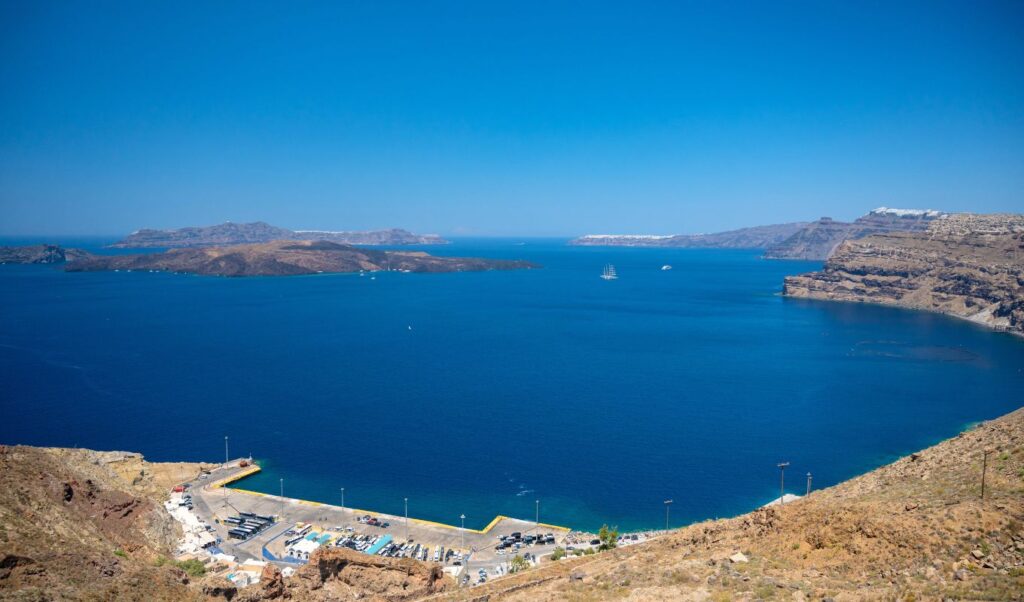
Through a network of cables reaching depths of more than 500 meters, the first electrical loads were transferred last week from the mainland grid to Santorini. This marked the first successful test energization of the island — not yet the full operation of the interconnection, which is scheduled for early autumn, when equipment checks are completed and Thira can be regularly supplied from the high-voltage network.
Which Cycladic islands are getting plugged in
Folegandros, Milos, and Serifos are scheduled to follow by the end of the year. The concept is straightforward: electricity travels under the sea and reaches the island. Behind it lies a network of 294 km of submarine and underground alternating current cables at 150 kV, four new digital substations, and a dedicated system that maintains voltage stability. This is the technical footprint of the fourth and final phase of the Cyclades interconnection project, with a budget of €385.7 million. The first energization of Santorini was announced via LinkedIn by Christina Houliaras, an executive at the Copelouzos Group. The island’s high-voltage substation was built by the Damco Energy – Xian Electric Engineering joint venture. The substation is the point where the transmission cable terminates and from which electricity is distributed — through the distribution network — to homes, hotels, and businesses.
Phase IV does not rely on a single line: the Santorini–Naxos segment, whose submarine laying was completed in 2022, connects Thira to the already-interconnected network of the central Cyclades. On the other side, the Santorini–Folegandros–Milos–Serifos–Lavrio route creates a second corridor to Attica. The Lavrio–Serifos and Serifos–Milos segments were completed in 2024, while the Milos–Folegandros and Folegandros–Santorini sections followed in 2025. In each of the four islands, a fully digitalized, gas-insulated switchgear (GIS) substation was built. Santorini also received an additional Static Var Compensator (SVC) system. Its role is specific: it absorbs or supplies reactive power depending on system conditions, maintaining voltage within acceptable levels and counteracting the fluctuations caused by the long lengths of submarine cables.
Of the project’s total €385.7 million budget, €164.5 million comes from EU Recovery Fund resources. The European Investment Bank also participates in the financing through a direct loan agreement of €157 million and a second agreement of €108.44 million backed by Recovery Fund resources.
Oil-fired generating units will not be decommissioned automatically, as the plan calls for a gradual phase-out while retaining specific local capacity in reserve for major faults
Since 2018
The total cycle of Cyclades interconnections exceeds €800 million. Since 2018, Syros, Paros, and Mykonos have been directly connected to the high-voltage grid, followed by Naxos in 2020, along with upgrades to the Euboea–Andros and Andros–Tinos lines. With this new phase, ADMIE (the Hellenic Electricity Distribution Network Operator) estimates that an additional 332 MW capacity for renewable energy units can be developed across the Cyclades. This is the tangible “green” gain: not exclusive supply from renewables, but the replacement of local oil-fired generation and new space for renewable energy. Oil-fired units will not be immediately decommissioned. The plan calls for a gradual phase-out following an initial period of interconnection operation, while retaining specific local capacity in reserve to handle serious faults or simultaneous cable losses. The Ten-Year Development Programme 2022–2031 had indicated that Thira would need to retain approximately 50 MW as an emergency reserve.
The economic benefit stems from replacing expensive oil-based generation, the cost differential of which is currently covered through Universal Service Obligations (USOs). According to ADMIE’s calculations, the full interconnection of the Cyclades and the dual interconnection of Crete will reduce required USO charges by approximately €550 million per year during 2026–2030. With the inclusion of the Dodecanese and the North Aegean from 2031, annual savings are estimated to reach €1 billion. Taking into account System Use Charges, ADMIE estimates the net benefit for the period 2026–2034 at €3.7 billion, or an average of €416 million per year.
The next step: Dodecanese and North Aegean
The next major step shifts focus to the Dodecanese. The backbone will be a direct current line from Corinth to Kos, with a converter station at each end. ADMIE is currently evaluating bids for the cable component, awaiting first-phase bids for the two converter stations, and advancing environmental permitting. This is a different project from the 150 kV AC island lines, which will subsequently connect Kos to Rhodes and Rhodes to Karpathos. For inter-island connections, as well as projects in the North Aegean, Ionian Sea, and Argo-Saronic Gulf, ADMIE is advancing a six-year framework agreement with a maximum budget of €2.07 billion excluding VAT. The first package, valued at approximately €1.15 billion, was conditionally awarded to Fulgor, a subsidiary of Hellenic Cables. It includes the Thrace–Lemnos, Kos–Rhodes, Lesvos–Lemnos, and Lesvos–Chios lines, covering 694 kilometers of submarine and 227 kilometers of underground cables. Production is scheduled to begin in 2027 and completion is targeted by 2031.
The second package, worth approximately €910 million, is subject to pending approvals and is being taken on by Prysmian. It includes the Rhodes–Karpathos, Aliveri–Skyros, Samos–Kos, Skyros–Lesvos, Chios–Samos, Aegina–Megara, and Kefalonia–Kyllini lines, totaling over 900 kilometers. Final delivery is set for 2033, and in certain locations the cables will be laid at depths of up to 1,150 meters. Having crossed the 500-meter threshold in the Cyclades, the Aegean’s electric highway is preparing to go even deeper.
Published in Kyriakатiki Apogevmatini