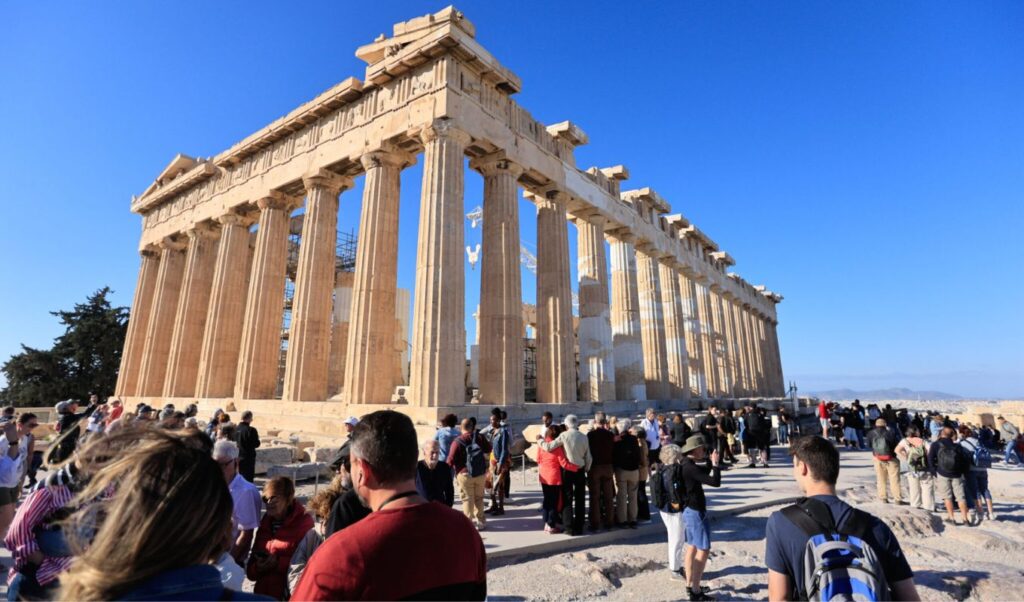
The resilience of Athens’ hotel market and the sustained appeal of the destination are confirmed by data for the first half of 2026. Figures released by the Athens-Attica and Argo-Saronic Hoteliers Association show that, despite ongoing challenges and an increased supply of accommodations, hotels in the Greek capital managed to improve their financial performance.
Specifically, the average occupancy rate remained virtually unchanged, recording a marginal decline of just 0.1% compared to 2025. However, the sector’s key performance indicators posted significant gains, with the Average Daily Rate (ADR) rising by 6.9% and Revenue per Available Room (RevPAR) increasing by 6.8%. As noted in an official statement, during the second quarter of the year — and particularly in May and June — the slight dip in occupancy did not prevent an overall improvement in hotel performance, reflecting the market’s resilience in an environment of growing supply.
When benchmarked against nine major European competitor destinations, Athens maintained the strongest overall performance compared to the same period in 2025. The city recorded the highest growth in both ADR and RevPAR, outperforming destinations such as London, Berlin, Rome, Amsterdam, and Istanbul. (Data source: CoStar in collaboration with GBR Consulting.)
“The H1 2026 results confirm the resilience of Athens hotels and the sustained attractiveness of the destination”
The President of the Athens Hoteliers Association (EXA), Evgenios Vasilikos, stated: “The results for the first half of 2026 confirm the resilience of Athens hotels and the sustained attractiveness of the destination. These results are being assessed against a backdrop of increased accommodation supply and significant global shifts in travel flows. Although a slight decline in occupancy was recorded in the final months of the half-year period, ADR and RevPAR indicators continued to trend upward, signaling that the destination retains its momentum and competitiveness as a quality urban destination. At the same time, regular communication between EXA and its members reveals that last-minute bookings have been gaining ground in recent months, to a greater extent than observed in previous years.
This trend makes forward planning more difficult and reduces market visibility for the months ahead, which calls for particular caution when assessing the outlook for this year’s tourism season. The tourist year is still ongoing and should be evaluated in its entirety once it concludes. Our goal remains to maintain competitiveness through quality-driven growth, infrastructure investment, and targeted destination promotion initiatives.”