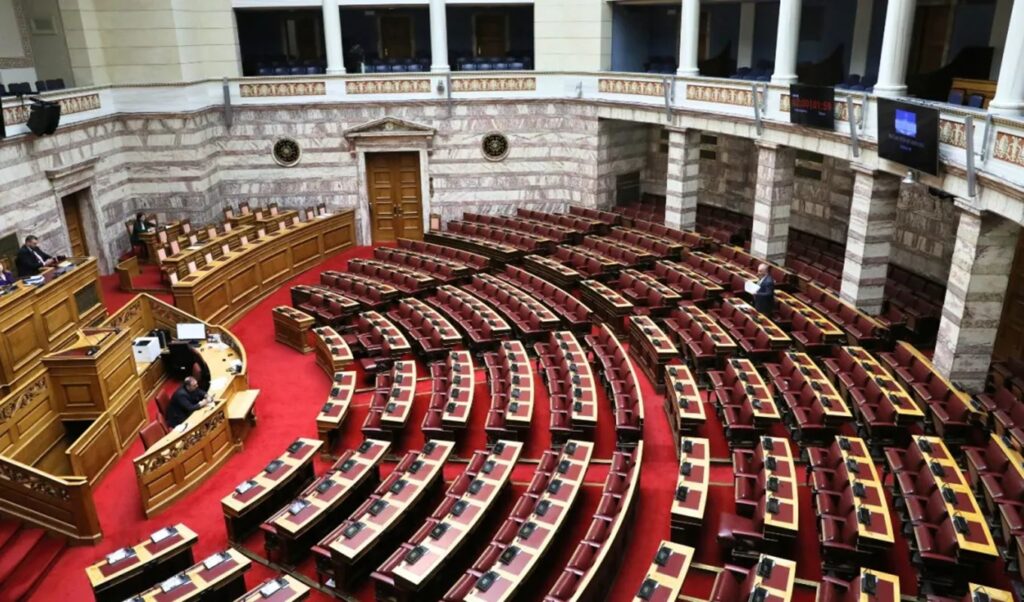
The process of Constitutional Revision is reaching a critical juncture, with a three-day debate in the Plenary Session today, Thursday, and tomorrow, Friday, followed by the first roll-call vote on Monday, July 27. The debate kicks off on the morning of Thursday, July 23, 2026, with speeches from party rapporteurs and designated speakers representing the political parties. The remaining members of the Constitutional Revision Committee will follow, after which any members of parliament who wish to take the floor may do so.
Read also: Constitutional Revision: Party positions on the articles reviewed by the Parliamentary Committee
On Friday, the remaining speakers will take the floor, with party leaders also expected to deliver their addresses. The session will run until 6:00 p.m., as a commemorative event marking the restoration of democracy will be held at the Presidential Mansion afterward. The third session, scheduled for Monday, July 27, 2026, is expected to conclude with a roll-call vote on all 40 “fields” of the Constitutional Revision. As for the second vote in the Plenary, it will be held immediately after Parliament resumes its work at the end of August.
Constitutional revision: three-day parliamentary debate gets underway
The key takeaway from the final meeting of the Constitutional Revision Committee is that, after many years, there are now indications that the next Parliament — which will serve as the Revisionary Parliament — may achieve consensus on both Article 16 of the Constitution and Article 86, which concerns the ministerial responsibility law. Notably, PASOK signaled its openness to both Article 16 and Article 86, as well as to the articles for which it had submitted its own revision proposals — meaning its current stance of “present” could well become a “yes” in the next Parliament.
At the same time, beyond monitoring the opposition’s position, the government is closely watching how a number of ruling New Democracy (ND) MPs will vote — lawmakers who, during the committee sessions, raised objections to specific proposals. These include the proposal on the incompatibility of holding ministerial and parliamentary office simultaneously (among them Yannis Kefalogiannis, Lefteris Ktistakis, Babis Athanasiou, Giorgos Kotsos, Notis Mitarakis, Giorgos Vlachos, Manos Konsolas, and Fontas Baraliacos), the proposal on permanent tenure in the public sector (Theodoros Skylakakis and Yannis Oikonomou), and the presidential term limits (notably, former Foreign Minister Dora Bakoyannis, who favors retaining the current two five-year terms, and Babis Athanasiou, who has also expressed reservations about Article 41, which would abolish the right to dissolve Parliament over a matter of exceptional national importance). Monday’s vote is therefore being watched with considerable interest, particularly regarding how many votes each article up for revision will receive — even though ND rapporteur Evripidis Stylianidis has stated, in reference to those party colleagues who have expressed reservations on specific articles, that they support the overall proposal and are reserving the right to state their positions in the Plenary and then decide, in accordance with their conscience, how to vote on individual articles. “As a matter of principle, ND says ‘yes’ to the entire package of the proposal,” he had declared.
It is worth recalling that under Article 110 of the Constitution, the need for constitutional revision is established by a parliamentary decision taken in two separate votes, held at least one month apart. If the decision — which specifically identifies the provisions to be revised — secures a reinforced majority of 180 votes, the next Parliament may approve the revised provisions during its first session by an absolute majority of all its members, i.e., 151 votes. However, if a reinforced majority is not achieved at this stage — as is widely expected, given the refusal of the main opposition and all other parties to support any of the proposed provisions — the Revisionary Parliament will be compelled to seek broad cross-party consensus in order to secure the required 180-vote supermajority.