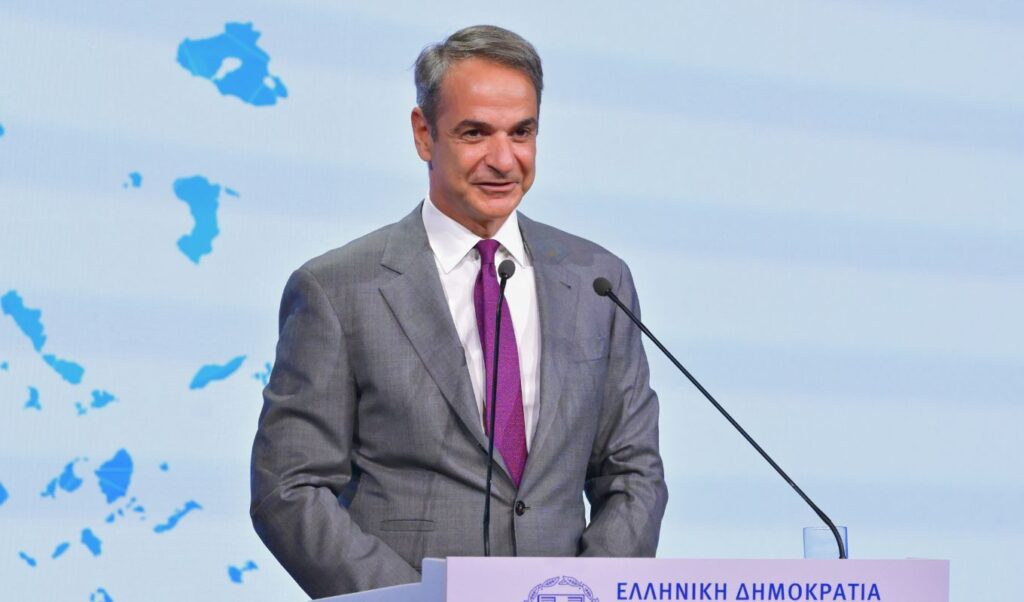
Kyriakos Mitsotakis is expected to unveil a comprehensive four-year economic programme from the podium of the Thessaloniki International Fair, with particular emphasis on the measures set to be implemented in 2027. Yesterday, the government presented the National Development Programme 2026–2030 at a dedicated event. According to Deputy Minister of National Economy Nikos Papathanasis, the programme amounts to €17.1 billion for that period. An additional €5.8 billion will be allocated to complete commitments from the previous programming period, bringing the total mobilisation of national resources to €23 billion.
Mitsotakis to present four-year economic programme at the Thessaloniki International Fair
This represents roughly double the resources compared to the 2021–2025 period, as Minister Papathanasis highlighted. Finance Minister Kyriakos Pierrakakis, speaking at the same event, outlined the key areas where these funds will be directed: “We are creating a coherent framework that channels available resources where there are real needs and significant development opportunities: social cohesion, infrastructure, transport, civil protection, and tackling the climate crisis. As well as innovation, outward-looking initiatives, digital transformation, Artificial Intelligence, and green growth,” he stated.
The vision for Greece in 2030, which the Prime Minister is expected to lay out at the Thessaloniki Fair, is built upon this €23 billion resource base. It simultaneously serves a core objective he has consistently championed: convergence — both of Greece with Europe across all key indicators, and of regions within Greece itself. As he has previously stated, “by making better use of European and national resources, we continue working towards dual convergence — that is, dramatically closing the gap with Europe while also reducing regional inequalities.”
At yesterday’s event, Mitsotakis described the allocation of these resources to the National Development Programme as “a deliberate political choice,” characterising it as a national development tool. He justified the decision by stressing that “the game of real convergence with Europe over the next five years will be decided primarily in the field of investment — both public and private.”
On the second dimension of dual convergence, Mitsotakis placed particular emphasis on the regional aspect of the programme. “Our goal is for development to reach every corner of our country — all 1,008 postal codes. Not just every region, but every corner of every region. And this can only be achieved through close cooperation between the regions and the central government — a cooperation that will require all of us to operate within a framework that serves important national priorities,” he said.
He also framed the so-called “Greece 2030” vision within a political context that is expected to form the backbone of New Democracy’s pre-election campaign, where one of the key dilemmas to be put to voters will be which government — and which prime minister — they trust to deliver the country’s necessary development leap. “We know very well that between now and 2030, Greece’s position in a changing Europe will essentially be determined. It will be decided whether we can achieve real convergence for the benefit of all Greek citizens, or whether we will remain among those countries that are constantly struggling to keep pace with Europe’s top performers. Personally, I have set the bar of our expectations very high,” Mitsotakis concluded.