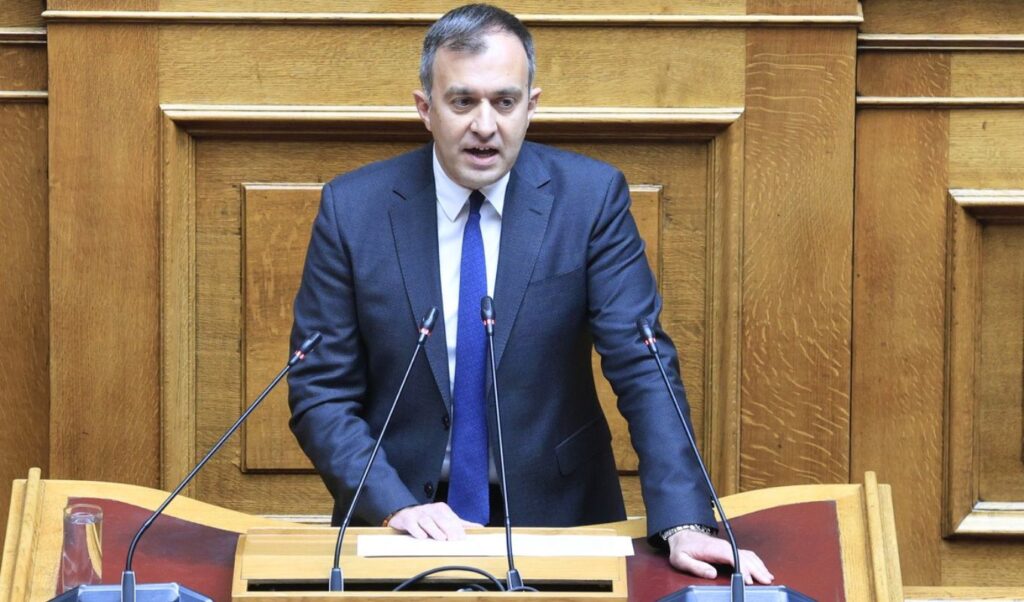
“We are ready, as a country, for security in the Strait of Hormuz, once the war is over,” stated Deputy Foreign Minister Tasos Hatzivasileiou, speaking earlier today before the Parliamentary Committee on European Affairs. “The Prime Minister has made clear that Greece is prepared to discuss its participation in a peacekeeping force that would ensure freedom of navigation in the Strait of Hormuz, once this war has concluded. If we move toward an environment of stability, Greece is a country that would be interested in contributing to maritime security in the region,” the Deputy Foreign Minister stated.
Read more: Middle East: Efforts intensify for a ten-day US-Iran ceasefire — What’s being discussed about Hormuz and Trump’s two options
He went on to add: “We are the ones who play a leading role in maritime security discussions. Who is participating in Operation Aspides today? Essentially, it is the Greeks and the Italians who are taking part in the maritime security operation in the Red Sea. In fact, just a few days ago, Commodore Pitykakis assumed command of the force. Greece currently holds command of Aspides. Therefore, the country that has a clear commitment and is taking action on maritime security is Greece — whether some people like it or not.”
Hatzivasileiou also addressed the “dark anniversary” of the illegal Turkish invasion of Cyprus and its 52 years. “This is a reality that the international community recognizes as an invasion and occupation. Only Turkey and the regime in the occupied territories — the pseudo-state — deny it, but that does not change the reality. If Turkey wishes to interpret this reality through its own logic, that is its own concern. The entire rest of the international community shares a different view alongside us, and we will continue to work in cooperation with the United Nations as well as the European Union,” said Hatzivasileiou, adding: “We have the new special envoy, the Vice President of the Commission, Mr. Fitto, the Italian Commissioner, in order to restart discussions from where they left off in the previous phase and to resume talks on a bizonal, bicommunal federation, exactly as defined by the UN Security Council resolutions, with absolutely no concessions. You are all very well aware that our national position — unchanged and steadfast — is the reunification of Cyprus through federation. There is no discussion of a two-state solution, no discussion of a de facto or de jure partition of the island.”
Hatzivasileiou: “Any crisis in the Middle East drives up energy costs, and therefore the prices of all goods”
On the situation in the Middle East, the Deputy Foreign Minister highlighted the risk of a prolonged crisis in the region. “We do not want this to become the new normal, which is why, at the European Union level, we are emphasizing the importance of taking measures to bring about de-escalation on the ground,” said Hatzivasileiou. He also noted the economic impact: “Unfortunately, any crisis in the Middle East drives up energy costs, and therefore the prices of all goods. There is a mechanism to address the effects of such crises — in this case in the Middle East — there is an affordable energy action plan, which is also being discussed in the General Affairs Council, where I participate as the responsible Deputy Minister for European Affairs, so that we can develop a concrete policy in that direction. Within the European Union, we have a combined approach to dealing with rising prices caused by crises: short-term relief measures for our citizens and consumers, as well as long-term structural reforms, so that the affordable energy action plan — which began to be discussed in February 2025 — can take clearer shape and deliver more tangible results. Following the rise in energy prices from 2026 onward, linked to the war in the Middle East, the Commission has also pushed forward additional measures to accelerate electrification in our markets across EU member states, to reduce energy costs and, of course — and this is the key issue — to strengthen the energy independence of the European Union.”
He also reminded the committee that the European Union does not have a mechanism to impose price caps on oil and natural gas, noting that “prices are determined — for better or worse, that is simply how it works — by international markets.”
Our strategy, Hatzivasileiou noted, is to mitigate, as much as possible, the impact of price increases and to reduce our dependence on imported fossil fuels. “So there is little else we can do at this point beyond that,” he said.
Regarding sanctions and Russian LNG, the Deputy Foreign Minister stated that the relevant discussions are currently ongoing in Brussels.
“I want to emphasize here that our country has provided multifaceted support to Ukraine so that it can continue to resist Russia’s war effectively. We support the continuation of legally grounded and, above all, targeted European Union sanctions against the Russian Federation, in order to drastically limit Moscow’s ability to finance its war of aggression against Ukraine by every means available. At the same time, we are here to highlight, at the European level, the need to avoid placing excessive burdens on the national economies of member states as a result of these sanctions — so that ultimately, European economies are not hit harder than the Russian economy, which is the shared goal of us all,” he stated. With this in mind, the Deputy Foreign Minister stressed the need for close coordination with other European countries as well as G7 nations, in order to ensure that the respective sanctions remain as targeted and effective as possible.
“We pursue a foreign policy based on principles and positions, and our priority is to defend the national interest in its entirety, for the benefit of our citizens, consumers, and businesses,” the Deputy Foreign Minister concluded.