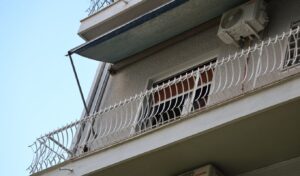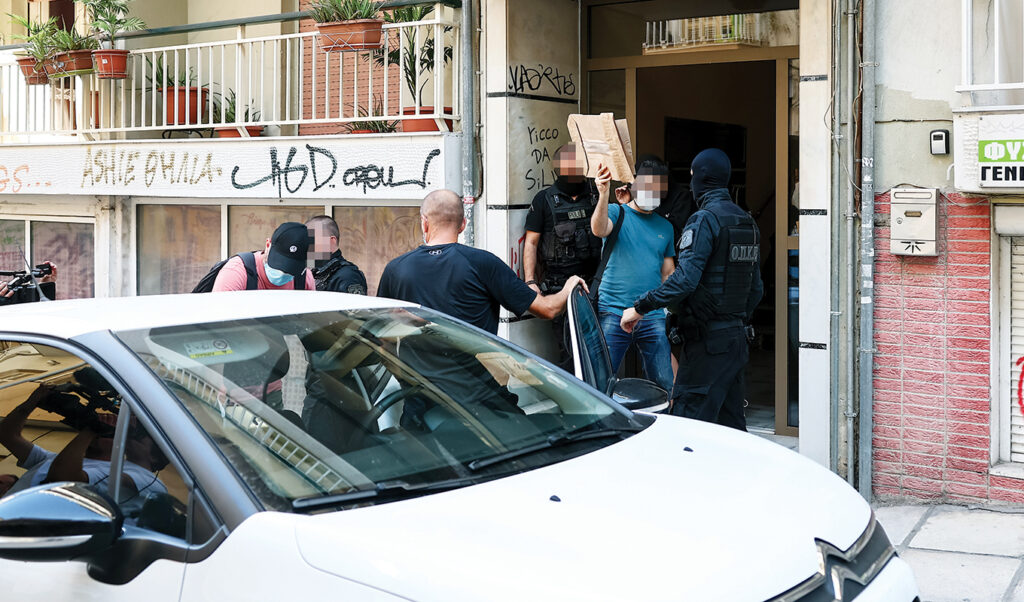
The three individuals arrested in connection with the explosive device attacks on the homes of ruling party officials in the early morning hours of July 1st in Thessaloniki were brought before prosecutors. The three suspects, who face the serious charge of manslaughter with potential intent in connection with the attack that tragically claimed the life of Vagia Nestora, were granted a postponement to enter their pleas on Tuesday (July 14).
Thessaloniki: Who are the three suspects and who allegedly played the operational role in the attack
The suspects include a 29-year-old man and a 26-year-old woman — who had been remanded in custody in 2022 for alleged involvement in the anarchist organization “Anarchist Action” — along with a third individual, the owner of an apartment to which the two fled following the killing of Vagia Nestora. One of the apartments searched, located on the fourth floor of a building on Papadiamantis Street in eastern Thessaloniki, is just two blocks from the Nestora family home. The second apartment, where one of the men was arrested, is on the first floor of a building on Sophocleous Street in the Ano Poli neighborhood — near locations where bombs had previously been planted at the home of a prison officer. Additionally, within a 300-meter radius of the small apartment on Sophocleous Street, other anti-establishment activists have been arrested between 2023 and 2025.
The Counter-Terrorism Unit believes — based in part on video footage — that the fatal injury to the victim was caused by a device planted by the 29-year-old. According to sources, the woman and one of the two men arrested allegedly formed the “operational pair” behind the attack, while the third suspect played a supporting role. Law enforcement authorities believe all three were involved exclusively in this specific attack. Following the bombing, the woman reportedly fled to Crete, where she was located in Chania and subsequently arrested.
The safe house apartments and the Counter-Terrorism Unit’s findings in Thessaloniki
Security authorities are once again scrutinizing the routes taken by the attackers through the Pylea and Toumba districts of Thessaloniki, days after the incendiary attacks on the homes of New Democracy officials. Investigators are questioning witnesses and gathering evidence across a radius of more than five kilometers. When news of Vagia Nestora’s death broke, it appears the suspects were moved or relocated to different areas or cities — possibly via the city’s main ring road. Among the approximately 30 suspects under investigation are individuals of foreign nationality who may have fled to Albania or Bulgaria.
On Wednesday evening, the eve of Vagia Nestora’s funeral, the Minister of Citizen Protection traveled to Thessaloniki to receive a first-hand briefing on the latest findings — most notably an “orphan fingerprint” discovered in remnants of the explosive devices. It is believed that the masterminds behind the attacks have been recruiting new members in recent months, following a wave of arrests at rallies and incidents on university campuses. For their operations, the perpetrators used gas canisters and containers filled with flammable material, without any wiring or triggering mechanism — apparently due to inexperience, but also in light of the tragic precedent set in October 2024, when a bomb detonated in the hands of 36-year-old Kyriakos Xymiteris as he was attempting to connect it, killing him.
Vagia Nestora’s funeral in Kozani and the family’s heartbreaking farewell
In Kozani on Thursday afternoon, images spoke louder than words in the face of such grief. Vagia, the latest victim of terrorism in Greece, was a humble person — a woman defined by generosity, selflessness, and love. Those who knew her said as much: her colleagues from the Court of Appeals, where she had served for decades; her relatives, close friends, and those who had grown up alongside her and her husband, Mr. Panagiotis — among them Paris Koukolopoulos. Five years earlier, the family had mourned the death of their other daughter, and now this grieving father had lost the pillar of his life.
Afroditi Nestora arrived at the church in a wheelchair, with bandages on both her hands and feet. She had gone down to the building’s entrance with her mother when the explosive device detonated, engulfing them both in flames. Afroditi survived; her mother did not, despite the superhuman efforts of medical staff. At the cemetery, Mr. Panagiotis stood alone to receive condolences. Afroditi had to return home, where she will remain bedridden for several days.
PASOK leader Nikos Androulakis set aside party lines to attend the funeral, calling urgently for the perpetrators to be identified and brought to justice. Stratos Simopoulos has been targeted in similar attacks in Thessaloniki seven times, as has Elena Rapti, who was inconsolable at the funeral. It seems impossible that no one saw or heard anything. It is quite possible that insufficient attention was paid to what were considered “low-risk” incidents — and yet, the worst has now happened. In total, five people were injured in the building where the family lived. Savvas Anastasiadis and Zisis Ioakeimovits, by contrast, were unharmed.
“What a shame, what a shame, the same thing again, what a shame,” Alexia Bakogianni murmured through tears — her eyes reflecting the horrors she and her brother had witnessed as children, 37 years ago, following the assassination of their father, Pavlos. Just days earlier, upon seeing the leader of the terrorist organization “November 17,” Alekos Yiotopoulos, roaming free, she had described him as a “dark god who decided who to kill in order to publicize his views,” and wondered aloud how she would react if she were to encounter him on the street…
Published in Parapolitika