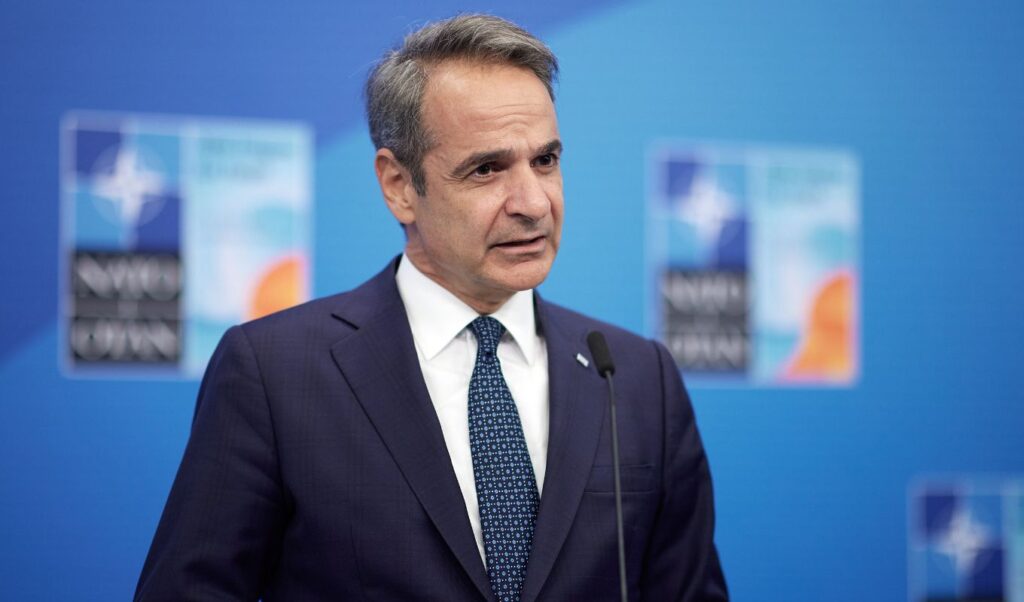
All eyes are on Ankara, where the 36th NATO Summit convenes tomorrow, bringing together heads of state and government from 32 nations to shape the future of the transatlantic alliance. The meeting takes place in a volatile environment, following Washington’s retreat from its unconditional commitment to European defense, while Russia continues to threaten Baltic states. Against this backdrop, Greek Prime Minister Kyriakos Mitsotakis is expected to arrive in Ankara tomorrow, where he will once again be called upon to firmly assert Athens’ position against Turkey’s revisionist and expansionist ambitions.
In the days leading up to the summit, intense behind-the-scenes activity surrounded the possibility of a new bilateral meeting between the Greek Prime Minister and the Turkish President. Their last face-to-face meeting took place on February 11 in Ankara, on the sidelines of the 6th High-Level Cooperation Council. However, no official announcement has been made as to whether such a meeting will actually take place this time. Relations between the two countries have cooled considerably, as Turkey’s looming legislative codification of the “Blue Homeland” doctrine is creating turbulence in the so-called “Positive Agenda” and hampering efforts to advance bilateral cooperation.
Diplomatic sources told parapolitika.gr that the tone Prime Minister Mitsotakis adopts toward Turkey during his address at the NATO session will depend largely on the dynamics that emerge within the summit itself. A key variable will be the stance taken by the American president, who has reportedly promised “gifts” to Erdoğan, as well as the positions of other allied partners — most notably France, one of Athens’ strongest strategic allies. The same sources indicated that the broader balance of power at the summit will also determine whether Mitsotakis feels empowered to raise both the casus belli issue and Turkey’s “Blue Homeland” legislation directly.
Further attention surrounding Greece’s presence at the summit centers on the prospect of a one-on-one meeting between Kyriakos Mitsotakis and U.S. President Donald Trump. While conditions do not appear to allow for the brief stopover in Greece that had previously been discussed — described as a carefully balanced gesture — consultations are reportedly ongoing with the aim of arranging a meeting between the Prime Minister and the American President on the sidelines of the summit.
Meanwhile, Turkey, hosting a NATO Summit for only the second time — the first was in 2004 — is projecting an enhanced international profile. Its strategic geopolitical positioning has amplified its diplomatic leverage, both with the American president and with many European leaders, having successfully engaged simultaneously with Europe, the Balkans, the Caucasus, Central Asia, and the Middle East.
Ankara’s rising influence is a source of concern in Athens. Panagiotis Ioakimidis, Emeritus Professor of European Studies, shared his analysis with parapolitika.gr, outlining two schools of thought. One holds that Turkey’s elevated status will work against Greece, in the sense that greater Turkish influence could hinder Greek ambitions in certain areas — such as expanding its footprint in the Middle East. However, Professor Ioakimidis himself takes a different view: “My own view is different. I believe it will not harm Greece. I believe Greece is a strong country. It has a role in NATO and in the European Union that Turkey does not have — Turkey is not in the EU. Therefore, Greece has very significant potential to exert influence. In other words, Turkey may emerge with an upgraded role, and that does genuinely concern some people, but on the other hand, it should not cause Greece to panic, because Greece also operates within two frameworks — NATO and the European Union simultaneously — which allow it to exercise influence.”
According to Professor Ioakimidis, reports that Turkey could gain two additional NATO headquarters in Adana and the Bosphorus are not based on any decisions that have been taken, but rather on “certain discussions,” the substance of which is expected to become clearer on Wednesday afternoon, during the second day of the summit.
What is certain, however, is that the Ankara Summit — already being dubbed “NATO 3.0” in reference to the new strategic direction expected to redefine the alliance’s role — will be overshadowed by the presence of the American president, who made clear that his primary reason for coming to Turkey is to meet his “friend” Tayyip Erdoğan.