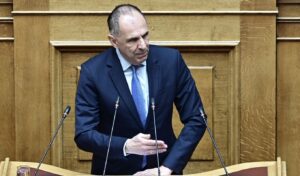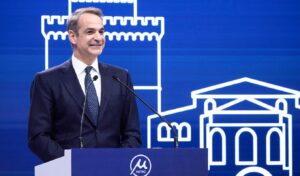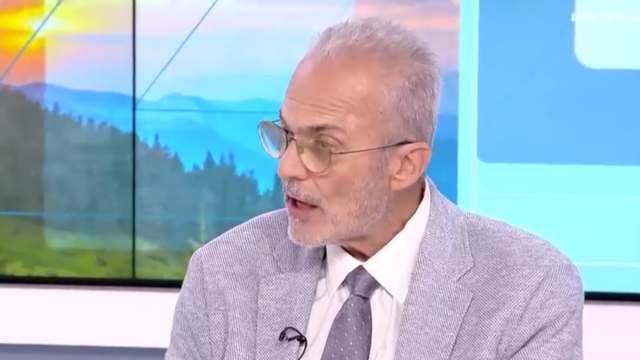
The latest polls, as well as the strategies being pursued by Kyriakos Mitsotakis, Nikos Androulakis, and Alexis Tsipras ahead of the next elections, were analyzed by MRB Managing Director Dimitris Mavros, speaking on OPEN TV’s program “Tora Mazi.” According to him, recent surveys are now painting a clearer picture of the political landscape, while he also explained which factors will ultimately determine the timing of the national elections.
Dimitris Mavros: “ELAS is now clearly the second party”
Dimitris Mavros argued that across all recent polls, the Greek Left Alliance (ELAS) consistently registers as the second political force. “In all the polls, we can see that the Greek Left Alliance (ELAS) is currently the second party, and its projected percentages are reminiscent of SYRIZA’s results in 2023. The gap between ELAS and PASOK persists — as does the gap between New Democracy and ELAS,” he noted.
Referring to the most recent Metron Analysis survey, the MRB chief observed that its findings reflect the broader picture emerging from all recent measurements. “The percentages in this survey essentially represent the center of gravity across all published polls. Some might debate whether New Democracy’s 30% is slightly above or below that mark. What is also made clear is that ELAS is firmly the second party with 17%, and that PASOK has moved away from the danger of dropping to fourth place,” he said.
The strategies of Mitsotakis, Androulakis, and Tsipras
Dimitris Mavros also commented on the electoral strategies being employed by the party leaders. “When parties come out and say they will win by a single vote’s margin, or that they will secure an outright majority from the first round, we should read those statements twice. The Prime Minister is no fool when he says an outright majority is possible from the first Sunday. He wants to secure a vote share that projects momentum for his government,” he said pointedly.
He also addressed the stance taken by Alexis Tsipras and Nikos Androulakis regarding potential post-election coalitions. “The Tsipras–Androulakis tactic of ‘I won’t cooperate with anyone’ is all about targeting the first round. Party leaders can’t afford to openly discuss cooperation, because the moment they do, voters start migrating and things get complicated. So they’re keeping their distance to maintain greater bargaining power when the time for coalition talks inevitably comes,” he emphasized.
A national unity government scenario now on the table
The MRB chief also highlighted that recent surveys have, for the first time, registered a national unity government as a serious option. “A few months ago, when we asked voters what kind of government they wanted, a national unity government wasn’t even on the table. Suddenly, in our most recent survey for OPEN, it appeared in second place,” he noted.
What he said about Maria Karystianou
Commenting on the polling numbers for Maria Karystianou, Dimitris Mavros argued that the decline being recorded is not driven by public disappointment. “This isn’t a drop born of disillusionment — it’s a drop born of prolonged waiting, which is exhausting people,” he observed.
What will determine the election date
Dimitris Mavros also weighed in on the possibility of early elections, noting that each party has its own distinct political interests. “If the numbers showed New Democracy securing a solid 31%–32%, they would call elections right now,” he said. As he explained, two factors will prove decisive: the policy announcements expected at the Thessaloniki International Fair, and when citizens actually feel a tangible improvement in their income. “Something needs to come front-loaded,” he concluded.