In exactly one year, Greece will assume the presidency of the European Union. National elections must be held no later than 10 to 11 months from now, and the government now has a concrete roadmap outlining its course of action in the period leading up to the start of the pre-election campaign next spring.
Inflation: the Mitsotakis government’s weapons — supermarkets, fuel prices, and income support
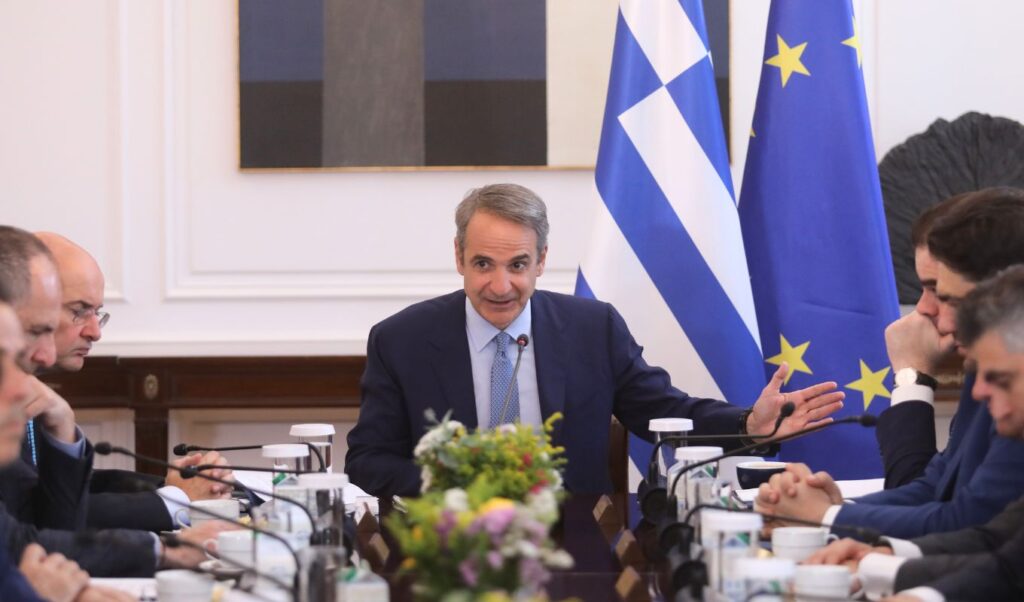
Curbing the cost of living remains the primary objective. According to an Alco poll for flash.gr, rising prices remain the most pressing problem facing Greek society for 45% of respondents. In a separate poll presented on Tuesday by Marc on ANT1, inflation and the high cost of living topped citizens’ concerns at 73.8%. The two new tools in the government’s arsenal are a two-month price freeze on all supermarket shelf items, followed by reductions on many basic goods from September onward, alongside intensified checks on fuel prices. “Our state oversight mechanisms will obviously ensure that petrol and diesel prices follow crude oil prices, with the slight time lag that always exists,” Kyriakos Mitsotakis stated on Tuesday during the Cabinet meeting. At the same time, the government continues to highlight the initiatives it is taking and the measures it is implementing to boost citizens’ income both directly — through allowances and rent rebates — and indirectly through tax cuts, presenting them as a bulwark against inflation.
The government’s three key bets through the end of 2025
Kyriakos Mitsotakis outlined the three core pillars of this roadmap for the coming months, while also taking aim at opposition parties and signalling how government and party officials should respond to them. “While our opponents are preoccupied with the contradictions within their own parties, our duty is to turn our attention to society — and of course, to respond at every opportunity to what I would call the arrogant, hollow, and baseless promises of our political rivals,” Mitsotakis said in his address.
Infrastructure: E65, Thessaloniki Metro, VOAK, and Flyover take centre stage
The first pillar is infrastructure, with the completion and delivery of new projects. During July, the E65 motorway will be opened to traffic in its entirety — a road of “immense importance for Western Macedonia and Western Thessaly,” as Mitsotakis noted. By the end of July, five additional stations of the Thessaloniki Metro will begin operating, extending the line to Kalamaria. During the summer, the first section of the Northern Road Axis of Crete — connecting Neapoli and Agios Nikolaos — will be opened to traffic. The Prime Minister also set targets for the next six months in the area of infrastructure: completing the restoration of the railway network damaged by the natural disasters caused by Storm Daniel, and further accelerating progress on the Flyover project in Thessaloniki.
Reforms: land registry, digital justice, and the national school-leaving certificate
The second pillar is the implementation of structural reforms. By the end of the year, the land registry cadastre must be fully completed across the entire country. Additional reforms highlighted by Mitsotakis include the absorption of urban planning services into the land registry authority, the completion of three special spatial planning frameworks covering industry, tourism, and renewable energy, the universal rollout of digital court case files, and the maturation of the national dialogue on a unified school-leaving certificate.
Recovery fund: the race to absorb EU resources
The third — and most urgent — pillar of the roadmap is the absorption of funds from the EU Recovery and Resilience Facility. “Our challenge, ahead of the final disbursement in September, is to present a plan that brings relief to Greeks while preserving the fund’s growth momentum even after it expires,” the Prime Minister stressed.
Agricultural subsidies: changes to payments and Mitsotakis’ message to farmers
Advancing reform of the farmer payment system carries significant social, political, and symbolic weight. The goal is not only to address past injustices but also to repair the relationship between New Democracy and parts of the farming community — a relationship that was strained during the two months of protests in January and December. The Prime Minister placed particular emphasis on the fact that the government now has the ability, as he put it, to redistribute resources that were left over from those not entitled to them, redirecting them to those who genuinely deserve support. “The vast majority of honest farmers and livestock breeders stand to benefit enormously from this reform. Since the beginning of the year, we have allocated more than one billion euros. A new round of payments will follow in the autumn,” he pledged.