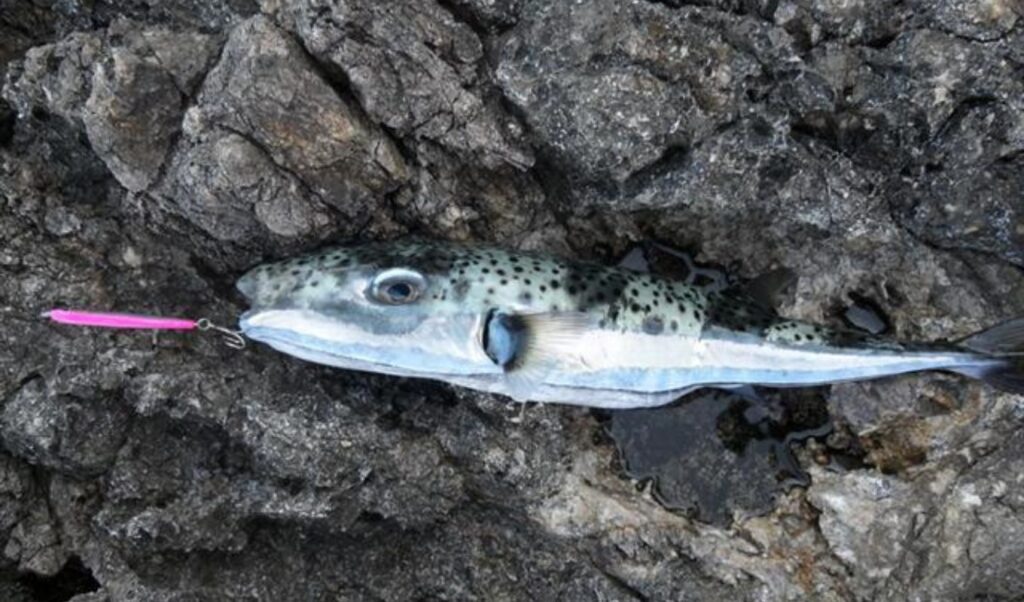
The silver-cheeked toadfish (Lagocephalus sceleratus) is considered one of the most dangerous species threatening the Mediterranean today. Its rapid spread from the Eastern Mediterranean across the entire sea basin is causing serious problems for biodiversity, aquatic ecosystems, and fishing activity. The scientific community is urgently searching for natural predators capable of controlling the populations of this toxic fish.
What animals eat the silver-cheeked toadfish in its native range
Scientific research has not identified any species that exclusively targets the silver-cheeked toadfish in the Indo-Pacific, where the species is native. For this reason, experts have studied the predators that attack fish of the family Tetraodontidae, to which this species belongs.
Among the species known to consume tetraodontids are mantis shrimp, lizardfish of the genus Synodus, tiger sharks, lemon sharks, Enhydrina sea snakes, Arius catfish, cobia, skipjack tuna, and the common octopus. However, none of these have been recorded as specialized predators of the silver-cheeked toadfish.
Predators of the silver-cheeked toadfish in the Mediterranean
In Greek and Mediterranean waters, scientific data remains extremely scarce. The only recorded instance of predation on an adult silver-cheeked toadfish involves the loggerhead sea turtle (Caretta caretta), which stands as the sole confirmed natural predator of adult individuals in the region. This isolated record underscores the absence of effective natural enemies for mature fish.
Juvenile silver-cheeked toadfish, on the other hand, appear to be more vulnerable. Young individuals have been recorded as prey for dolphinfish (Coryphaena hippurus) and garfish (Belone belone), offering some degree of natural control in the species’ early life stages. Nevertheless, the predatory pressure exerted by these fish does not appear to significantly affect overall population dynamics.
Cannibalism and other natural threats
Researchers have documented cannibalism among individuals of the same species in the Mediterranean. Larger silver-cheeked toadfish prey upon smaller or younger members of the population, adding an additional source of mortality. Despite the existence of this phenomenon, there is no evidence that cannibalism meaningfully limits population growth.
In the western Atlantic, where predators of tetraodontids have been studied more extensively, octopus, frogfish, and various seabirds have been identified as predators. This information provides useful reference points but cannot be directly applied to the Mediterranean environment.
Why natural predators are failing to stop the spread
Experts emphasize that the available data on natural predation of the silver-cheeked toadfish is insufficient. What data has been collected indicates that natural predation is unable to effectively control populations in the Mediterranean. The scarcity of natural enemies — particularly for adult fish — is a decisive factor in the species’ explosive spread across the entire Mediterranean basin.
This situation leads to a clear conclusion: managing silver-cheeked toadfish populations cannot rely solely on natural mechanisms. Targeted human interventions are required to remove and control the species, as existing predators have proven inadequate to halt its continued expansion.
How the silver-cheeked toadfish reached Greece
The silver-cheeked toadfish (Lagocephalus sceleratus) is not native to the Mediterranean. Its natural distribution spans the Indian and Pacific Oceans, as well as the Red Sea. Its presence in Greek waters is directly linked to the Suez Canal, which opened in 1869 and created a maritime corridor between the Red Sea and the Mediterranean.
Scientists refer to this phenomenon as “Lessepsian migration”, named after French diplomat and engineer Ferdinand de Lesseps, who is associated with the construction of the Suez Canal. Through this artificial waterway, hundreds of species have migrated from the Red Sea into the Mediterranean, gradually altering the balance of local ecosystems.
Rapid spread and future challenges
The silver-cheeked toadfish was first recorded in the Mediterranean in the early 2000s and has since spread with remarkable speed to the Aegean Sea, Crete, the Dodecanese, and later to the western Mediterranean. Scientific studies highlight it as one of the most successful and aggressive invasive species to have entered the Mediterranean through the Suez Canal.
As sea temperatures rise and conditions become increasingly favorable for tropical species, experts predict that the silver-cheeked toadfish will continue to pose one of the greatest challenges to Greek waters in the coming years — with consequences felt across both the fishing industry and the coastal communities that depend on the sea for their livelihoods.