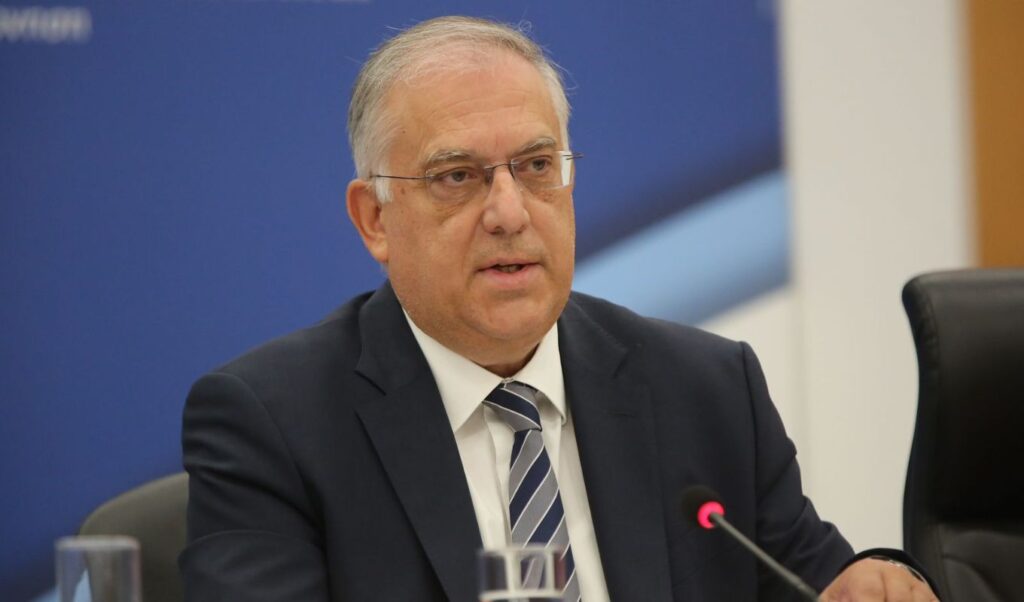
Greece’s Minister of Development, Takis Theodorikacos, highlighted the government’s strategic commitment to actively supporting research and innovation during his address at the 171st Session of the country’s Research Centers. The minister announced a major funding package for the Greek scientific community, revealing the extension of the loan agreement with the European Investment Bank for ELIDEK-2. This strategic partnership with the Ministry of National Economy secures a total of €286 million in resources through 2028.
Read also: Akis Skertsos: In 2023-2024, brain drain became brain gain for the first time in 14 years (Photos)
Theodorikacos: We are investing systematically in research and innovation
Addressing the presidents of research centers and members of the scientific and research community, the minister emphasized that in an increasingly volatile international environment of geopolitical challenges, the true strength of nations is built on knowledge, research, and innovation. “We are not simply observing developments — we are actively shaping them,” he said, adding that Greece has entered a new era in research and its technological standing on the world stage.
Theodorikacos further noted that “our country has transformed from a nation of promise into a mature, institutionally fortified, and highly dynamic hub of cutting-edge technology in Southeastern Europe.”
Special mention was made of the country’s recent initiatives at both European and national levels. On May 29, 2026, the EU Competitiveness Council adopted the Recommendation for a European Framework for Scientific Diplomacy, recognizing science as a tool of foreign policy and strategic autonomy. In parallel, on April 30, 2026, the Sectoral Scientific Council for Synergies with the Greek Scientific Diaspora and Technological Diplomacy was established under ESETEK.
Historic funding increase and 20,000 new jobs created
Presenting the results of government policy from 2019 to the present, the Minister of Development highlighted a historic increase in national Research and Development expenditure — rising from €2.2 billion in 2018 to €3.65 billion in 2024, representing a 68% increase and reaching 1.54% of GDP.
“The boost to research was accompanied by strong tax incentives for businesses, with the super-deduction on research expenditure reaching up to 315% for green transition initiatives and collaborative schemes,” he noted.
The standout outcome of this policy was the creation of 20,000 new highly specialized jobs over the past six years, making a meaningful contribution to reversing the brain drain.
Addressing the operational concerns of research centers, Theodorikacos outlined four key priorities: simplifying the management framework for co-financed projects, ensuring the smooth implementation of the Recovery Fund, enhancing staffing flexibility for research projects through fixed-term contracts while reinforcing legal compliance and audit capacity, and resolving the outstanding payment of the remaining 2025 regular subsidy.
Emphasis was also placed on transparency in the evaluation process for research infrastructures, with a commitment to clear timelines for final project approvals and the handling of objections.
Closing his remarks, the minister underscored the government’s commitment to ongoing dialogue with the research community on critical institutional and employment matters.
The Session of Presidents of Research Centers and Technology Bodies was also attended by Deputy Minister of Development Stavros Kalafatis and Secretary General for Research and Innovation Dimitris Terzis.