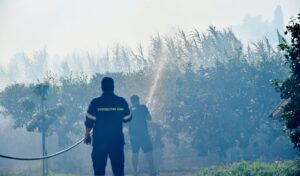
Temperatures above normal levels are expected to characterize the summer of 2026 in Greece, according to seasonal forecasts from scientists. However, experts clarify that a warmer summer does not necessarily mean extreme or prolonged heatwaves. At the same time, there is growing concern about the upcoming fire season, as high temperatures combined with the abundant vegetation that has grown in recent months are creating conditions of heightened wildfire risk.
As Kostas Lagouvardos, Director of Research at the National Observatory of Athens, explains to parapolitika.gr, seasonal forecasts for June, July, and August point to temperatures above climatically normal values.
“The only thing we can say with relative certainty is that we will have yet another summer with temperatures above normal levels,” he states, noting that this is a pattern that has been repeating frequently in recent years.
Despite average temperatures being expected to run above normal, Lagouvardos stresses that it is impossible to know at this stage whether there will be prolonged or particularly intense heatwave episodes.
“A summer can be warmer than normal without having extreme heatwaves,” he notes. As he explains, the rise in average temperature can result from the frequent occurrence of days reaching around 35 or 36 degrees Celsius, without recording extreme values over many consecutive days.
This distinction is important, as the general public often equates a hot summer with continuous heatwaves. In reality, scientists look at the full range of temperature data for a season, not just extreme events. So even without prolonged heatwaves, a year can still be recorded as warmer than average.
It should be noted that the uncertainty surrounding long-range forecasts remains significant. Seasonal estimates allow scientists to identify general trends, but not to accurately predict specific extreme heat events weeks or months in advance. For this reason, meteorological conditions are continuously monitored throughout the summer.
This pattern is linked to the broader warming trend observed in recent years across both Greece and the wider Mediterranean. Scientists are recording increasingly frequent hot summers, more days with high temperatures, and longer periods of heat stress.
The wildfire risk
Beyond the heat, this year’s fire season is causing particular concern. As Kostas Lagouvardos points out, high temperatures are a significant factor that encourages the ignition and spread of wildfires — but they are not the only one.
The amount of available fuel — that is, the material that can feed a fire — also plays a decisive role. And on this front, conditions this year are especially noteworthy.
The rainfall recorded across many parts of the country in recent months has contributed to lush vegetation growth. While this is a positive development for water availability and ecosystem regeneration, it can simultaneously act as a factor that increases wildfire risk during the summer months.
“The fact that it has rained is a positive element for water availability, but it essentially constitutes an aggravating factor for wildfires,” the researcher explains.
The reason lies in how vegetation changes during the course of summer. Grasses, small branches, pine needles, and other plant material that develops after rainfall can dry out very quickly once high temperatures and arid conditions take hold.
This creates a larger volume of flammable material that can act as fuel if a fire breaks out. The more of this fuel there is, the more easily a fire can start and spread.
According to Lagouvardos, if prolonged warm periods set in from the very beginning of summer, the vegetation drying process will accelerate even further. This means conditions could become increasingly dangerous as the fire season progresses.
Experts remind us that wildfire risk does not depend on temperature alone. Wind intensity, low atmospheric humidity, and the state of vegetation are equally critical factors that determine how easily a fire can spread and how difficult it will be to extinguish.
This summer is therefore expected to follow a now-familiar path: warmer than normal, but with no way yet of predicting whether it will bring powerful, prolonged heatwaves. What does appear certain is that the combination of high temperatures and the increased fuel load created by spring rainfall makes heightened vigilance against the risk of wildfires absolutely necessary. Once again, Greece faces the challenge of managing the consequences of an ever-warming climate and staying prepared for one of the greatest threats of the Greek summer.