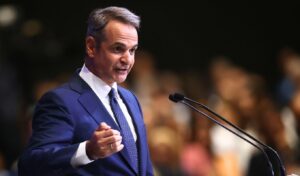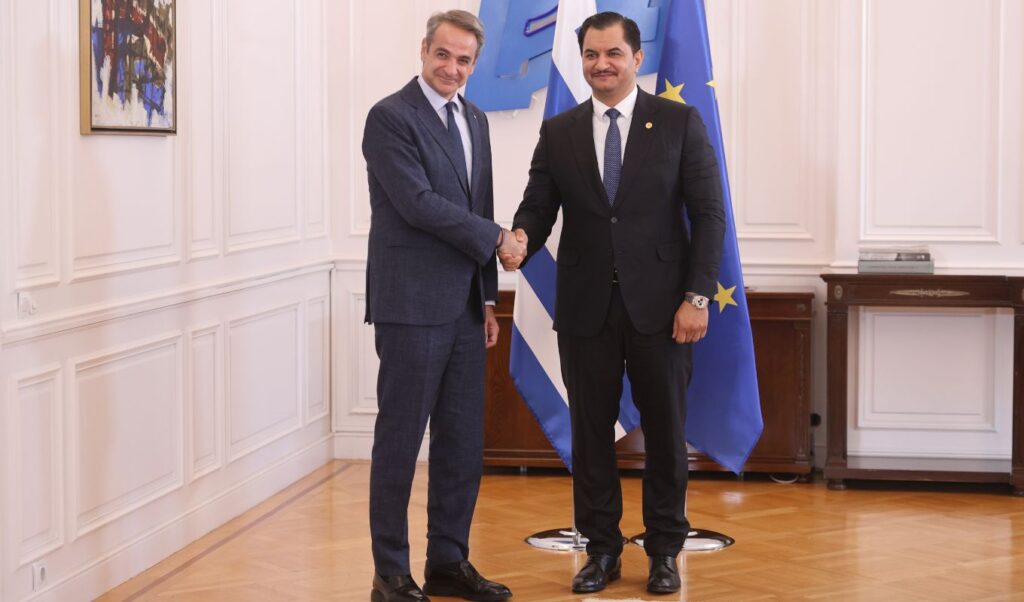
Having just returned from trips to Italy and France, Saddam Haftar — son of Marshal Khalifa Haftar, who commands Eastern Libya — visited Athens and held successive meetings with Foreign Minister Giorgos Gerapetritis and Prime Minister Kyriakos Mitsotakis. According to government and diplomatic sources, the agenda covered migration, maritime zone delimitation, and economic and trade cooperation.
Saddam Haftar’s visit to Athens comes on the heels of technical committee talks with the Tripoli government on delimiting an Exclusive Economic Zone (EEZ) between the two countries — either through a direct agreement or by referring the matter to the International Court of Justice in The Hague.
According to well-placed sources, however, both sides also explored alternative forms of bilateral cooperation pending a final resolution. “A modus vivendi,” as the same sources put it — specifically, “some form of memorandum of understanding that would be signed and serve as a modus vivendi for exploration and exploitation in the area, without proceeding to full delimitation, for as long as talks continue.”
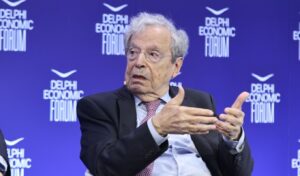
Theodoros Tsikas: The most important issue surrounding Saddam Haftar’s Athens visit is the refugee crisis
According to international relations expert and political scientist Theodoros Tsikas, “the most important issue surrounding Saddam Haftar’s visit to Athens is the resolution of the refugee crisis. The largest flows of refugees and migrants moving out of Libya originate from the eastern side, which is controlled by Marshal Khalifa Haftar — not from Western Libya, which is under the Tripoli government’s control. Now that the weather has improved, we are already seeing mass migration flows, particularly toward Crete. I believe the primary Greek interest regarding Saddam Haftar is the migration and refugee issue,” he stressed.
Tsikas raised an additional point regarding EEZ delimitation between Greece and Libya: any discussions about referring the matter to The Hague can only take place with the Tripoli government, as it is, he argues, the only internationally recognized government in Libya. He also noted that “taking Libya to The Hague is easier than doing so with Turkey, because Libya’s official policy is the unconditional and unreserved recognition of the International Court of Justice’s jurisdiction, with no exceptions.”
Saddam Haftar seeks international support
Saddam Haftar, commander of the Benghazi-based National Army and the frontrunner to succeed his father’s leadership of Eastern Libya, is actively seeking international backing to consolidate his power ahead of Libya’s next political chapter and to bolster stability in the country. Libyan media reported on his meetings with French President Emmanuel Macron and Italian Defense Minister Guido Crosetto with this context in mind. Nevertheless, holding elections in this North African nation remains a formidable challenge given the ongoing civil unrest. According to research by the Kofi Annan Foundation, Libya ranks among the countries most vulnerable to electoral risks.
As part of broader efforts to establish stability in Libya, Greek Foreign Minister Giorgos Gerapetritis held a phone call with his Egyptian counterpart Badr Abdelatty (June 11, 2026), discussing the need for a comprehensive political settlement between the two Libyan factions and an end to the country’s division.
The prospect of a unified government emerging in Libya is a significant factor for Greece in resolving outstanding bilateral issues — including EEZ delimitation and curbing migration flows from Africa to Europe via Crete.