The security of prisons is no longer judged solely by fences, watchtowers, and entrance control systems. In recent years, a new threat has emerged internationally and is now being recorded increasingly frequently in Greece: drones being used to transport contraband items into correctional facilities.
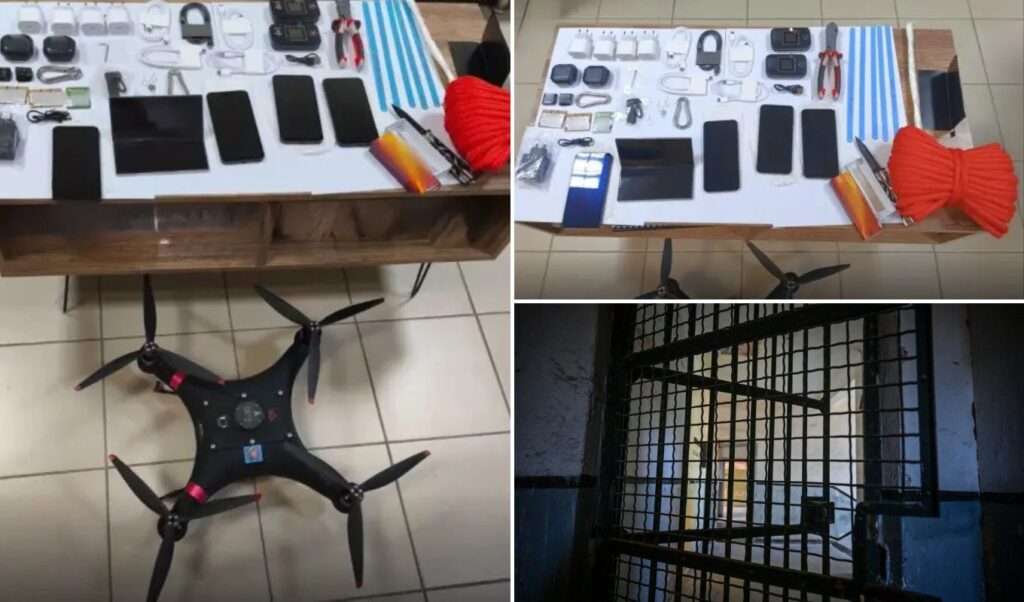
Read: Alert at Chania prisons: They attempted to smuggle knives, phones and blades with drone (Images)
The fifth incident of preventing contraband smuggling via drone in a correctional facility this year
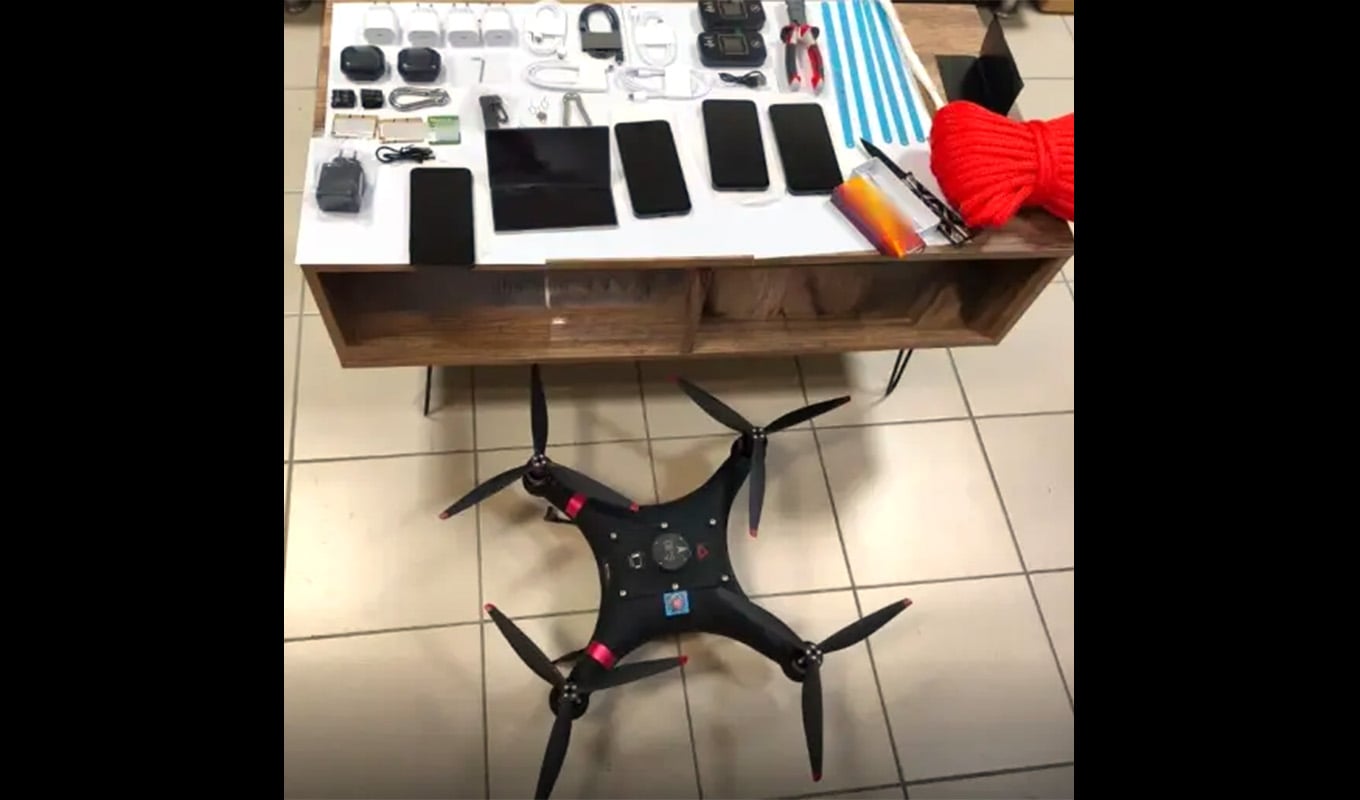
The most recent incident occurred at the Chania Correctional Facility, when staff from the External Guard Service for Detention Centers spotted an unmanned aircraft approaching the facilities in the afternoon of June 6th, heading toward the exercise yards. After activating the anti-drone system, the drone was neutralized and crashed near a facility watchtower. Shortly after, a bag that had been previously dropped by the drone was found on a building rooftop. According to the authorities’ announcement, it contained five mobile phones with chargers, two wireless routers, three SIM cards, four pairs of headphones, five metal hacksaw blades, one folding “butterfly” knife, one metal cutter, climbing rope approximately 20 meters long, one climbing safety ring, and two Allen keys. Indeed, according to the General Secretariat of Anti-Crime Policy, this is the fifth incident of preventing contraband smuggling via drone in a correctional facility in the country in 2026.
For Nikolaos Tsoumas, Director of Flight Operations at Vanguard Drones, this specific incident represents yet another indication that criminality has already moved into airspace. “In Greece we don’t yet have, at least publicly, a unified statistical picture to say precisely how many such incidents occur each year. But we’re no longer talking about theoretical danger. The incident at the Agia prison in Chania shows that the issue has entered Greek reality,” he characteristically states, speaking to parapolitika.gr.
Change needed in correctional facility security approach
And although recorded drone incidents in Greece are limited in number, the picture abroad is very different. According to UK Ministry of Justice data, England and Wales recorded 1,712 drone incidents at prisons during April 2024 – March 2025, showing a 43% increase compared to the previous twelve months. For Mr. Tsoumas, these figures reflect a profound change in how correctional facility security must be designed. “In my opinion, prisons should no longer be guarded only from the ground. They must be guarded from airspace too. The drone bypasses the perimeter, the fence, and traditional control. This changes the entire logic of security,” he emphasizes.
“A small drone with small payload can create major security problems”
The technological capabilities of drones are constantly increasing. However, according to the expert, in prisons the real threat isn’t measured based on the weight a drone can carry. “Today drone capabilities have increased tremendously. We don’t need to talk only about large payloads though. In a prison, even a few hundred grams can create enormous security gaps. A phone, a SIM card, a small quantity of drugs, or a sharp object can change the balance within a correctional facility,” he says characteristically. As he explains, small commercial drones exist that can operate at distances of several hundred meters, while other commercial platforms have much greater payload capabilities. Factors like wind, temperature, battery condition, payload weight, and flight method always affect actual performance. “We shouldn’t view the drone only as a machine. We must see the mission it can execute. A small drone with small payload can create major security problems,” he notes.
Night favors perpetrators
One of the biggest problems for authorities is early detection of a drone before it reaches its target. “It’s difficult, especially at night. A small drone has low visual signature, can fly low, approach quickly, drop its payload and leave within minutes. The issue isn’t simply detecting it. The issue is seeing it in time and understanding what it’s doing,” the expert clarifies, adding that human observation alone is no longer sufficient. “At night, human observation alone isn’t enough. Acoustic detection systems, electro-optical and infrared systems (EO/IR), passive radio frequency detection (passive RF), small target radar, and data fusion from multiple sensors are needed to create a unified operational picture,” he emphasizes. According to him, the human factor is equally important. “Security personnel must be trained to interpret this complex field and integrate tactics that will allow them to recognize and neutralize such high-level threats.”
The new generation of anti-drone systems
Today, protection from unmanned aircraft doesn’t rely on just one technology. “Countering drones cannot be based on a single technology. Multi-layered anti-drone architecture is needed. That means combining sensors, software, operational awareness, and proper response from security personnel.” According to Mr. Tsoumas, the basic technologies used internationally today include radio frequency detection (RF detection), electro-optical and infrared systems (electro-optical/infrared sensors), short-range radar, acoustic sensors (acoustic detection), and data fusion systems. “It’s no longer enough to simply see that something is flying. We must be able to know what it is, where it’s located, where it’s moving, whether it’s authorized or not, and where technically feasible, have assessment or detection of the operator’s position.”
The importance of early warning
For the expert, the value of a modern anti-drone system isn’t limited to technical detection. “The most important thing isn’t just technical detection. It’s operational utilization of information. A modern anti-drone system must provide real-time airspace awareness, connect to Security Operations Centers, maintain incident records for subsequent analysis or judicial use, and allow creation of white lists for authorized drones.” He makes special reference to the use of jammers. “Neutralization with jammers is a very legally and operationally sensitive procedure. It cannot be done uncontrolled, because it can affect communications, flight safety, or other critical functions. That’s why in many cases the first and most critical line of defense is lawful passive detection, identification, early warning, and proper operational response.”
One person or entire network?
Regarding the Chania prison incident, Mr. Tsoumas says such a drone flight can be accomplished even by an operator with basic knowledge. “Modern drones are user-friendly, have stabilization, GPS, automatic return, and high control accuracy.” Nevertheless, he explains that the operational dimension of such an action is much more complex. “When we’re talking about a prison, knowledge of the area is needed, proper timing selection, payload preparation, possible drop point, and possibly inside information or coordination with someone outside the prison. Technically it can be done by an individual operator. Operationally though, such actions often show planning, coordination, and possible organized involvement.”
From smuggling to target surveillance
Transporting contraband to prisons represents only one of many possible uses of drones for illegal activities. “Drones can generally be used for transporting drugs or contraband, illegal target surveillance, privacy violations, area reconnaissance before burglary or attack, monitoring critical infrastructure, airport harassment, or even transporting dangerous cargo,” according to the expert. As he emphasizes, the real threat isn’t in the technology itself but in how it’s used. “The drone shouldn’t be treated as a toy. It’s a platform. It can carry cameras, sensors, cargo, or other equipment. The threat changes depending on the operator’s intention and the payload it carries.” Europol has already referenced the use of unmanned systems by criminal and terrorist groups for activities like surveillance, smuggling, and attacks. “The drone multiplies the criminal’s range of action. It allows them to operate without entering the security perimeter themselves. This changes the philosophy of security. We’re no longer looking just at the fence and gate. We’re looking at what can come from above.”
The future of security
Mr. Tsoumas estimates that drone use for illegal activities will increase in coming years. “Drones are becoming more economical, easier to use, quieter, more autonomous, and more capable. This is positive for legitimate applications like civil protection, inspections, precision agriculture, search and rescue, and security. But every powerful technology can also be used illegally.” At the same time, he emphasizes that countering illegal drones shouldn’t be confused with the European U-space framework. “U-space isn’t an anti-drone system and isn’t a mechanism for shooting down illegal drones. It’s the European framework for digital management of UAS traffic in specific geographical zones.” He also refers to Remote Identification of drones, which is now a basic element of the European regulatory framework.
“We shouldn’t demonize drones”
However, according to him, the essence lies elsewhere. “We shouldn’t demonize drones. The drone isn’t the problem. The problem is criminal use of it. The answer isn’t fear of technology. The answer is organization, training, proper regulatory framework, and operational readiness.” “The next day in protecting prisons, critical infrastructure, borders, and public spaces isn’t simply buying an anti-drone system. It’s creating an integrated surveillance doctrine: technology, trained personnel, procedures, operations center, and immediate threat assessment capability. Airspace is now a normal security field and must be treated as such,” Mr. Tsoumas concludes.