Greece is ready to participate in a European or international operation in the Strait of Hormuz – after the end of the war, of course – with the country setting maritime security and freedom of navigation as key objectives amid the ongoing Middle East crisis. “Greece has made it absolutely clear that, if a peace agreement is reached and if there is a UN resolution requiring a peacekeeping force in that part of the world, we will be ready to participate,” Kyriakos Mitsotakis said about twenty days ago in his discussion with Ben Hall, Europe Editor of the Financial Times. He thus effectively announced our country’s participation in the post-war peacekeeping force, most likely with a frigate, while also recalling that Greece is already present in the Red Sea with the “Aspides” operation. Recently, Foreign Minister Giorgos Gerapetritis also confirmed in his statements the country’s readiness to contribute “to appropriate efforts for freedom of navigation in the Strait of Hormuz when the environment permits, in full cooperation with all involved parties.”
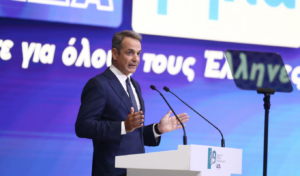
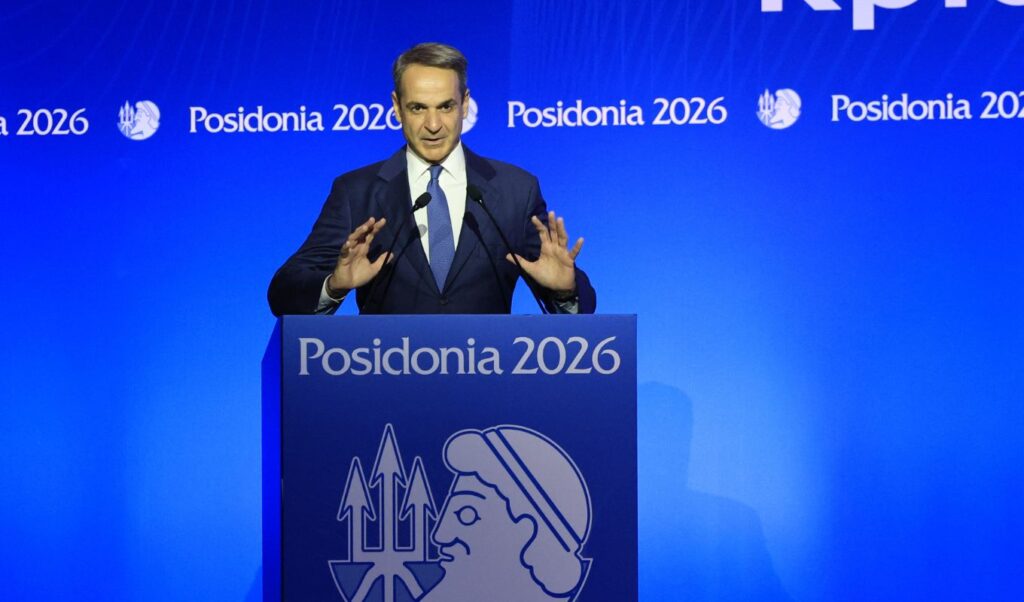
Yesterday the prime minister emphatically returned to the same issue. Speaking at the inauguration ceremony of the international maritime exhibition “Posidonia 2026,” he noted that “Greece actively advocates for a return to the previous status quo of the Strait of Hormuz, so that there will never be any additional economic burden, tolls, fees, and the Strait of Hormuz remains a channel of free navigation, as it was and as it should become again.” He committed that “this issue will obviously continue to be raised by Greece with even greater persistence in the UN Security Council,” with our country assuming the rotating presidency again next October.
“I remembered, Madam President,” said Kyriakos Mitsotakis addressing Melina Travlos from the podium, “the video you presented two years ago regarding the impact on the global economy from a potential paralysis of global shipping. Unfortunately, that video proved disturbingly prophetic, when the closure of just one maritime route, such as the Strait of Hormuz, is enough to skyrocket transportation costs, rapidly increase inflation worldwide, and even lead to actual shortages of both fuel and goods.”
The prime minister once again expressed his concern and worry about the economic, energy, and commercial consequences of the war in the Middle East, particularly the de facto closure of the Strait of Hormuz. “One need only consider that, as mentioned, 90% of global trade, slightly more than 80% of European trade, takes place by sea. This percentage is even higher when we talk about petroleum products. So we know very well that a shock to shipping, to free navigation, automatically translates into a global energy shock,” he characteristically stated.
The prime minister, as he has emphasized during this period of crisis in the Middle East, believes that our country has a direct interest in protecting freedom of navigation, as Greece is a medium-sized open economy and simultaneously a leading maritime nation.
As he mentioned last night in closing his remarks at Posidonia, “the Greek state will remain an ally and supporter, recognizing the enormous importance of Greek shipping for the country, as well as the increasingly critical role it plays for international security and economic stability. Treating shipping as a unique, globally significant strategic advantage for our homeland in an uncertain world, and as a dynamic ‘springboard’ that extends the reach not only of Greece but also of Europe to every corner of the planet.”