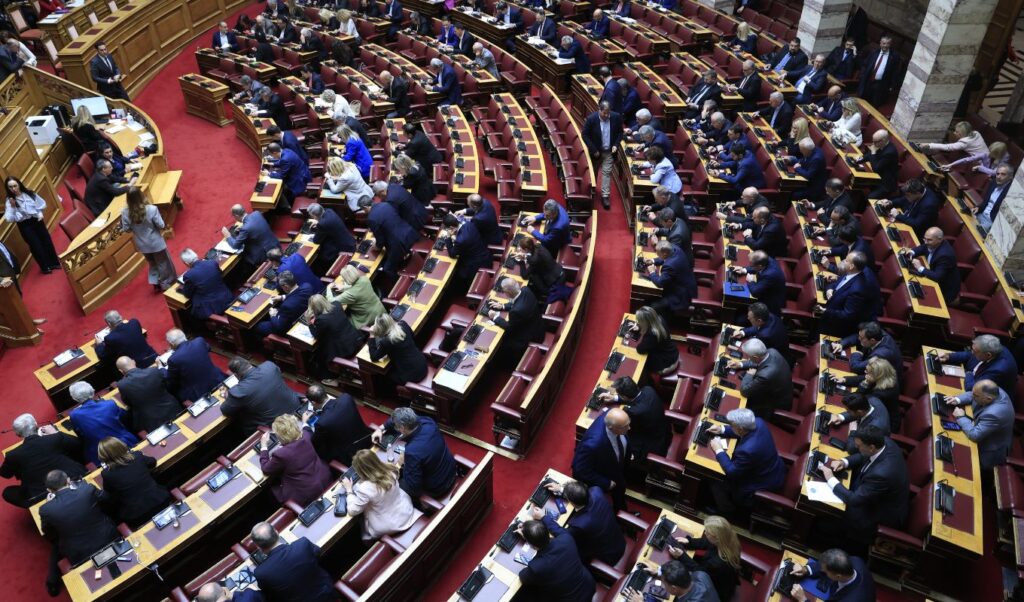
The government is “launching” the constitutional reform process today with the submission of its proposal to Parliament, officially setting related developments in motion. The government will leverage this process in the political arena, presenting citizens with dilemmas about which major institutional changes they want to see implemented in the country. “The elections will be held in 2027 and our election campaign will be based partly on our proposals for constitutional reform, as we believe popular legitimacy is required, meaning we need to present these issues to the electorate ahead of the next elections,” Kyriakos Mitsotakis recently stated.
The Prime Minister and the government majority’s rapporteur, Euripidis Stylianidis, have already presented a reform plan covering 30 articles. Following today’s expected presentation of the final proposal, the Constitution Reform Committee will be established and discussion will proceed in the plenary session. Subsequently – as stipulated by Article 110 of the Constitution – the voting on articles to be reformed will take place “in two votes separated by at least one month.” If procedures move relatively quickly, as the government majority desires, both votes could occur in mid-July for the first and mid-September for the second.
Specifically, the current Parliament is the proposing body. With a three-fifths majority of all members (180 MPs) in two votes separated by at least one month, all provisions requiring reform are determined. The next Parliament, emerging from the 2027 national elections, will decide during its first session with an absolute majority of all members (151 MPs) on the reform provisions. If the constitutional reform proposal passes in autumn with more than 151 but fewer than 180 MPs, the next Parliament can decide on these reform provisions with a majority of at least 180 MPs. As things stand today, the most likely scenario is that all New Democracy’s proposed reform provisions will pass with approximately 160 MPs (ND plus some independents) and the reform will be decided entirely by the new Parliament in summer 2027.
Among the changes the governing party will propose, as presented by Mr. Stylianidis, the following stand out:
– Constitutional protection of the Greek Flag as a timeless symbol of the nation and culture, and protection of the Greek language as a carrier of Greek culture and national heritage, as well as a living bond with Worldwide Hellenism.
– The application of Artificial Intelligence in ways that contribute to protecting human rights, democracy and the rule of law is established as new Article 5B.
– Extension of minimum compulsory education from 9 to 11 years
– Establishment of Non-State Non-Profit or Private Universities through reform of Article 16
– A six-year term for the President of the Republic with transitional provisions for the incumbent president.
– Abolition of invoking serious national issues for Parliament dissolution, which can henceforth be dissolved by government proposal and Parliamentary decision for popular mandate renewal.
– Introduction of good conduct rules for referendums
– Possibility of exercising voting rights through postal voting for voters within the national territory.
– Ministers are constitutionally obligated to provide substantiated responses to parliamentary oversight by MPs, and systematic communication between MPs and their constituencies becomes mandatory, along with transparent public transfer of legitimate collective or individual issues to the executive branch through parliament.
– Abolition of “immediate action” and Parliament’s authority for conducting preliminary examinations of ministers. Preliminary examination will be conducted by Appeals Court prosecutors and prosecution proposals by Supreme Court prosecutors. Prosecution will require Parliamentary decision by absolute majority of all MPs through roll-call voting.
– Judges are prohibited from participating in government in any capacity, from appointment to political positions, or placement in independent authorities for at least three years after retirement.
– Selection of Presidents and Members of Independent Authorities will be made by parliamentary committee from a list of three candidates proposed by an Expert Council following public calls for expressions of interest.