Intense diplomatic activity is observed in Greece-Libya relations, as efforts are being made to restart dialogue on maritime zone delimitation.
Greece – Libya: The Gerapetritis – Dbeibah agreement and the attempt to restart dialogue
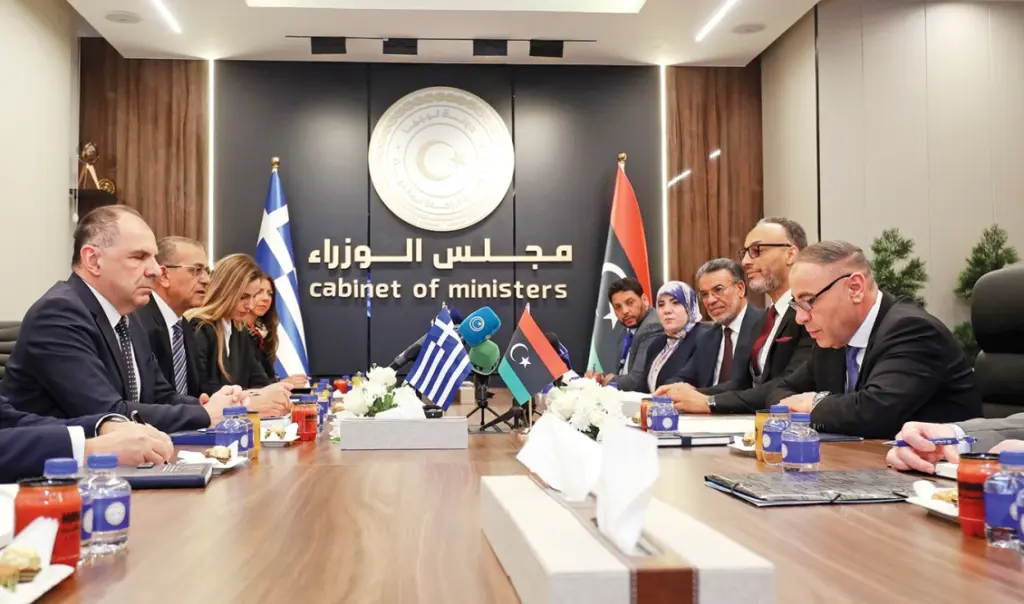
Diplomatic sources told parapolitika.gr that technical committee work between Athens and Tripoli is expected to begin during the summer. The agreement was reached during the last visit of Foreign Minister Giorgos Gerapetritis to Tripoli, Libya, on April 27 and his meeting with the Prime Minister of the Government of National Unity, Abdul Hamid Dbeibah. This followed a corresponding visit by the head of Greek diplomacy to Benghazi on March 28. These meetings with Libya’s political leadership sealed both sides’ intention to hold technical talks on defining the Exclusive Economic Zone (EEZ) and continental shelf.
However, this dialogue is developing in an extremely complex environment, where diplomatic approaches are complicated by deep disagreements and regional challenges. The most significant obstacle to advancing discussions remains the Turkey-Libya memorandum of 2019. This agreement, which connects Turkish with Libyan coasts while completely ignoring the influence of Greek islands, constitutes the main obstacle making dialogue fragile. The Greek side rejects the memorandum as invalid and unfounded, arguing that it violates fundamental rules of International Maritime Law. Indeed, this position is non-negotiable for Athens, which seeks any solution to be based on the application of International Law and recognition of islands’ sovereign rights.
Additionally, Libya’s internal political situation adds another layer of difficulty to diplomatic dialogue. The country remains politically divided between the recognized government in Tripoli and the authorities of eastern Libya in Benghazi. This dual power structure forces Greece to balance simultaneously between two different governance centers with conflicting positions on most issues. Regarding the Turkey-Libya memorandum, Tripoli remains Ankara’s official interlocutor and continues to support the memorandum, while the Benghazi side, under Khalifa Haftar’s influence, has distanced itself from the agreement, questioning the country’s commitment to its implementation.
Despite obstacles, starting technical talks is considered critically important. As diplomatic sources maintain, the goal is not only immediate resolution of a difficult dispute, but creating a minimal communication base. Athens consciously chooses to keep channels open, seeking to transform the technical process into a framework for substantial future negotiations. The development of this process is expected to determine possible de-escalation in a region where civil war still rages, as it will test both power centers’ willingness for common agreement on a supremely important issue.
How Turkey affects Greece-Libya negotiations
On the other hand, Turkey’s role remains a decisive and often destabilizing factor. Ankara’s close cooperation mainly with Tripoli’s government limits margins for a fully independent Libyan stance in negotiations with Greece. Turkey promotes the memorandum as a geopolitical power tool, complicating Athens’ effort to support dialogue and negotiation with both power centers.
In this fluid environment with Eastern Mediterranean tensions and Ankara’s expansionist ambitions, Greece-Libya dialogue balances on fragile conditions. On one hand, there’s persistence in conflicting legal positions from Tripoli and Benghazi, while on the other, the need for diplomatic activity seems imperative, especially given energy giants’ presence south of Crete. Greece’s strategy is based on applying International Law and Maritime Law with legal stability and persistence in diplomatic channels. Simultaneously, it recognizes that maintaining dialogue is the only path that can, under appropriate conditions, lead to sustainable prospects for managing Eastern Mediterranean differences.