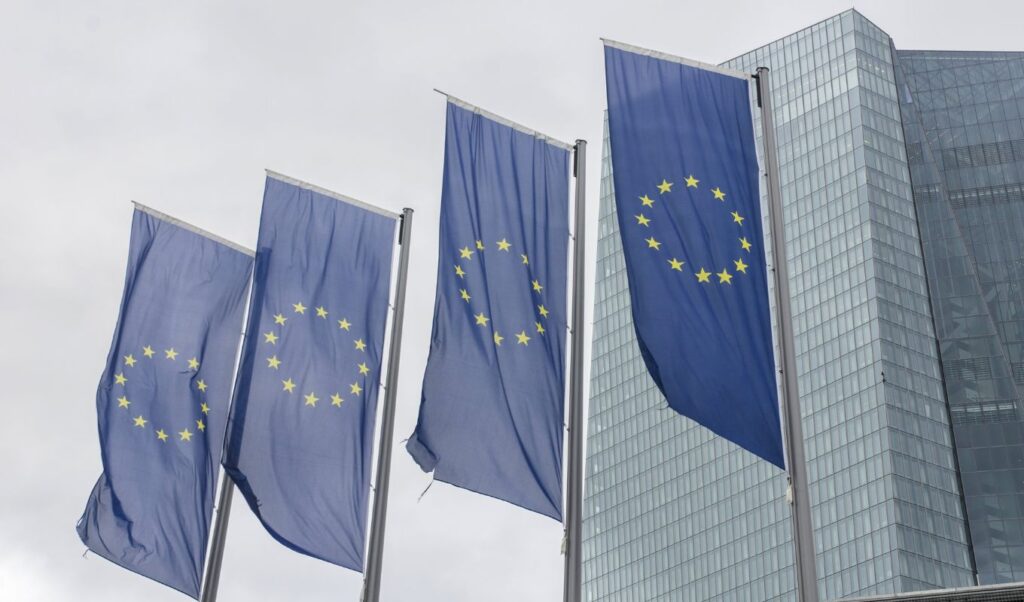
The European Central Bank (ECB) kept interest rates unchanged in its meeting held today, Thursday (30/04). This move marks the seventh consecutive time the bank has maintained its monetary policy stance unchanged. Specifically, the deposit facility rate remains at 2.00%, the main refinancing operations rate at 2.15%, and the marginal lending facility rate at 2.40%, confirming the ECB’s wait-and-see approach toward economic developments. Meanwhile, in a press conference held earlier, ECB President Christine Lagarde confirmed that interest rates remain stable. “We are certainly moving away from our baseline scenario,” she warned.
Read: ECB: Interest rate hike in June and shift to cuts by 2027 due to inflation and Iran war (charts)
The ECB’s announcement
The Governing Council decided today to keep the three key ECB interest rates unchanged. While incoming information is broadly consistent with the Governing Council’s previous assessment regarding inflation outlook, upside risks to inflation and downside risks to growth have intensified. The Governing Council is committed to determining monetary policy to ensure that inflation stabilizes at the 2% target medium-term.
The war in the Middle East has led to a sharp increase in energy prices, providing upward momentum to inflation and negatively affecting the economic climate. The war’s consequences for inflation and economic activity medium-term will depend on the intensity and duration of energy price disruption and the extent of its indirect and secondary effects. The longer the war lasts and energy prices remain at high levels, the more intense the potential impact on overall inflation and the economy will be.
The Governing Council is positioned to manage the current uncertainty. The eurozone entered this period of sharp energy price increases with inflation around the 2% target, and the economy has proven resilient in recent quarters. Longer-term inflation expectations continue to be anchored, although inflation expectations on shorter-term horizons have shifted significantly upward.
The Governing Council will carefully monitor the situation, following a data-dependent approach and making decisions from meeting to meeting to determine the appropriate direction of monetary policy. Specifically, its decisions regarding interest rates will be based on its assessment of inflation outlook and surrounding risks, in light of incoming economic and financial data, as well as underlying inflation dynamics and the intensity with which monetary policy is transmitted. The Governing Council does not pre-commit to a particular interest rate path.