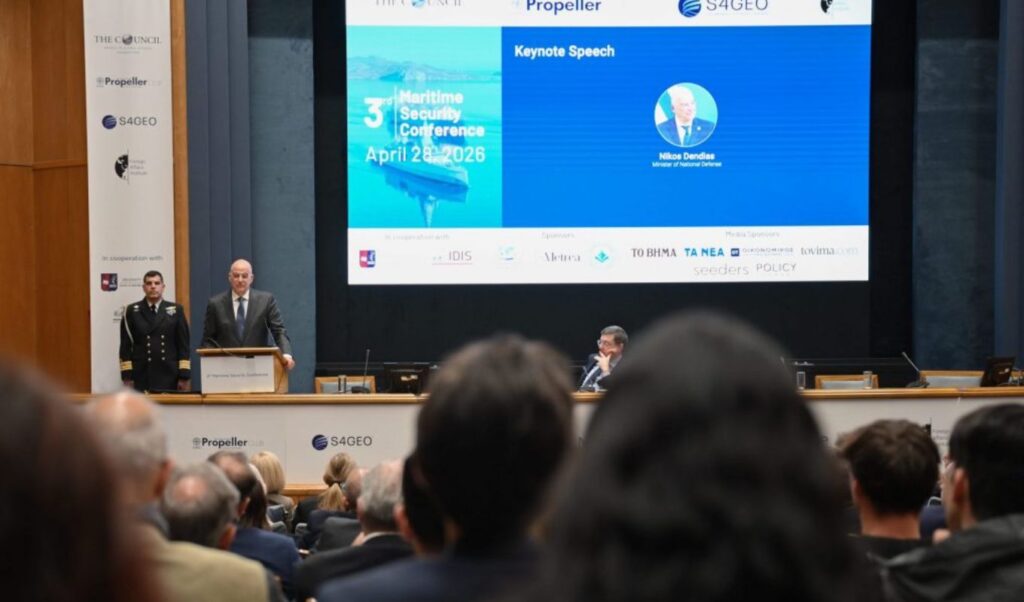
The Minister of National Defense, Nikos Dendias, participated yesterday, Wednesday April 29, 2026, as the keynote speaker at the 3rd International Maritime Security Conference, held at the Eugenides Foundation. “We will protect the Aegean Sea much better than we have done so far, but we will do it in a much more sophisticated way,” stated Nikos Dendias.
Read: Nikos Dendias: Meeting with NATO’s Supreme Allied Commander Transformation
Dendias: “We will ensure the security of the Aegean”
Specifically, Nikos Dendias explained that “we will do it with missiles. We will do it with unmanned vessels (drones). We will also do it with smaller surface vessels, as well as with unmanned underwater vehicles. This way, we will ensure the security of the Aegean Sea in a much more cost-effective manner than in the past, and we will guarantee our larger platforms freedom of movement and freedom of deterrence.”
The conference
The Conference themed “Maritime Security in an Era of Geopolitical, Geoeconomic and Technological Disruption” is organized by the Council for International Relations, the International Propeller Club, S4GEO and the Foreign Affairs Institute, in cooperation with the School of Maritime and Industry of the University of Piraeus and the Institute of International Relations of Panteion University.
Present were Rear Admiral Stefanos Sarris PN, Commander of Naval Education Command representing the Chief of the Hellenic Navy General Staff, representatives from the maritime, business and academic community, as well as international organizations.
Dendias’ speech
The Minister of National Defense stated in his speech:
“Thank you very much for this very kind presentation.
Distinguished guests, I will spare you from reading a meticulously prepared speech, as I believe I came here to speak, not to read. Therefore, allow me to present my view on how the Greek Armed Forces and the Greek government approach the current security environment, the current maritime security environment. I clearly understand and it is absolutely expected that the Conference has focused mainly on what is happening in the Strait of Hormuz, which indeed constitutes – I absolutely agree – an enormous challenge for maritime security, for the global economy. The Conference on this issue, Maritime Security, underlines the enormous challenge we face.
But let’s first see exactly where we stand. If we look at it through Greek eyes, from the Greek perspective, regarding new realities, I would like to start with something less obvious that we don’t talk about, yet it exists and changes many things. I’m referring to the northern route, the northern sea corridor, which changes many things, but also the security challenges we will face in the coming years.
I won’t elaborate further on this subject, but please always keep it in mind. And I must say there are bold and visionary Greeks who are already using the Northern Route. However, this Northern Route changes the security architecture we must provide. The security of the seas. And of course, the Black Sea; the challenges in the Black Sea continue to exist. The Black Sea is being used, but we cannot characterize it as safe. I’m sure you have spoken extensively about the Strait of Hormuz. I won’t elaborate specifically on the Strait of Hormuz, but it’s not the only chokepoint. Bab al-Mandeb is a few hundred miles east and every year the Houthis tell us they will close it again.
And finally, perhaps we should be grateful that the Strait of Malacca remains open, because its very existence has challenged the very essence of freedom of navigation. We never thought, I don’t think anyone would have thought, except for military analysts in Iran, that the day would come when the Strait of Hormuz would be completely closed. As if this weren’t enough, the challenges we face in the modern maritime environment are not only on the surface. They extend below it, to critical underwater energy and communications infrastructure. And these too we must protect.
So, in this environment, we, Greece, must make choices. We don’t look beyond our means. We are a small country, medium-sized. Of course, we are also the country with the world’s largest merchant fleet, relying on open lines of communication, and this doesn’t just affect numbers or statistics. I always emphasize the impact on the daily lives of Greek and European citizens. Inflation “kills” the economy and particularly affects the poorest among us.
Freedom of navigation, therefore, is not an abstract concept, it’s not something that only concerns International Law specialists, lawyers, shipowners or Navy officers. It concerns all of us, each one of us. For Greece, then, these are the international challenges, and I must tell you that I don’t forget a challenge that is closer to us, closer to home, because we continue to have a neighbor who interprets International Maritime Law in a rather peculiar way.
For example, our dear friends in neighboring Turkey openly claim that islands have no right to a continental shelf. That islands, regardless of their size—Crete, for example—are not part of Exclusive Economic Zones, that the Aegean islands are located on the Asian continental shelf. These claims are presented seriously in international forums, although I must tell you that if a first-year university student attending International Law classes, for example, wrote something like this, they would either fail miserably in their exams, or their classmates would laugh to tears. But still, we must address this kind of position in serious Forums around the world.
Now, what do we do? First, regarding legal issues, Greece has always proclaimed that UNCLOS, the United Nations Convention on the Law of the Sea, is “holy gospel” for us and should be “holy gospel” for the entire world. For me, it should be the “holy gospel” for all countries in the world. Regardless of whether they have signed UNCLOS or not, as most countries in the world have done, there are countries that fully accept UNCLOS, although they haven’t signed it, like the United States of America.
The truth is that the United States signed the treaty, but it has not been ratified by Congress. However, this concerns the legal level. We must be more practical. So, I’ll tell you what we do. We are proceeding with radical restructuring, so that we are able to address the challenges.
The chairman had the kind courtesy to refer to our new frigate, the “KIMON,” which is (its photo) right behind me. However, “KIMON” is just the visible tip of the iceberg. This iceberg is “Agenda 2030” and the Greek Armed Forces. And when someone asks me what we’re changing, my answer is very simple and very brief. We’re changing everything, except our values.
We’re changing the way the Hellenic Navy operates. We’re changing the means of the Hellenic Navy. I’ll give you an example. As you may know, we are procuring 4 frigates from Groupe Navale, French frigates, the FDI, Frégates d’Intervention. These frigates are not simply a more modern variant of the MEKO class or other frigates we already have.
They are a different type of ship. They are something different. And why is this? Because these 4 frigates belong to a category that, allow me to tell you, is not the type of frigate used by the French Navy. The French use Standard 2 type frigates.
We will use Standard 2+++. Just 3 days ago I had the opportunity to explain to President Macron the changes we have made, and he was quite impressed. And I believe the French will upgrade their FDIs to the “+++” category. The “+++” category has the ability to carry 32 strategic missiles, as opposed to the 12 anti-aircraft missiles of French frigates. And this will also be the capability of the new Bergamini class frigates, which we are about to procure from Italy.
Ten-year-old frigates, large ships, even larger than the FDIs, over 6,000 tons, capable of operating in open seas. I repeat, frigates that will be able to carry strategic missiles. And this will constitute our means of deterrence, but also our ability to participate in operations that ensure freedom at sea.
Of course, the obvious question they ask me is: what will happen to the Aegean? the most important for Greece? My answer is very simple. Of course, we will protect the Aegean. We will protect the Aegean much better than we have done so far, but we will do it in a much more sophisticated way. We will do it with missiles. We will do it with unmanned vessels. We will also do it with smaller surface vessels, as well as with unmanned underwater vehicles.
This way, we will ensure the security of the Aegean Sea in a much more cost-effective manner than in the past, and we will guarantee our larger platforms freedom of movement and freedom of deterrence. Because, as we knew until now, the scenario we faced is that someone “comes,” as we were told, and occupies a small island. And then Greece is called upon to decide: “What will we do? Will we declare full-scale war? Will we invade Eastern Thrace?
Will we conduct a small operation to recapture something that will be extremely difficult”? What will we do? What is the dilemma? And in such a scenario, the attacker has the advantage.” So, in a future case, the potential attacker will have to keep in mind that we have the capability and will have the ability to respond with a significant number of strategic missiles from platforms that will be distributed, not only in the Aegean, but also in the Eastern Mediterranean and wherever we deem it will be useful, while the platforms will be protected. And these same platforms will be able to be in the Red Sea, if required, where the Frigates HYDRA, PSARA and SPETSES operated with tremendous success last month in Operation ASPIDES.
Incidentally, Operation ASPIDES has a Greek name, because Greece supported from the beginning that the European Union must have an operation to protect the Red Sea and the Bab el-Mandeb strait. And it is not an honor for the European Union that the countries participating steadily in the operation are Greece, Italy and, from time to time, the Netherlands and Germany. When we talk about geopolitical perspective. And Ursula von der Leyen spoke about the geopolitical commission. If we want to be taken seriously, we need to do much more than this, as Europe. But that’s another story. Now, I want to make it clear to you. Greece is not and should not become “Turkey-centric.” Turkey is not our main problem and should not be our main problem. We just need to be capable enough to deter any threat coming from our neighbor.
Greece must have, should have, a 360-degree approach. And please remember that out of these 360 degrees, more than 220, 230 degrees, if you look at our geography, face toward the sea, from the Northern Aegean to the Southern Adriatic Sea. Therefore, the way we operate in a maritime environment and the way we can operate in a maritime environment is of paramount importance. Apart from the platforms I mentioned, there are many other elements that would require hours to explain to you.
We are also investing in people—in our human resources. We have improved NATO’s Maritime Deterrence Training Center, which trains the best personnel to operate in the maritime environment, the best special forces the world has ever seen, so that they are able to protect our interests in the maritime environment. And as its name suggests, it doesn’t just concern Greece, but the entire NATO. So, NATO’s best come to train with us.
But again, this is not enough. Things have changed, and radically so. And you must of course have presence at sea, just as you must have presence in the air, and you must have presence on land. But this is no longer enough. The world has changed.
Therefore, within the framework of Agenda 2030, which I have supported since 2023 – the first day I went to the Ministry of Defense – we started an initiative we call “Shield of Achilles.” Why do I call it “Shield of Achilles”? Because it is the second shield of Achilles – I mean, that of the Greek hero, as we remember from the Trojan War. In that war, when Patroclus was killed, Hector took all the weapons. So, Achilles had to beg his mother to make new weapons.
Among them was this famous shield. This shield has 5 layers. Professor Mr. Chatziemmanouil had the kindness to remind me of the 5 circles I was talking about in my previous speech. It seems I have a special relationship with the number 5. These 5 layers of the Shield of Achilles symbolize the sea, the land, the air, but also cyberspace and space.
And until now – until 24 months ago – we had no substantial capability in these two levels. That’s why we are working hard on both. I won’t talk about cyberspace, although that would be extremely interesting, but I would like you to know that it is the first time in our history that Greece already has two mini satellites in space, two photographic mini satellites, and we will proceed to create an entire system in the coming years. We will reach 13 or 14. Thus, thanks to these mini satellites, we can provide photographs to our own forces for analysis in minimal time.
And we don’t need to depend on others to provide us with information that is extremely important. And of course, the areas we were talking about are included in the area that these satellites can photograph. But we are also planning and will acquire the first communications satellite that will belong to Greece. Because in the modern world, if you don’t have communication, you have nothing. And without a satellite, in the modern environment, you cannot ensure your communication.
In short, therefore, we are transitioning from a traditional environment that includes a series of frigates and other ships, to a completely different environment in which unmanned vessels, modern platforms, satellites and human resources, within the framework of a holistic approach called “Shield of Achilles” and using modern communications equipment, will be able to guarantee, on behalf of the Hellenic Republic, maritime security in areas where we have vital interests. Thank you very much.”