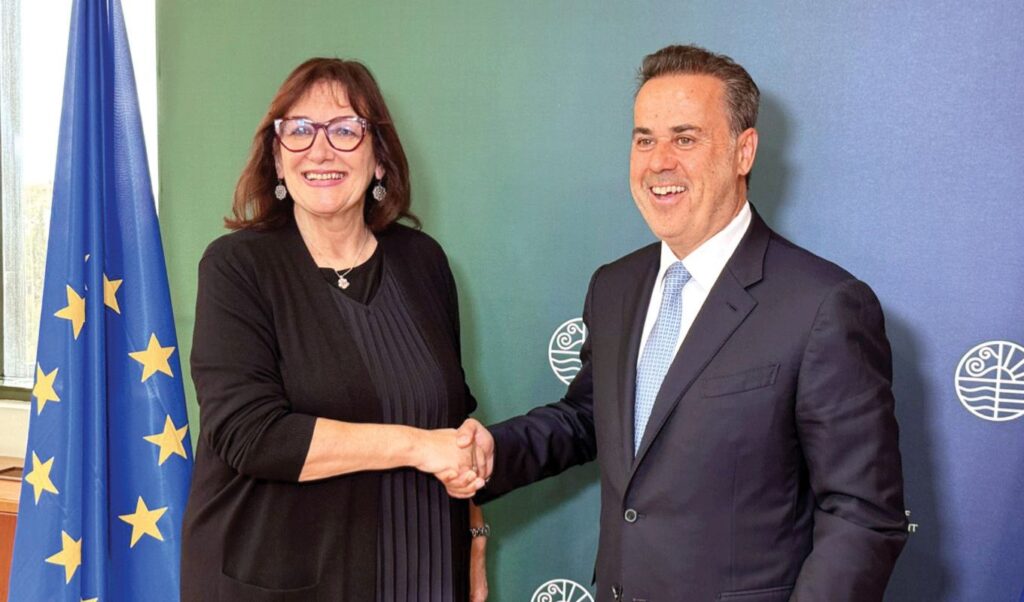
The Minister of Environment and Energy, Stavros Papastaurou, met today with the Commissioner for the Mediterranean, Dubravka Šuica, to strengthen Greece-European Union cooperation on developments in the broader Mediterranean region. “Initiatives such as the Mediterranean Pact, the GSI, the 3+1 as well as the East Med Gas Forum are partnerships that consolidate stability in the region, create conditions for development and cooperation, and marginalize extreme behaviors and threats,” the Minister of Environment and Energy characteristically stated.
Papastaurou: Greece is a key pillar of strategy implementation
During the meeting, it became clear that the Mediterranean is emerging as an area of increasing strategic importance for Europe, both in terms of energy security and economic development as well as geopolitical stability. Mr. Papastaurou emphasized that “our country constitutes a key pillar for implementing this strategy”.
Among other topics discussed were the situation in the Middle East and the new Mediterranean Pact, an initiative that can provide a more cohesive and strategic direction to the European presence in the region. Mr. Papastaurou highlighted our country’s role, noting that “Greece, in recent years, actively contributes to shaping a new energy architecture in the broader region, through projects such as the Vertical Corridor, which strengthens supply security for Southeastern and Central Europe, as well as through LNG infrastructure and electrical interconnections being developed in Southeastern Europe”.
“Initiatives such as the Mediterranean Pact, the GSI, the 3+1 as well as the East Med Gas Forum are partnerships that consolidate stability in the region, create conditions for development and cooperation, and marginalize extreme behaviors and threats,” the Minister of Environment and Energy characteristically stated.
European Commissioner congratulates Greece
For her part, the European Commissioner congratulated Greece, “for its increasingly strengthened role as a key energy hub. Greece is building strong partnerships in the region and beyond. At the same time, it is making significant progress in the transition to clean energy and renewable sources.” She particularly emphasized that Greece has “very good performance in renewable energy production, better than many other European countries. The average in Europe is about 23% participation of renewables in the energy mix, while in Greece the percentage exceeds 50%”.
In a particularly challenging geopolitical period internationally, with the situation in the Middle East remaining tense, Ms. Šuica recognized our country’s role in Europe’s energy security and the broader Mediterranean region, noting that “Greece has a decisive role to play. Its geographical position and emblematic projects – such as GREGY or the electrical interconnection with Saudi Arabia – that connect Europe with neighboring regions, make it a natural bridge for energy cooperation. Greece can contribute to market interconnection, strengthening energy security and promoting clean energy transition in the broader region”.