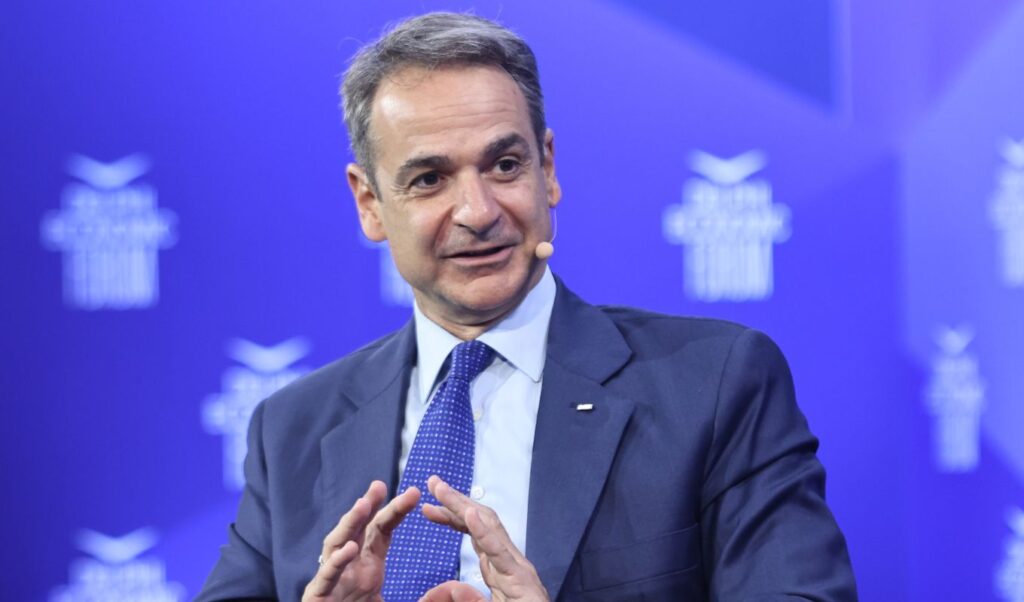
“Greece is starting again, for the first time in decades, natural gas exploration thanks to agreements with American companies like ExxonMobil and Chevron,” emphasized Prime Minister Kyriakos Mitsotakis, on the sidelines of the Delphi Forum, speaking to the American network Breitbart News. He discussed the war in the Middle East and expressed support for US President Donald Trump’s efforts to reach an agreement with Iran, aimed at ending hostilities in the Middle East and restoring stability to the region. Such a development, as Mr. Mitsotakis noted, would allow the opening of the Strait of Hormuz and help global energy markets recover from the “economic impacts” of recent months.
As the American outlet writes about the Greek Prime Minister, this “interview comes approximately one year after he had stated to the same outlet, immediately after Trump imposed tariffs globally during the first year of his return to the White House, that the international community should maintain its composure and that the United States and European Union would soon reach a ‘mutually beneficial’ trade agreement. His assessment was confirmed a few months later, when the US and EU signed an agreement, ratified by Trump and European Commission President Ursula von der Leyen, during the American president’s visit to the Turnberry golf resort in Scotland last July.”
The American network continues: “Today, the Greek Prime Minister returns, expressing hope that the US and Iran will reach an agreement that will end the conflict and restore stability to international energy markets. As he stated, he hopes this can be achieved as soon as possible. He also emphasized that he agrees with Trump that Iran must never acquire nuclear weapons, noting however that after the US military success in Iran, attention now turns to economic consequences and the need for diplomacy to prevail.”
Kyriakos Mitsotakis: Greek-American relations at their best point
“Let’s hope there will be some form of agreement for the Middle East situation, because we are all concerned about the economic impacts,” the Prime Minister stated, while at another point he emphasized: “We had made it clear from the beginning that Iran cannot acquire nuclear weapons. As a country in the region, we are always concerned about its destabilizing role, but now we are at a point where we must be particularly concerned about the economic consequences of the situation.”
“The initial two-week ceasefire between the US and Iran ended earlier in the week, however Trump announced its indefinite extension. Talks between the two sides, under Vice President J.D. Vance in Islamabad, did not lead to an agreement, although it is estimated that a framework has been formed that brings the two sides closer, despite the absence of immediate conclusion,” he noted.
On Europe’s energy autonomy
Kyriakos Mitsotakis further emphasized that developments in Iran and the Strait of Hormuz highlight the need for Europe to become more energy autonomous. He noted that Greece is starting again, for the first time in decades, natural gas exploration, thanks to agreements with American companies like ExxonMobil and Chevron.
As he mentioned, Europe should approach the energy transition more realistically: “This constitutes a wake-up call for a more pragmatic approach. We support both renewable sources and natural gas and have proven that the two can coexist.”
Meanwhile, Mr. Mitsotakis rejected the view that Europe-US relations are deteriorating due to the conflict with Iran, estimating that the crisis will ultimately bring them closer. He emphasized that the transatlantic alliance remains strong, while highlighting the need for European countries to increase their defense spending and strengthen their economies’ competitiveness.
Regarding Greek-American relations, he noted that they are at the highest level they have ever been. He highlighted the historical ties between the two countries and Greece’s active geopolitical role in the Eastern Mediterranean, emphasizing that the country functions as a strategic ally of the US.
“Greece gateway for LNG entry to Europe” – “Path opens for new exploration from 2027”
He also emphasized that energy partnerships with American companies open the path for new exploration from 2027, which, if successful, could constitute a decisive development for Greece and Europe. At the same time, he highlighted Greece’s role as a gateway for American liquefied natural gas entry to Europe.
Finally, he noted that developments in the Middle East may positively affect the promotion of the IMEC corridor (India–Middle East–Europe Economic Corridor), provided there is progress on the Gaza issue as well.