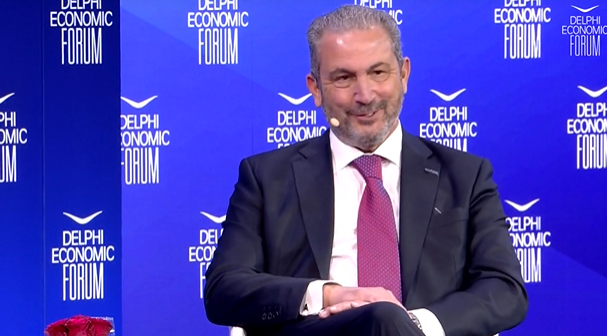
“Europe can no longer compete with the great powers. It is not a great power itself, unfortunately,” emphasized the Chairman and CEO of AKTOR Group and CEO of Atlantic SEE LNG Trade, Alexandros Exarchou, in an interview with journalist Katerina Panagopoulou at the Delphi Forum, sending his own message amid geopolitical challenges. “The Vertical Corridor will proceed and at a business level will deliver what is expected and possibly more than expected. I simply fear that sometimes we are not adequately prepared at the European Union level, precisely to limit prices and have competitive pricing between American and Russian energy, and balance between the two,” Mr. Exarchou noted.
“Recently, I have often been forced to say that in Europe nowadays, in recent years, we find ourselves in a state of constant surprise. Crises constantly make us consider that the conditions of life are changing, and I truly believe that we are indeed living, for different reasons from the crisis, in a different world. Well, recently, for at least the last year, we speak differently, we conduct business differently,” he noted initially.
“I will use the words of the Canadian Prime Minister as well, a speech he gave in Davos, which made an excellent impression on me because I found it truly inspired, the theory that says suddenly the powerful do whatever they want because they can, and the less powerful suffer the strong because they cannot do anything else,” he meaningfully added
“And unfortunately, Europe is no longer counted among the powerful in life. And in the world. This was not always the case. And I believe that the only way – and I will come to the crisis, because yes, I too believe that indeed this winter Europe will be tested once again very much. And we will all attribute this test to the new war in Iran, which succeeds the previous war in Ukraine, where we again had a crisis, while I believe that the reality is that the crisis with which Europe will be tested from winter onwards is mainly due to the fact that Europe can no longer compete with the great powers. It is not a great power itself, unfortunately. In my opinion, it could become a field of brilliant glory, I would say. But until that happens, unfortunately it is no longer counted among the great powers, so it cannot stand competitively against America, against Russia and against China, with the result that it constantly reacts. Yes, and I believe that the war in Iran has created conditions of exceptional inflationary pressure, pressure on Europe and I believe indeed that this winter will be particularly difficult,” he emphasized.
“And I believe that the only way – and I will come to the crisis, because yes, I too believe that indeed this winter Europe will be tested once again very much. And we will all attribute this test to the new war in Iran, which succeeds the previous war in Ukraine, where we again had a crisis, while I believe that the reality is that the crisis with which Europe will be tested from winter onwards is mainly due to the fact that Europe can no longer compete with the great powers. It is not a great power itself, unfortunately. In my opinion, it could become a field of brilliant glory, I would say. But until that happens, unfortunately it is no longer counted among the great powers, so it cannot stand competitively against America, against Russia and against China, with the result that it constantly reacts. Yes, and I believe that the war in Iran has created conditions of exceptional inflationary pressure, pressure on Europe and I believe indeed that this winter will be particularly difficult. I also believe it is an opportunity, because I am certain that, as happened with COVID, so it will happen in this case too, Europe will be forced, when faced with a situation that threatens to put it in a very difficult position, to address it in the same way it addressed COVID,” Mr. Exarchou emphasized.
“I don’t know if it was right or wrong, but by issuing a new RRF, possibly a European bond, something that will essentially allow addressing the strong inflationary trend that will arise from the fact that it will simply not be easy to procure either natural gas or oil, and mainly natural gas. Listen to where we’ve come. Europe started actually using as an excuse the low price coming from Russia, regardless of whether it was real or not, it was extremely low, became absolutely dependent on one energy source, resulting in now finding itself in a state of silence. It was forced due to the war and crisis in Ukraine to ban the provision of natural gas from Russia from now on. The war in Iran happened, destroyed the Qatari installations, so whatever one would expect to be able to get in terms of LNG from Qatar, will not be able to succeed at least. So there is American LNG now. American LNG remains, which we consider given, but today as we speak, without long term agreements, the Americans are not in a position to produce and deliver the quantities that Europe needs to be able to sustain its needs. So it’s not a matter of price at this moment so much, as supply, as offering. Does it exist? Is it so certain that this winter I read and believe it. That problems are being faced at this moment, I think the oil issue will be less serious, if indeed the strait issue is resolved, the oil issue may not be as acute as it seems now, but the natural gas issue will not depend only on whether they will be free, the straits will be free, as much as on where, who has these quantities of natural gas to bring them to Greece, to Europe, given that Russian is banned. States. States must rush. They should have rushed.”
Alexandros Exarchou on the Vertical Corridor and Greece’s upgraded position
“I believe that long term the only solution is indeed that of long term agreements both with America and with other suppliers, but at this moment the obvious is with the Americans, which long term agreements for which there is much discussion in Europe at this moment and I believe there is also significant reaction from certain European states, mainly northern Europe and let’s say it, in any case, mainly from Germany. This is what I wanted to tell you. I have heard you saying that there are some who undermine the vertical corridor. You have mentioned interests, you have mentioned nation states. You say it openly now. You are talking about Germany. Yes, of course. Germany is a country which I believe at this moment is fighting very hard to prevent mainly long-term agreements with the United States. The problem that one must see with the European Union at this moment, as it stands, is the following: we have a single currency without having a unified economic policy. We have a single currency without having a unified foreign policy and we have a single currency without having a unified defense policy. 27 states, 27 different governments, 27 different vetoes. So most with the same currency. This is not funny. Because usually currency actually expresses the policy that a state has, towards the basic factors of its existence, which are the economy, foreign policy and defense. At this moment then we have a Europe which is being tested defensively, we need to realize after World War II now that we need to acquire an army, it took us a little extra time.”
Because usually currency actually expresses the policy that a state has, towards the basic factors of its existence, which are the economy, foreign policy and defense. At this moment then we have a Europe which is being tested defensively, we need to realize after World War II now that we need to acquire an army, it took us a little extra time, this is due to the fact that we lost the support actually of the United States. That’s it. It’s nothing else. So the United States came and said, guys, we will not pay from now on and will not support you at no cost for your defense and we realized in Europe generally that from World War II until today we have actually disarmed, with the result that we have no army. Not even with foreigners in Greece. Another important part of what I described to you earlier is the following: that Greeks find themselves at this moment in the fortunate position of facing the crisis from the best position versus the rest of Europeans. So we can calculate benefits as a state from this geopolitical reshuffling and we are considered ready precisely to exploit this situation and what is the optimal way to do it? We as a country. It is as follows: that we are in contrast to the past, at this moment the Greek economy is a flourishing European economy. Also due to relations with Turkey we have significant, if you will, military adequacy. In view of what is going to come in the future in terms of equipment, at this moment Greece is in the best position versus many other European states. As long as we maintain it. The opportunities of the vertical corridor that one should not see only purely business-wise, but should see nationally, essentially creates better and more significant prerequisites for geopolitical stability in the region and geostrategic power. If one sees this also from the side of the fact that we have acquired the capability of equipment procurement from the United States, much more significant than our neighbors, this in relation to the fact that an American hub is being created actually for providing American natural gas northward to Europe, strengthens both the geopolitical and geostrategic position in Greece as much as I don’t remember in the past, with the result that I believe at least my opinion is this, that if one combines this capability and exploits it as it should, in relation to the fact that at this moment Greece has the most flourishing and developing economy within the European Union, I believe we are in the best position to use this crisis in our favor. Atlantic will complete several commercial agreements within the next months with southeastern European countries. It is clear as you say that these agreements far exceed the national, sorry , the economic framework and have a deep and substantial geopolitical footprint. And I want to ask you because you also mentioned America, could LNG constitute a springboard for further development of Greek-American economic relations, because we see that our energy policy is ultimately emerging as a central pillar of our foreign policy.