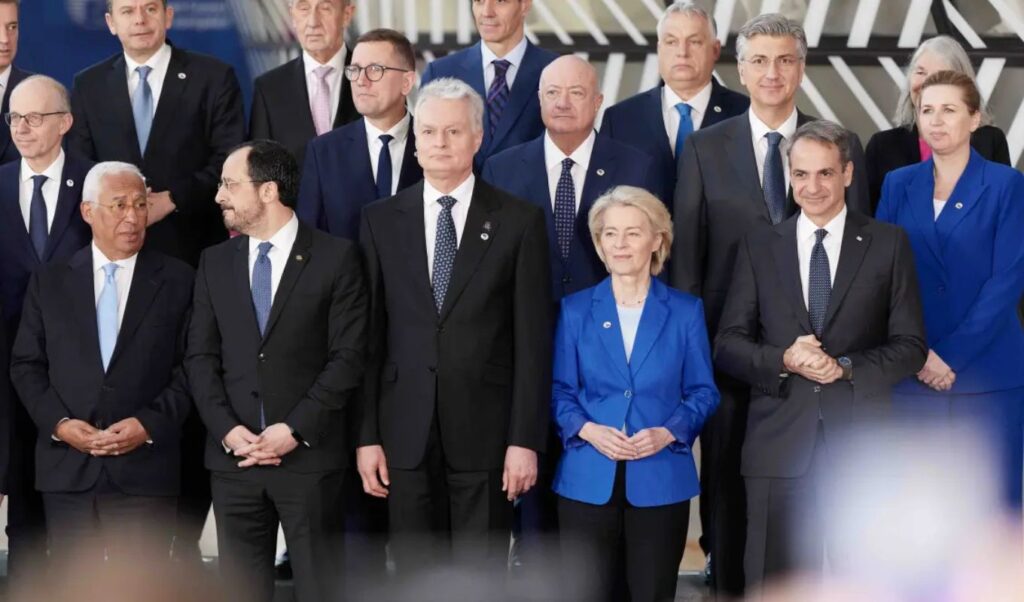
Cyprus hosts today the leaders of the European Union for the Informal Summit organized under the presidency of the Republic of Cyprus. The arrival of EU leaders in Nicosia highlights the island’s role as the “front line” of developments in the Middle East and the need for enhanced security in maritime channels. While the agenda focuses on the EU’s next multiannual budget (2028-2034), the Summit is expected to shape the ground for a common European direction on all geostrategic issues following the intense geopolitical volatility triggered by wars in the Middle East and Ukraine.
The President of the Republic of Cyprus, Nikos Christodoulides, had extended an invitation to Turkey to attend the Summit, however, as expected, the Turkish side rejected it. Instead, Turkish President Recep Tayyip Erdogan has exercised sharp criticism regarding the presence of even defense systems from European states on the island.
Kostas Yfantis to parapolitika.gr: “Turkey fights anything that strengthens or confirms the state existence of the Republic of Cyprus”
According to Professor of International Studies Kostas Yfantis, Turkey’s hostile stance toward the Cypriot Presidency is expected, as he argues to parapolitika.gr, “Turkey fights anything that strengthens or confirms the state existence of the Republic of Cyprus. Whatever happens, Turkey will challenge it, make statements against it, will want to continuously record its view that the Republic of Cyprus is not a state, but is a Cypriot administration”.
Von der Leyen’s statements that “sparked fires” and caused reactions in Turkey and EU – Charles Michel’s position and Christodoulides’ response
The complex relationship between the European Union and Turkey returned to the spotlight following recent statements by Ursula von der Leyen that provoked strong reactions in Ankara, as well as within the European Union. Several European officials criticized von der Leyen’s statements, which put Turkey in the same sentence as Russia and China, emphasizing that Ankara remains a strategic partner and NATO ally, as well as that it continues to be an official EU candidate country. Indeed, EU-Turkey relations and the position initially expressed by Ursula von der Leyen caused a clash between the President of the Republic of Cyprus, Nikos Christodoulides, and former President of the European Council, Charles Michel, who has never hidden his pro-Turkish sentiments.
Mr. Michel argued that Turkey is a “key NATO ally, key migration partner, energy corridor,” provoking a reaction from Mr. Christodoulides, who reminded him that Turkey invaded Cyprus in 1974 and continues to occupy European territory.
EU-Turkey relations were clearly reflected once again in the recent European Parliament Report, which leaves no doubt that, despite its geopolitical significance, the country’s accession process remains “frozen” due to serious regression in the rule of law and provocative actions in the Eastern Mediterranean.
This observation is also made to parapolitika.gr by Professor of International Studies Kostas Yfantis, who emphasizes that “EU-Turkey relations have been in stagnation, in inertia for many years. Neither is cooperation with Europe expanding, nor have those internal European correlations changed that would allow the revitalization of the accession process, which simply exists because no one wants to bear the cost of declaring it failed and stopping it”.
As Mr. Yfantis argues, much will depend on how Europe evolves from now on and explains that Europe-Turkey relations depend largely on “whether there will be a greater coordination effort -not unification, because that presupposes treaty revision and no one is going to propose something like that now-, whether there will be greater defense coordination. Then it is certain that several countries will see Turkey as an attractive partner. A NATO country with a modern army, with war industry, particularly the northern countries will not reject this prospect. But again we are very far from something like that. That is, what we once called ‘Europe of multiple speeds’ or ‘concentric circles’, which could include more participants in an external circle that would be defense cooperation”.
Until now, however, Turkey faces questioning from European partners about its intentions to harmonize the rule of law and stop its aggressive policy toward Greece and Cyprus. No one can claim that the message sent by the Commission President, on the eve of the Informal Summit of the Republic of Cyprus, has not been fully received by Turkey.