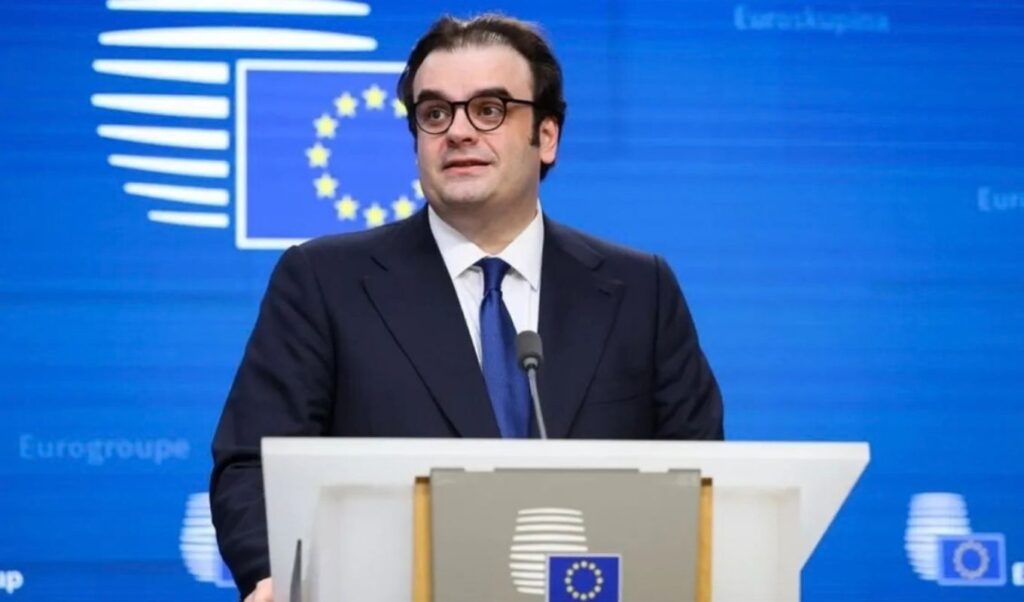
The Eurogroup meeting in Brussels on Monday (09/03) took place amid intense concern, as tensions escalate in the Middle East. The Eurogroup president and Minister of National Economy and Finance, Kyriakos Pierrakakis, issued a warning about a period of geopolitical and energy instability that threatens the European economy, despite the relatively good start to 2025.
Pierrakakis: Europe must be prepared for a scenario of “prolonged instability”
Specifically, Eurogroup president Kyriakos Pierrakakis stated at the press conference after the meeting that ministers’ discussions took place “during a period of intense turbulence,” focusing on the Middle East conflict, which is not limited to economic impacts but has “broad geopolitical ramifications,” as reported by ertnews.gr. He emphasized that the EU stands in “absolute solidarity” with those affected in the region, while simultaneously monitoring market reactions and energy price pressures closely.
Meanwhile, Mr. Pierrakakis reminded that 2025 was a “positive year” for the European economy, with better-than-expected growth, stabilizing inflation, and strong employment, though he clarified that the environment has now changed dramatically.
As Mr. Pierrakakis stated, the EU is closely monitoring market reactions to Middle East developments that dominate international news. “The European economy has the capacity and resilience to absorb temporary shocks. At the same time, we must be prepared for a more prolonged period of instability, with possible shipping disruptions, energy price increases, and consequences for inflation.” He emphasized that energy is at the center of attention.
Strategic oil reserves
The discussion around strategic oil reserves and the possibility of using them as a buffer against new price increases gained particular importance. Economics Commissioner Valdis Dombrovskis explained that strategic reserves “exist precisely for such crisis moments” and that intervention through coordinated release could be justified if deemed necessary, though he clarified that no final decision exists at this stage.
Kyriakos Pierrakakis, responding to questions about when and how the EU’s energy “toolkit” should be activated, reminded that policy tools have been developed since the 2022 crisis that can be activated if the situation deteriorates. However, he stressed that Europe is not yet at that point and needs first a more stable market picture, recalling the high volatility in oil prices “even within a few hours.”
The Eurogroup president emphasized the need for full coordination between member states, the European Commission, and G7 partners, as finance ministers of the seven strongest economies declare themselves “ready” to consider coordinated reserve releases if deemed necessary for market stabilization.
From crisis management to strategic autonomy
Beyond short-term crisis management, Kyriakos Pierrakakis tried to shift the discussion to a more strategic perspective. As he noted, Europe “cannot remain in permanent crisis management mode”, but must accelerate steps toward strengthening its strategic autonomy, with energy and capital markets at the forefront.
In the energy sector, he particularly emphasized the need to accelerate the energy transition, develop interconnected European networks, and create a truly unified European energy market. He reminded that energy infrastructure is planned over long time horizons, thus requiring “clear strategy, stable regulatory framework, and reliable policies” if Europe wants to be less exposed to future geopolitical shocks.
Special reference was made to how energy intersects with inflation and social cohesion. Pierrakakis noted that the main drivers of inflation remain energy, housing, and food, and that “these are exactly what concern European households.” In this context, he expressed the view that decisions must have citizen and business protection as their central criterion, without undermining fiscal stability.
Calm, but without illusions
The general message from both Kyriakos Pierrakakis and Valdis Dombrovskis was the need for “calm” in the face of an extremely uncertain environment. The Economics Commissioner described two basic scenarios: a rapid conflict de-escalation scenario where impacts would be limited, and a scenario of prolonged attacks on shipping and energy infrastructure that could lead to stagflationary shock for the European and global economy.