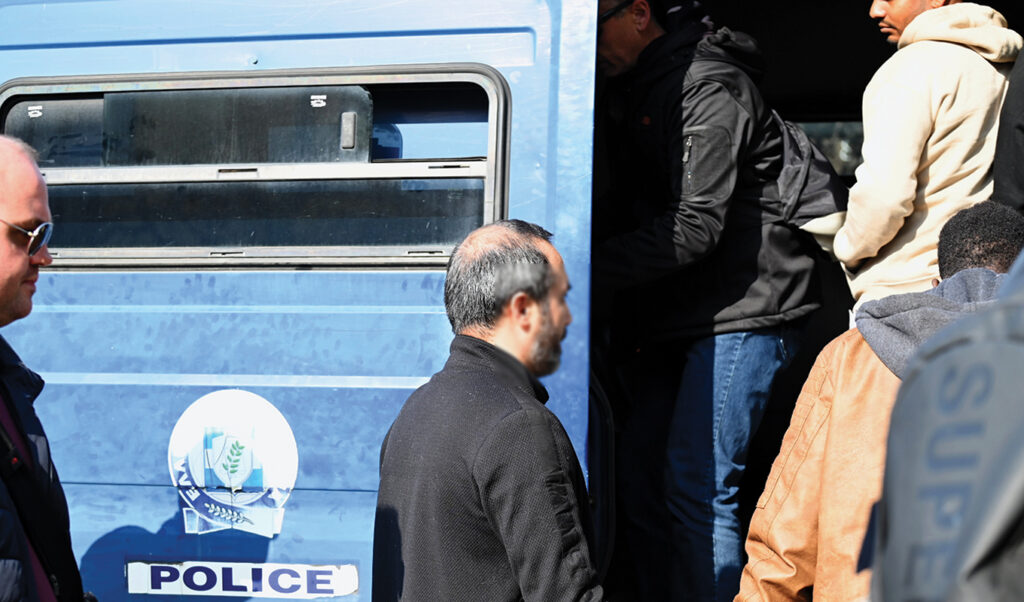
Security services are systematically reexamining previous cases involving Iranians and other third-country nationals involved in espionage activities and terrorist attempts, following the arrest of a 36-year-old Georgian who was photographing the Souda naval base and monitoring warship movements.
Espionage cases under review after Georgian’s arrest
A connection emerged between him and one of the arrested Azerbaijanis in June 2025, also charged with espionage on behalf of Iran, while his name reportedly appears on an international suspects list. Consequently, it was decided he should serve the two-year sentence imposed by the Single-Member Court for illegal entry and stay until all necessary evidence is collected.
According to sources, he received orders from Iran through a mobile app, while his device contained numerous photos of the American aircraft carrier “USS Gerald R. Ford”. Surveillance began immediately upon his arrival in Chania on February 3, and on February 16 he attempted to rent a room at the same hotel in Souda where the Azerbaijani stayed opposite the naval base, but no rooms were available. He stayed at another nearby hotel at least until February 24, when the aircraft carrier arrived. He reached Athens on February 27 and was arrested one day later while heading to Eleftherios Venizelos Airport.

VEVAK’s online agent recruitment operation
The Azerbaijani spy and his accomplice were operatives of Iran’s Ministry of Intelligence and Security (VEVAK), using identical forms of electronic communication as the 36-year-old Georgian. In fact, spies arrested in Greece and Cyprus who were monitoring American bases and Israeli operatives were recruited for VEVAK through online applications and electronic advertisements. Both the 26-year-old found in Crete and the 44-year-old in Limassol, Cyprus, received regular payments as collaborators with the foreign operations and technology directorates of the Iranian Authority, where they worked sporadically.
How “sleeper” agent networks operate abroad
According to the service handbook, “in case of bombing of Iran’s nuclear facilities by the Israeli Air Force, VEVAK’s mission is to activate sleeper networks of operational agents for terrorist strikes against Jewish targets abroad.” Technical expertise is provided by Imam Mohammad Baqer University of Tehran, however these individuals operated as regional members without other knowledge, at least from what has become known so far.
The 26-year-old entered Greece in January 2025 and came under surveillance a few days later when he purchased a camera and high-tech equipment from a store in central Athens. For six months, until mid-June, he moved mainly in Attica, though according to some sources he also traveled outside the country before going to Crete. The 44-year-old, who arrived as a tourist in Cyprus in April, rented accommodation in a luxury apartment complex in Zakaki, Limassol, where Israelis reside. When they were arrested hours apart last June, their contacts and “connections” had been fully documented.
According to a Reuters report, attempts at extremist actions by Iranians occurred in Athens in 2021 and 2022, but were prevented in time
Iranian operative Eshan Bidi’s activities in the Balkans
A middle-aged Iranian named Eshan Bidi plays a role in the Balkans, who was expelled from both Greece and Albania in 2020, where a group of dissidents lives in a camp north of Tirana. Bidi and two Iranian diplomats were in direct contact with former Quds Force commander General Qasem Soleimani, who was killed in January 2020. While imprisoned in Egypt, he also maintained contacts with the military regime.
The mullahs’ secret services tried to send Bidi to Austria, Finland or Denmark, but these countries refused to accept him. Using an Iranian passport, he was sent to Turkey and then from Turkey to Romania, until he ended up in Albania and Greece. Mossad director David Barnea had said that Israeli intelligence services collaborated with other agencies to dismantle 27 groups that attempted to organize attacks abroad which were directed by Iran.
In the United States, there have been at least five assassination or kidnapping cases allegedly linked to Iran. Three involved assassination plots by hired killers. According to a Reuters report, attempts at extremist actions by Iranians occurred in Athens in 2021 and 2022, but were prevented in time.
Published in Parapolitika