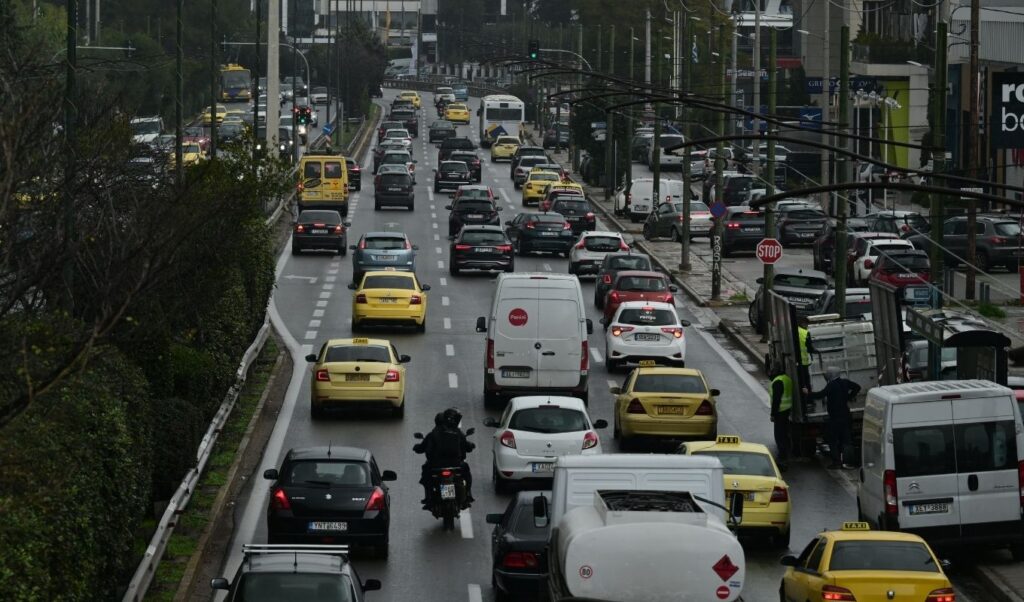
The government’s comprehensive plan for addressing a complex and billion-euro problem – traffic congestion in Attica – is expected to be presented in March. Prime Minister Kyriakos Mitsotakis convened an extensive meeting yesterday, Wednesday, at the Maximos Mansion with the participation of eleven ministers and deputy ministers to hear all ideas and proposals. He then called on them to study these in depth, determine which ones can be implemented and how, and proceed with comprehensive planning.
The facts are as follows: Attica is home to 3,814,064 citizens, according to the latest census data. Tens of thousands of tourists also circulate daily, as Athens has become an increasingly major international tourist destination in recent years: In 2024 alone, their total number reached almost eight million. Meanwhile, hundreds of trucks use the National Highway, Attiki Odos, and other roads to transport goods to and from the three major ports (Piraeus, Rafina, Lavrio) and the international airport “Eleftherios Venizelos.” Additionally, during the crisis years, public infrastructure investments were significantly reduced, and the only new project delivered in the Athens basin in the last decade has been the metro and tram extension to Piraeus.
These factors create an “explosive” scenario regarding traffic in Attica, with most roads reaching saturation limits and drivers losing many hours every day behind the wheel.
The proposals presented at the Maximos meeting were on three levels, depending on the time required for implementation: Immediate, medium-term, and long-term.
Traffic congestion: What measures are being considered to ease Kifissos congestion
Immediate measures include reducing truck traffic on Kifissos and better managing daily incidents that cause delays. Deputy Transport Minister Konstantinos Kyranakis had proposed banning heavy vehicles from 7:00 to 10:00 AM on the national highway, but its implementation presents problems and difficulties and therefore will not proceed.
However, measures being considered include, for example, changing ferry schedules from Crete ports to Piraeus, so that morning arrivals occur before 6:00 AM, thus exiting onto Kifissos before rush hours. There’s also consideration for utilizing – even on a pilot basis – the old Elefsina-Thebes national highway for trucks and heavy vehicles to bypass Kifissos.
Medium-term solutions include the so-called “smart traffic lights” measure, which has already yielded results in Thessaloniki and is now being seriously considered for Attica. Modern systems utilize cameras, sensors, and artificial intelligence to ensure that the timing between green and red lights is not predetermined but adapts to actual road traffic and facilitates flow.
Medium-term solutions also include improving the frequency of Attica Mass Transit schedules, which, as mentioned, will improve by year’s end. Additionally, the development of the Business Park at the “Spilies” site in Fyli Municipality, where the relevant tender is pending. This project will relocate all freight transport operations from Eleonas, where they are currently scattered chaotically, to Fyli in a modern and organized manner, significantly helping reduce daily truck traffic on Kifissos.
New road axes and Metro Lines 2 and 4
Long-term solutions include new bypass road axes, requiring time for studies and tenders and, naturally, significant national and European resources: The connection of the Western Ring Road of Egaleo with the Athens-Corinth National Highway and completion of the Scaramanga Junction, which is the most mature project for execution. The intervention at the Metamorfosis interchange to create a new, independent entrance to the Athens-Thessaloniki national highway from Attiki Odos (exclusively toward Piraeus). The extension of Attiki Odos southward, with a new section approximately 3 kilometers long, almost entirely underground (the so-called Ilioupoli Tunnel), connecting Karea with Elliniko. The “Elefsina-Oinofyta” highway, which will decisively contribute to Kifissos decongestion. The last two projects require hundreds of millions of euros to implement, and the necessary resources are being sought.
Long-term projects also include completion of Metro Line 4, expected no earlier than 2030, as well as bicycle lane creation. Simultaneously, with Metro Line 4 construction, Line 2 extension is planned both westward, with three new stations (Palatiani, Ilion, Agios Nikolaos), and southward: With line branching after “Elliniko” station, one section toward Ano Glyfada and Vouliagmenis Avenue and another section, also with two stations, in the major investment area at the former Elliniko international airport and downtown Glyfada.