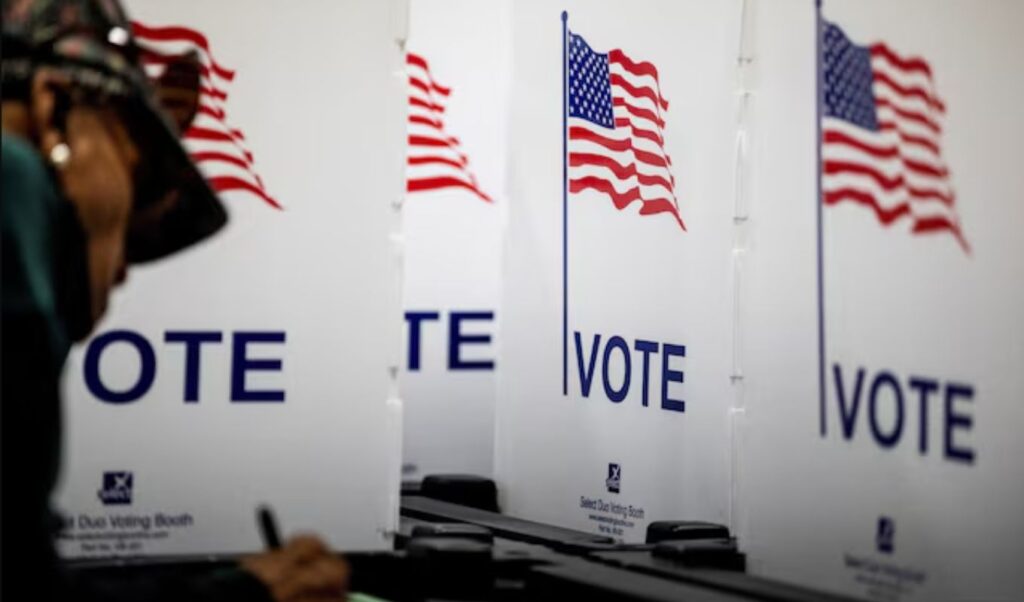
Forecasts ahead of the US midterm elections are shaping up in a particularly favorable climate for the Democratic Party, with the prospect of a significant electoral victory gaining ground. Despite indications of a Democratic win, all outcomes remain open, and the result will largely be determined by key Senate battleground states.
Read also: USA: Who is Abdul El-Sayed, the Democratic Senate candidate from Michigan
A “blue wave” is considered almost certain to materialize; however, it is not guaranteed to automatically translate into a strong majority in the House of Representatives while simultaneously securing control of the Senate. The Republican Party still holds significant electoral strongholds that could limit its losses, even if Democrats deliver an impressive performance.
The “blue wave” vs. the “red fortresses”
In fact, it cannot be ruled out that Republicans may emerge as the winners on the night of November 3rd. The picture resembles a powerful wave approaching the shore, without any certainty that it will manage to sweep away all obstacles in its path. Republicans already hold strong electoral bases, particularly in the Senate, giving them considerably greater resilience.
The critical question, therefore, is not simply whether a “blue wave” will materialize, but rather whether it will carry enough force to overturn the balance in the most competitive districts and states. As Democratic vote shares increase, more Republican seats could come under threat. Most of these seats are located in areas with strong conservative traditions, though there are cases where Republican electoral dominance is not considered equally secure.
Republicans had long been preparing for a potential “blue wave.” Midterm elections have historically been a difficult test for whichever party occupies the White House, particularly as Donald Trump’s approval ratings sit at their lowest levels.
In an effort to maintain their advantage, Republicans redrew electoral maps and spent billions of dollars. These pre-election maneuvers, however, may not prove sufficient to retain their majority in the House of Representatives. In the Senate, on the other hand, things appear far less straightforward for Democrats, who will need to prevail in states where Trump secured double-digit margins of victory.
New York Times: The four scenarios for the Senate
Scenario 1: Republicans comfortably retain control
In the first scenario, the anticipated “blue wave” fails to reach the scale predicted by the polls, allowing Republicans to retain their Senate majority with relative ease. In this case, the polls will have overestimated Democratic momentum, with the party settling for a slim majority in the House of Representatives.
The “blue wave,” in this outcome, fails to sweep through the red stronghold states, where strong Republican voter turnout proves decisive.
Scenario 2: Republicans narrowly hold their Senate advantage
The second scenario foresees Democratic gains being confirmed, but without generating the momentum needed for a full Senate takeover. The party records significant gains in the House of Representatives, but Republicans manage to retain control of the Senate by the narrowest of margins.
In this scenario, races in traditionally Republican states turn into genuine thrillers. Democrats post notable performances in states such as Texas and South Carolina, recording vote shares that could be the highest seen in decades. Nevertheless, despite their strong showing, they fall short of winning the critical seats that would allow them to assume Senate control, and Republicans hold on to their lead.
Scenario 3: Democrats pull off the upset and win the Senate
In the third scenario, Democratic electoral momentum proves strong enough to overturn the existing balance of power and deliver a Senate majority. The wave of discontent is not confined to the most competitive states, but extends into areas where Trump had previously won by wide margins. Dissatisfaction among conservative voters toward Trump plays a pivotal role in this scenario.
A portion of conservative voters may choose to stay home, while others could back Democratic candidates, contributing to upsets in states previously considered safe Republican territory.
Scenario 4: A sweeping “blue wave” reshapes the political map
The fourth and most favorable scenario for Democrats envisions an electoral victory of far greater magnitude, exceeding initial expectations and striking even the strongest Republican strongholds. In this case, Democrats could secure approximately 250 seats in the House of Representatives, achieving a broad majority, while capturing at least 53 seats in the Senate. Such an outcome would carry wider political implications, potentially signaling the beginning of a new era in American politics.
“This election will mark the moment we begin to turn the page and look toward a new chapter in American politics,” a Democratic camp source is quoted as saying, according to the New York Times.
A major Democratic victory could mark the beginning of a new political era. Nevertheless, voters who have traditionally supported Republicans are very likely to ultimately show up at the polls and cast their ballots for their party.