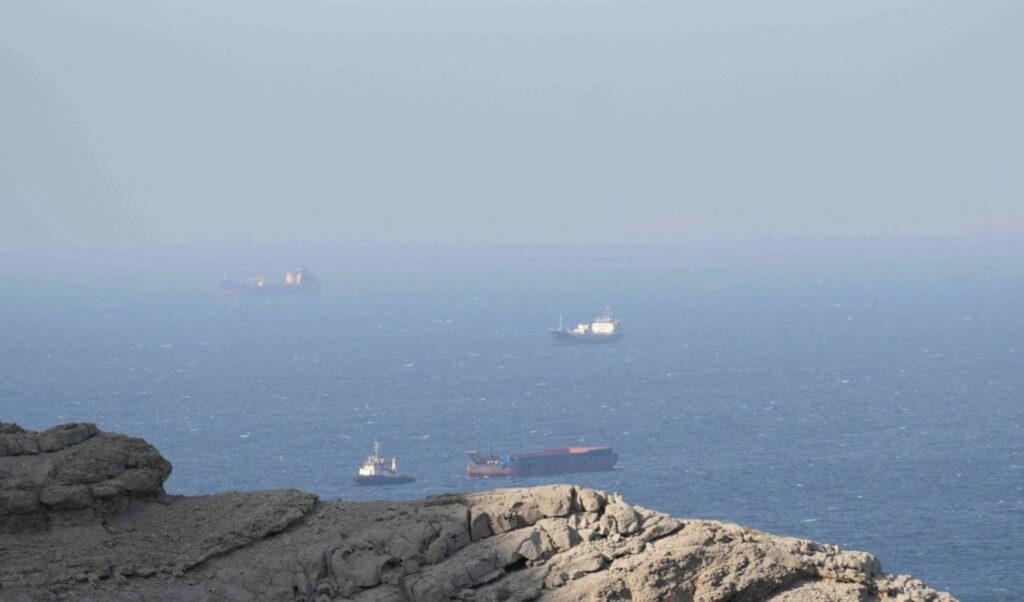
A new reality is taking shape in the Strait of Hormuz, as supertankers navigate this strategically vital waterway with tracking systems disabled in order to evade Iranian attacks. This tactic, carried out with the support of the U.S. Navy, is directly affecting international oil prices and exposing the true scale of the energy crisis gripping the world. On July 25, a supertanker approached the Mesaieed oil terminal in Qatar, forty kilometers south of the capital Doha. Four days later, loaded with crude oil, it set course for the Strait of Hormuz. On July 31, shortly after noon and as it was approaching Dubai, the vessel vanished from every tracking system.
The dark passage tactic through the Strait of Hormuz
The supertanker had disabled its AIS system — the transponder that broadcasts every vessel’s identity, position and course. As far as international maritime services were concerned, the vessel — more than three hundred meters in length — had temporarily ceased to exist. The following day, at 10 a.m., the signal reappeared. The tanker had already transited the Strait of Hormuz and was on the other side. This route is no isolated incident. According to extensive reporting, it is part of a systematic industry-wide tactic aimed at reducing the risk of Iranian drone attacks.
Oil companies from Saudi Arabia, Kuwait, Qatar and the United Arab Emirates have chartered tankers that transit the strategic chokepoint with their transponders switched off, operating under the protection of the U.S. fleet. The vessels carry oil from the Persian Gulf to the Gulf of Oman, where the cargo is transferred to other tankers owned by the end buyers. The original ships then return for new loads, effectively shifting the bulk of the insurance risk from international commercial charterers to the oil-producing countries themselves.
How global oil prices are being affected
The practice appears to be delivering far more than the markets reflect. According to the U.S. Department of Energy, an average of eight to nine million barrels continue to pass through the Strait of Hormuz each day — roughly double the figure estimated by Wall Street analysts and shipping intelligence firms such as Kpler, which rely primarily on AIS signals. The gap is explained precisely by those vessels disappearing off the charts. Within just two days, more than twelve ship-to-ship transfers were recorded in the Gulf of Oman, with cargoes continuing on to China, Taiwan, South Korea, the Philippines, Vietnam and Thailand.
This new strategy is being implemented at a critical juncture for the global energy market. The conflict has disrupted roughly one fifth of the world’s oil supply for approximately six months. At the same time, commercial inventories have dropped dramatically, U.S. strategic reserves have fallen to levels not seen since the early 1980s, and China is drawing down its vast stockpiles to prevent a further surge in international prices.
The risks of invisible transits
The dark passage solution is anything but risk-free. The Strait of Hormuz is just thirty-seven kilometers wide at its narrowest point, and a tanker can be detected by radar or satellite even with its AIS system disabled. Two vessels belonging to the United Arab Emirates were recently attacked. Despite the danger, according to Kpler, approximately eighty percent of traffic through the Strait over the past two weeks took place without active transponders, with ships hugging the Omani coastline as closely as possible and keeping their distance from Iran. Satellite imagery reveals the true scale of the operation. Photographs taken on August 14 show rows of dots — vessels moving in an arc along the Omani coast and through the Strait of Hormuz — with no corresponding records in AIS data.
Alternative routes and increased production
The covert transits are not the only tool Middle Eastern producers are using to sustain their exports. Saudi Arabia has rerouted approximately five million barrels per day through the East-West Pipeline to the port of Yanbu on the Red Sea — quantities that under normal circumstances would have been exported through Persian Gulf ports. Regional producers have managed to bypass the Strait by an additional two million barrels per day.
At the same time, production has increased in other parts of the world. Brazil, Guyana and Venezuela have together added more than one million barrels per day to the global market, while the United States is also producing hundreds of thousands of additional barrels daily. On the demand management side, Washington has released four hundred million barrels from its strategic reserves, dramatically drawing down the Strategic Petroleum Reserve. China is also utilizing large stockpiles while simultaneously curbing crude imports significantly. Demand itself has declined as a result of elevated oil prices.
The pressure on refineries and fuel supplies
The strain has already begun to show in refined fuel products. Three of the four major global refining hubs are under serious pressure. The conflict has damaged refineries across the Middle East and curtailed the region’s product exports. Meanwhile, Russian refineries have been struck by Ukrainian drones, and Moscow — facing domestic fuel shortages — has restricted its own exports. China is also cutting refined product exports to ensure adequate domestic supply. An increasing share of the burden is falling on American refineries along the Gulf of Mexico coast, which cannot realistically operate at maximum capacity indefinitely. The pressure is particularly acute for gasoline, but especially for diesel and aviation fuel, where available refining capacity is insufficient to meet demand.
The outlook for oil prices
Donald Trump had managed for months to hold market expectations in check by speaking of imminent diplomatic progress. However, U.S. strategy has since shifted toward sustained economic and naval pressure on Iran. That shift has driven oil prices gradually higher, now approaching one hundred dollars per barrel. The system is buying time, but it is not solving the problem. Over the course of the conflict, global inventories are estimated to have fallen by as much as 1.9 billion barrels. Even if the market eventually reaches equilibrium, those reserves will need to be replenished at some point. If they are not, they will fall to levels so low that they can no longer serve as a buffer against future crises.
In such a scenario, the primary balancing mechanism will be far more painful. Prices will need to rise enough to suppress global consumption even further. The battle for control of the Strait of Hormuz continues to keep oil — and even more so, gasoline, diesel and aviation fuel — at elevated levels, fueling inflation and squeezing consumer purchasing power. Yet the fact that the global market has managed to forge new routes, ramp up production elsewhere, tap strategic reserves and move millions of invisible barrels through the Strait of Hormuz has, so far, prevented the worst-case scenario. Without this coordinated and largely unseen operation, the largest supply disruption the global market has ever experienced could have driven oil prices far higher.
Iran grants special permits to Iraqi tankers to transit the Strait of Hormuz
Iran has issued special permits to selected tankers with Iraqi interests, allowing them to transit the Strait of Hormuz. The decision comes in the wake of the outbreak of armed conflict in the Middle East, as reported by Iran’s official news agency, IRNA. The agency notes that despite facing the most stringent military measures imposed by the United States, the Iranian government permitted Iraqi tankers to transit the Strait of Hormuz throughout the past six months.
According to the same source, the Iraqi government had repeatedly submitted requests for transit permits for its tankers through this passage, which is of vital importance to global hydrocarbon trade. IRNA points out that the experience of the past six months has demonstrated that Iraq has no viable alternative for exporting the bulk of its crude oil beyond the Strait of Hormuz. It is worth noting that prior to the outbreak of hostilities, Iraq — which derives nearly 90 percent of its revenues from crude oil sales — moved the majority of its petroleum exports through the Strait.