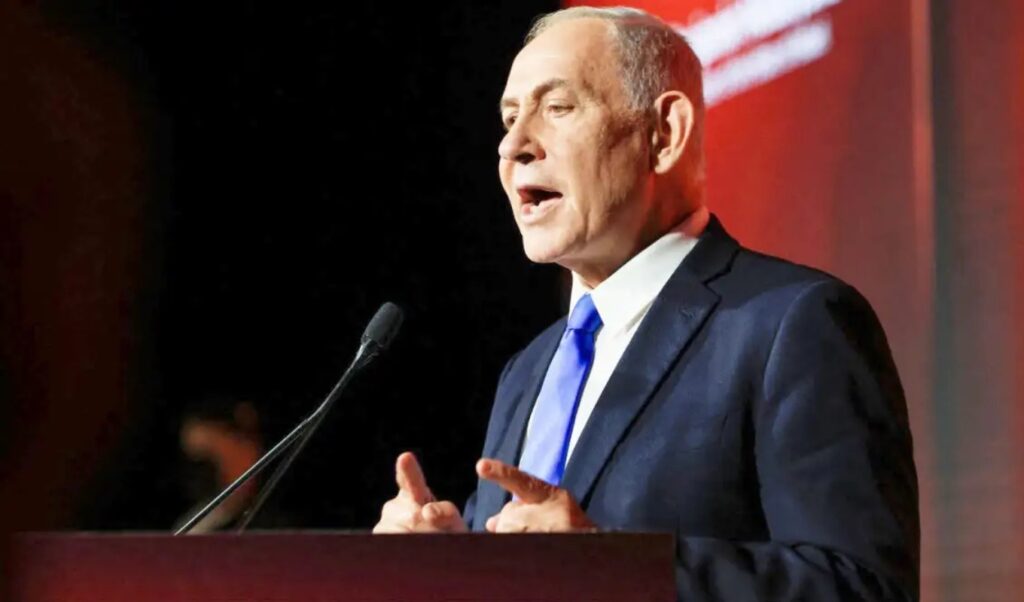
Israeli Prime Minister Benjamin Netanyahu reiterated Israel’s well-established position against the US-backed “Gaza Peace Council” plan, directly refuting claims that he had accepted the proposal for the enclave’s disarmament.
“I want to make this clear,” Netanyahu said at the opening of the weekly cabinet meeting, according to the Times of Israel. “Israel rejects the 15-point document.”
The US-backed “Peace Council” has been pushing its post-war Gaza roadmap, which Hamas has accepted. Israeli officials warn that the organization is exploiting the process to prevent further Israeli military action. While the security cabinet approved the entry of an International Stabilization Force (ISF) into Gaza to disarm Hamas and take control of the territory, senior Israeli officials and ministers had publicly called on Netanyahu to openly declare that he would not comply with the plan’s terms — terms that would lead the Israel Defense Forces (IDF) to begin withdrawing from Gaza.
“I heard people saying: ‘You didn’t say that,'” Netanyahu stated on Sunday. “So I’m repeating it here: Israel rejects the 15-point document. The IDF will not carry out any withdrawal until Hamas is disarmed. And when I say Hamas must be disarmed, I mean heavy weapons, lighter weapons, all weapons. We’re talking about real disarmament, not symbolic disarmament.”
Hamas still retains the capability to launch an attack against Israel, he claimed. “It can attack, but why have so many weeks passed without it attacking us? Because it knows how powerful a blow we will strike if it does,” Netanyahu said.
Netanyahu: “I will never accept a Palestinian state in Gaza or the West Bank”
He said Israel is discussing its reservations with the United States. “They have ideas — some of them are acceptable to us and others are not, and we know how to stand firm on these matters. We’ve proven it in the past and we’re proving it today. Furthermore, the IDF will continue to deter threats against our forces and our citizens.” Netanyahu also emphasized that he would never accept a Palestinian state in Gaza or the West Bank.
The key points of the Gaza “roadmap”
As a reminder, the main points of the plan — made public on July 31 — are as follows:
– Both Israel and Hamas will halt their military operations.
– The timeline and implementation mechanisms of the roadmap will be determined within 14 days — a period that may be extended — following approval of the plan by all parties.
– The National Committee for the Administration of Gaza (NCAG), a Palestinian technocratic body, will enter the Gaza Strip and assume its responsibilities.
– The transition from one phase to the next will depend on the fulfillment of commitments made in the previous phase.
– Implementation of the plan will be monitored by an International Verification Committee (IVC), which will also oversee any violations of the agreement by either side.
– The Gaza Strip will be governed on the principle of “one authority, one law, and one weapon.” The NCAG will operate in accordance with Palestinian laws and international standards.
– Trained police officers will be integrated into existing police units after all personnel undergo thorough vetting. Those excluded will be offered alternative positions in the public sector. All police weapons will fall under NCAG authority.
– A process will begin to disarm Hamas and store its heavy weapons, while military production facilities, weapons depots, and tunnels will be dismantled.
– This process will be carried out gradually by the NCAG, based on an agreed-upon timeline.
– The process is linked to the phased withdrawal of Israeli forces from areas they still control in Gaza, as well as the dissolution of armed organizations.
– No weapons will be handed over to Israel or to non-Palestinian organizations.
– Once the process is complete, only the NCAG will be permitted to possess, store, or control weapons in Gaza.
– A “social peace” agreement will be signed to end intra-Palestinian disputes and prevent reprisals, shows of force, or armed demonstrations.
– A temporary International Stabilization Force (ISF) will be deployed in the Gaza Strip to separate Israeli forces from areas controlled by the NCAG.
– The ISF will monitor the ceasefire, train Palestinian police, guarantee the protection and delivery of humanitarian aid and food to the Gaza Strip, and support the NCAG.
– The ISF will have no policing duties nor any mandate toward Palestinian civilian society.
Netanyahu: “Trump is a great friend, but we know how to stand our ground even with our closest allies”
“I have great respect for President Trump,” Netanyahu also stated in his remarks at the weekly cabinet meeting. “He is a great friend of ours in the White House. I particularly value the historic cooperation with the United States against Iran’s efforts to acquire nuclear weapons. And I want to emphasize again: with or without a deal, as long as I am prime minister, Iran will not have nuclear weapons.”
“Unlike all those who lecture us, we do what needs to be done for Israel’s security, and we can and know how to stand our ground even with our closest friends when necessary,” he said.
The prime minister’s hardline rhetoric comes as the pre-election period intensifies, with his political rivals having accused him of weakness in the face of US pressure.
“Regarding Lebanon — and here we hear all kinds of rumors,” he said. “I want to make this clear: in recent days, Israel has acted with force in Lebanon, neutralizing terrorists, including in the Ali al-Taher mountain range. I cannot go into detail on this. We are engaged in a very significant operation. We are acting with sound judgment and wisdom.”
Netanyahu stated that “the security of all Israeli citizens is non-negotiable. We remain unwavering on these interests.”
“We don’t do this in PR firms,” he said, in an apparent dig at his political rivals. “We do it in action, on the ground.”