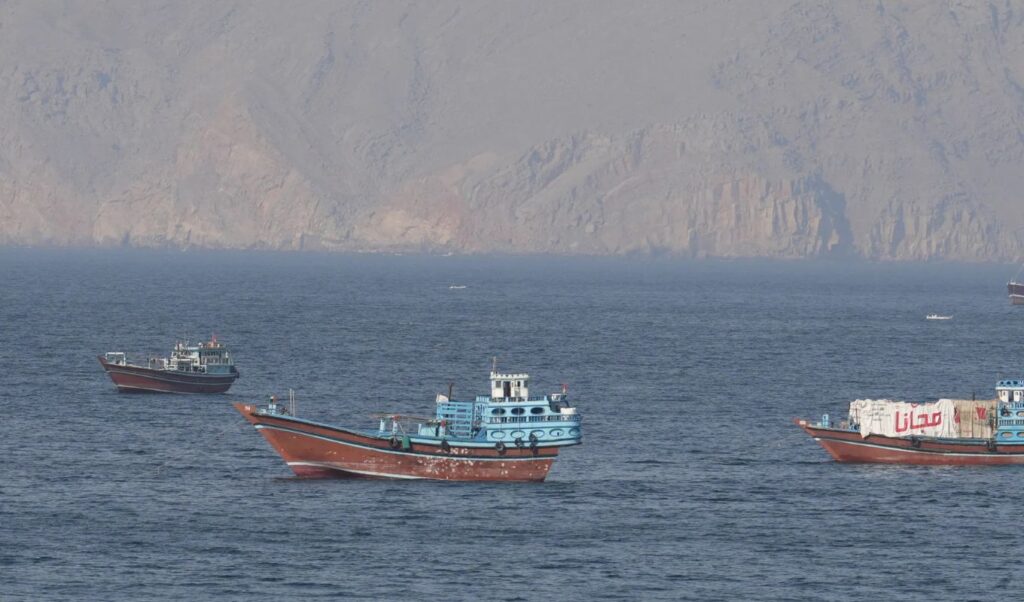
The Iranian parliament is reviewing the initial draft of an agreement reached with Oman regarding the transit regime through the Strait of Hormuz. According to state broadcaster IRIB, the draft bill under consideration would ban passage through the strategically vital waterway for “ships from hostile countries.” As IRIB reports, states and individuals that “have caused harm to Iran” would be barred from receiving transit authorization through the Strait of Hormuz until the required compensation has been paid, as stipulated in the draft legislation.
The bill also provides for fines of up to 20% of a vessel’s cargo value in cases of violations of the proposed restrictions. According to the same sources, the sanctions included in the draft legislation are expected to target primarily vessels with American and Israeli interests.
An Iranian lawmaker stated that the bill is still under review by specialists, and that parliament has invited experts to submit their proposals and observations before the final text is approved.
Agreement with Oman reached, but does not automatically guarantee safe passage
It is worth noting that Iranian Foreign Ministry spokesperson Esmail Baghaei announced on Wednesday that an agreement had been reached with Oman on the geographic coordinates in the Strait of Hormuz. Baghaei stated that the two countries are in the final stages of preparing a joint statement on the agreement, provided that “certain third parties” do not interfere in the process.
He also noted that the agreement does not automatically guarantee safe passage, warning that US military action in the region could undermine security in the strait.
In comments shared on the Iranian Foreign Ministry’s Telegram channel, Baghaei remarked that many of the factors contributing to insecurity in the Strait of Hormuz remain in place, citing the US naval blockade of Iran and other “aggressive and threatening actions against Iran and its interests.”
Part of the new route will pass through Iranian territorial waters under the Oman agreement
Kazem Gharibabadi, Iran’s Deputy Foreign Minister for Legal and International Affairs, stated that his country is working on a “new model” for managing traffic through the Strait of Hormuz as part of an agreement with Oman.
According to the proposed plan:
- Large sections of the designated maritime route will pass through Iranian territorial waters, while certain sections will pass through Omani territorial waters.
- The existing temporary routes — including a northern route near Iran’s Larak Island and a southern route through Omani waters — will be closed.
- The new Hormuz route will be used for a period of two to four months, or possibly longer.
Gharibabadi also emphasized that Iran continues to distrust the United States, accusing Washington of repeatedly violating its commitments. He stated that a US return to its obligations under the memorandum of understanding signed with Iran in mid-June would be a necessary — but not sufficient — condition for reopening the Strait of Hormuz, in comments carried by Iran’s official news agency IRNA.
He further noted that the US “violation of promises and commitments” must ultimately be “resolved.”