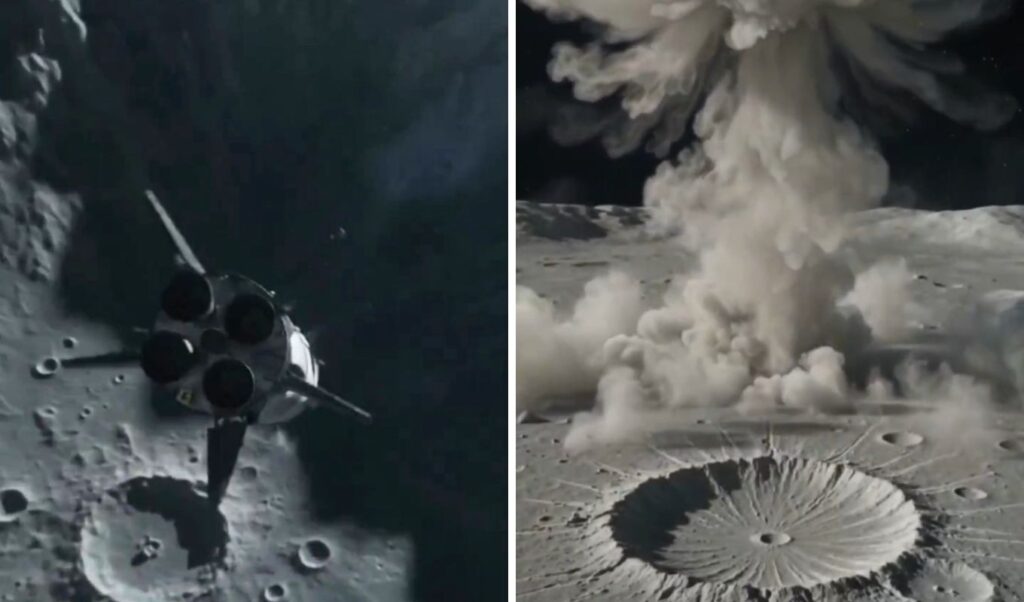
An inactive SpaceX rocket stage is expected to crash into the Moon in the early hours of Wednesday (August 5), in a rare space event that is set to provide scientists with valuable data on the effects of high-speed impacts on the lunar surface. The rocket stage, which has remained in orbit since a SpaceX mission in 2025, will collide with the Moon at a speed of approximately 8,700 kilometers per hour. The energy of the impact is estimated to be equivalent to roughly three tons of TNT, and is expected to carve out a brand-new crater. The collision is anticipated to occur near the Einstein crater, on the western limb of the Moon, with scientists closely monitoring the event to study the behavior of the lunar soil in real time.
Read also: SpaceX rocket launch in Texas aborted at the last moment — several engines failed to ignite
SpaceX: Impact expected to create a crater roughly 27 meters wide
The impact will take place near the Einstein crater, on the far western edge of Earth’s natural satellite. The collision is expected to produce a crater approximately 27 meters in diameter and around five meters deep, while large quantities of dust and debris will be blasted from the surface. The resulting cloud will not dissipate quickly, as the Moon has no atmosphere and its gravitational pull is far weaker than Earth’s. Scientists estimate that the dust will remain visible in the area for several tens of minutes, allowing for detailed observations. The flash generated by the impact will not be visible to the naked eye, but it will be captured by both ground-based and space-based telescopes. The data collected is expected to yield valuable insights into the composition and structure of the Moon’s subsurface.
NASA’s Lunar Reconnaissance Orbiter and South Korea’s Danuri spacecraft — both already in lunar orbit — will play a key role in recording the event. Danuri is set to pass directly over the impact site just two minutes before the collision, and both spacecraft will photograph the area before and after the event.
SpaceX Rocket Accidentally Crashes Into the Moon. pic.twitter.com/QQRKB0OtLW
— Stellarix (@Stellarixorine) August 1, 2026
The particular rocket stage had been used in January 2025 to transport two lunar landers and scientific equipment. It was never intended to end up on the lunar surface, but it remained in an uncontrolled orbit, with no possibility of preventing the eventual collision.
This marks only the second known instance of an inactive rocket stage accidentally striking the Moon. In 2022, a component from a Chinese spacecraft created two craters on the Moon’s far side — an event that similarly captured significant attention from the scientific community.
While meteorites strike the Moon on a regular basis, this particular impact is of special scientific interest because the precise time and location of the collision are known in advance — making it the first event of its kind to allow such extensive and coordinated scientific observation.