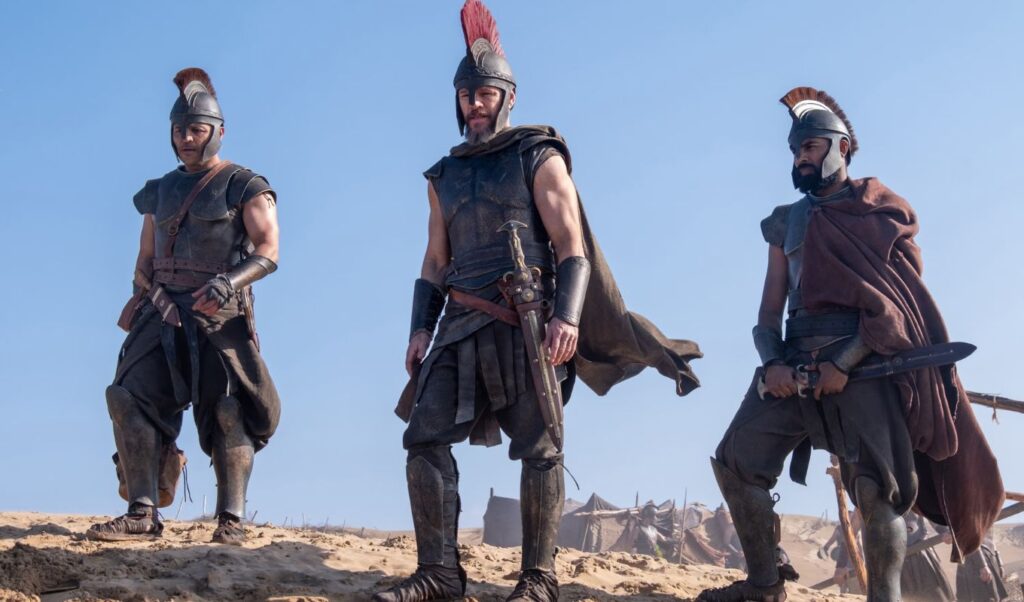
Emily Wilson, chair of the classical studies department at the University of Pennsylvania — best known for her landmark 2017 English translation of Homer’s epic — has leveled sharp criticism at Christopher Nolan’s new film The Odyssey. Wilson’s translation was notably cited by Nolan himself in the early promotional campaigns for the highly anticipated adaptation, yet the acclaimed academic has emerged as one of the film’s harshest critics. In an essay for the London Review of Books, Wilson argued that the film “has nothing convincing to say” and lacks “psychological, emotional, political, and moral depth.”
Read also: Nolan’s “Odyssey” is inspiring thousands of Britons to learn Greek — searches for language courses surge
In her scathing essay for the London Review of Books, Wilson writes: “I had hoped that Nolan’s affinity with these Homeric themes would push him to new creative heights and allow him to create more believable characters. But The Odyssey delivers the usual combination of grandeur and superficiality… The film’s vision is too muddled, its characters too underdeveloped, to fulfill what it partly promised in terms of big ideas — although it is very good at delivering big explosions and giants.”
Classicist Emily Wilson has written that Christopher Nolan's adaptation of The Odyssey is "abysmal."
Wilson's translation of the epic was the inspiration for Nolan's adaptation.
Follow: @europa pic.twitter.com/drSqrhlpb2
— Europa.com (@europa) July 27, 2026
“The Odyssey”: “It lacks many of the elements that make the poem great,” says professor on Nolan’s film
“Nolan’s Odyssey lacks many of the elements that make the poem great,” Wilson emphasizes. “It has nothing convincing to say about time, memory, history, war, or about the relationship between a warrior’s glorious homecoming and the lives of his family, rivals, companions, friends, and neighbors. It lacks psychological, emotional, political, and moral depth. Its narrative structure is contrived. The writing is unacceptable. None of the characters have convincing motivations for their actions or words. There are no sex scenes, and all the food looks disgusting.”
Wilson also noted Nolan’s own admiration for the opening line of her translation of the Odyssey — “Tell me about a complicated man” — yet stressed that she “would be ashamed to have written any part of this screenplay.”
Wilson also attacked Nolan’s film in an interview with the Sunday Times, noting: “It didn’t move me emotionally at all. Which I think is partly because, unlike Homer, it’s not very well written. The characters don’t have the depth that Homeric characters have. I thought: ‘Do I really care whether this guy gets back to his wife?’ You haven’t given me any reason to care.”
“It remains an event worth celebrating”
Despite her criticism, Wilson acknowledged the impact the film has already had on cultural awareness of ancient Greek literature and on cinema itself. Stating that “the release of The Odyssey remains an event worth celebrating,” she suggests: “This epic is bringing audiences back to theaters… translations of the Odyssey, including my own, are immediately selling out… [and] perhaps the film will convince some university administrators not to abolish literature, languages, and history departments. Nolan is doing what he can to re-engage the general public with reading, and I am grateful to him for that,” she added.