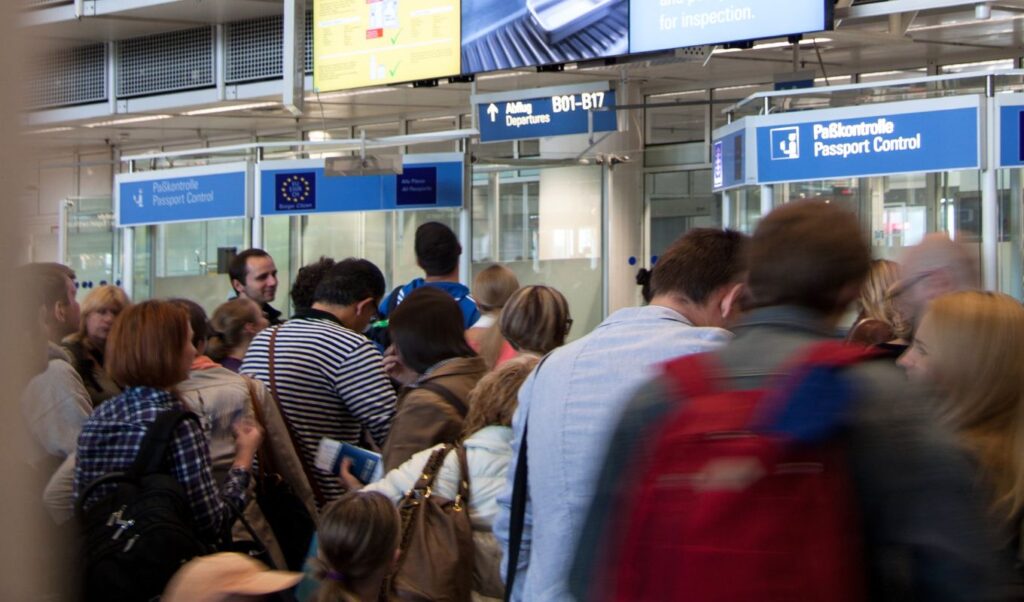
Long queues and significant delays are being caused by the new automated border control system (EES) at airports across Europe, with the European Commission acknowledging that serious problems with its implementation persist. A striking example is Brussels, where delays during peak hours are reaching up to 5 hours due to border services being unable to process travelers quickly enough.
Airports: How the new automated border control system works
As a reminder, the EES (Entry/Exit System) is the EU’s new digital border control system. The new system registers non-European travelers as they enter and exit the Schengen Area, replacing the traditional manual passport stamp. It collects and stores data such as personal details, travel information, and biometric data.
Emergency measures and Frontex support under consideration
Addressing the issue, European Commission spokesperson Markus Lammert announced today that a meeting will be convened on Tuesday (07/07) with the aviation industry, as the problem is intensifying ahead of the summer season. He stated that “we have an enormous number of travelers and registrations — more than 2 million per week.” The Commission is continuously supporting member states in addressing these challenges, and that support will continue in full.
He further noted that many of the difficulties being observed at certain airports are not related to the system itself, “but to structural challenges that existed before,” explaining that they concern infrastructure and technical capacity. To address the situation, he emphasized, Frontex will also be deployed to provide assistance, with personnel stationed at the busiest airports, as well as to help with the rollout of a newly developed pre-registration app available to all member states — one that effectively streamlines the entire process.