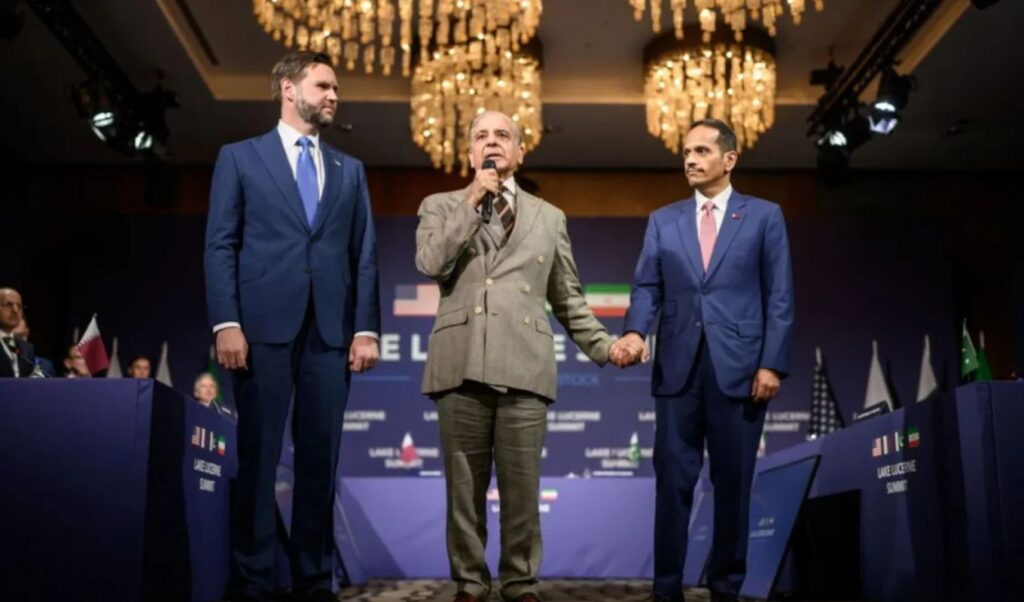
The United States is emerging as the losing side from the Middle East crisis and its conflict with Iran, according to Antonis Klапsis, Associate Professor of Modern History and International Politics at the Department of Political Science and International Relations at the University of the Peloponnese. Speaking in the aftermath of the Switzerland talks on Parapolitika 90.1’s morning show “Prôto Proïno” with Alexandros Klôssas, he offered a comprehensive assessment of the ongoing negotiations.
He also noted that Iran will hold firm to the end on the issue of the Strait of Hormuz, emphasizing that either way, Tehran is coming out ahead in this standoff. He also commented on Donald Trump, characteristically stating that “business and diplomacy are two very different things.”
Excerpts from Antonis Klапsis’s analysis of the US-Iran negotiations on Parapolitika 90.1
Speaking first about the nuclear program and whether Iran would or would not acquire a nuclear weapon, he stressed that this is something they had already stated previously — that they would not develop nuclear weapons — which is distinct from the nuclear program in general. “So I don’t think the Americans are going to get much more than what they already had back in 2015, before Mr. Trump scrapped the previous agreement.”
“The question is, based on our experience from previous negotiations, this is not something easy, not something fast, not something that happens overnight. It requires persistence, it requires time. But there are factors here that suggest there isn’t much persistence — or rather, much patience — to let things move at their own pace. At the very moment Vance was speaking yesterday, for example, about the significance of this meeting, Trump was saying ‘we’ll bomb you again.’ After all, everything Mr. Trump has said since the beginning of this war… he has said everything and its opposite. He is an inherently contradictory person — even more so when it comes to matters of international politics.”
“I don’t think all of this reflects a strategy — it’s more a reflection of his current state of mind. That is, how he perceives things at any given moment, or reacts in a manner I’d call instinctive. Mr. Trump is not a chess player. He’s more like someone who day-trades stocks on the market. That’s what he knows and what he does best. He even said it himself — that a good businessman can do everything better than anyone else.”
“The difference is that business and diplomacy are two very different things. They are not the same. Yes, there is a concept of negotiation in both, but the terms are not the same, the desired outcomes are not the same, and the consequences are not the same.”
“Right now, he is conducting diplomacy based on a business model. Even the people he sends to negotiate are his personal representatives — not diplomats. He is practicing personal diplomacy, entirely bypassing the bureaucracy of the State Department — the people who carry the institutional memory of American foreign policy and who possess not only experience but genuine expertise. That’s why professional diplomats exist. Otherwise, no country would need a diplomatic service — you’d just have a leader who changes from time to time, a foreign minister, and that would be enough. The value of having technocratic advisors on these matters is that they can take the long view, with greater composure and fewer political constraints, and try to assess things more objectively.”
KLOSSAS: Where is the ceiling of these negotiations — what exactly are they actually discussing at the table?
“I think they are discussing the elaboration of a preliminary agreement, within terms that are fairly clear. There are essentially three major issues. The first, which we already mentioned, is Iran’s nuclear program. The second is the ballistic missile program, which is closely related to the first. And the third, I would say, is the Strait of Hormuz — which emerged as a problem after the American military intervention and therefore represents a new negotiating card that Iran has acquired along the way. I believe Iran will hold firm on all of this until the very end. It will hold firm because certain issues are, for Iran, a matter of life and death. The nuclear program is both a question of internal legitimacy and a card to play in future international negotiations. And on the Strait of Hormuz, Tehran will hold firm, because this is something it gained in the course of events and has no intention of giving up.”
“This means that after 60 days, things may not look exactly the same. Meaning Iran may seek to impose some kind of toll. It will probably not succeed outright — but it will present the supposed concession of that demand as a card to be exchanged for something else. So once again, it will come out ahead in this story. And at the level of global relations — because a discussion has already begun about what is happening with NATO — we can see that interstate relations have become somewhat interpersonal. That is to say, it’s about how Donald Trump gets along with each individual leader or what they say to each other. The world has changed — the balance of power has shifted significantly — very quickly in recent times.”
“Mr. Trump is a catalyst for developments. There’s no doubt about that. There were forces that were already pushing toward change anyway — the international system always changes. But his own behavior is what shapes and defines the character of this change. Take everything that happened with Ms. Meloni — it’s unprecedented. It has no precedent and it’s not… wonderful that it’s happening this way. So the personal element here carries enormous weight. Because, as we said earlier, for better or worse — worse in my opinion — Mr. Trump is practicing an entirely personal style of diplomacy that breaks from all established norms.”
“For those who don’t know, Ms. Meloni posted something on social media like an announcement, saying that Italy does not beg — and neither does she herself. Because Donald Trump had made his classic comments — ‘she was begging me to take a photo together’ and eventually we took one,” it was recalled, with Mr. Klápsis noting that all of this has created tension with, theoretically, an American ally — Ms. Meloni. A traditional ally, like Italy. Italy is a founding member of NATO. And moreover, Ms. Meloni was the European leader most closely aligned with Mr. Trump. From the very first moment, he is isolating himself even from people who had a positive disposition toward him, who had expressed that through real investment, and who had open channels of communication with him. So this is not a rational choice, let’s put it that way. It’s more of an instinctive scene in that moment — wanting to show how great he is and that everyone else needs him.”
“Even if we accept that Ms. Meloni asked for the photo — that is something a normal leader simply does not say. Does not announce. There is nothing to gain from it.”
“Donald Trump operates in a way that defies convention, and we shouldn’t analyze him in terms of cost, benefit, interest, or loss — but rather in psychological terms. I think that is his primary motivation. Can the world adapt to an unpredictable world leader, given that crises are multiplying on all fronts and Europe, for example, is not at its best? It’s not in a phase where it has no problems of its own to deal with.”
“The European Union faces an existential question: whether it can evolve into a real player in the international system, or whether it will remain a kind of rhetorical club where member states come together, exchange views, talk, negotiate, let days and weeks pass, and by the time they are ready to make a decision, the crisis will have changed, the environment will have shifted, and they will simply be watching events unfold as spectators. In this deregulated world, Mr. Trump’s policy — as it is being practiced — not only does not help the situation, but makes it even worse. The problem already exists; he highlights it and exacerbates it further. The United States actually faces a far deeper threat. That threat is not Iran, nor Russia — it is China, which is advancing at a rapid pace to replace the United States across many domains of international relations. I think they are squandering their resources left and right without thinking it through carefully. They are isolating themselves from allies. And ultimately, what American foreign policy is revealing — this deregulation of US foreign policy — I believe signals not only the internal deregulation of the United States itself, but also the broader retreat of the West in the global distribution of power. And that is perhaps the most alarming development — for us in Europe, and especially for Greece.”
KLOSSAS: Closing, obviously as long as Trump is around, this is just one episode among the many we’re going to see ahead, the way things are going. Because I’ve been reading the first previews of the book you’re preparing to release tomorrow. I remember well that he himself feels more powerful than Attila, Genghis Khan, Napoleon, and various other leaders of that kind. Are we entering a phase where the entire world will be remeasured, where we’ll be searching for our balance again?
“We have already entered such a phase. And the balance of power has fundamentally shifted for quite some time now. What Mr. Trump is doing is accelerating the timeline. However, it’s not easy for a single person to do that alone. We are seeing, for example, a shift in demographic power in a manner that is cumulative. In 1900, the populations of Europe and Africa were roughly equal. By the late 20th century, the population of Africa had grown to be approximately 20 to 30% larger, and the gap keeps widening. That alone creates pressure on the international system. We see similar phenomena in India, China, and so on. But it’s not just the policy of one man. These are the deeper forces that drive history. And instead of this man — who holds the greatest power in the world — trying to manage them somehow, he appears to be unleashing them. Trump is acting somewhat like an accelerant. Whether he is opening Pandora’s box even more intensely, even more widely — that remains to be seen.”