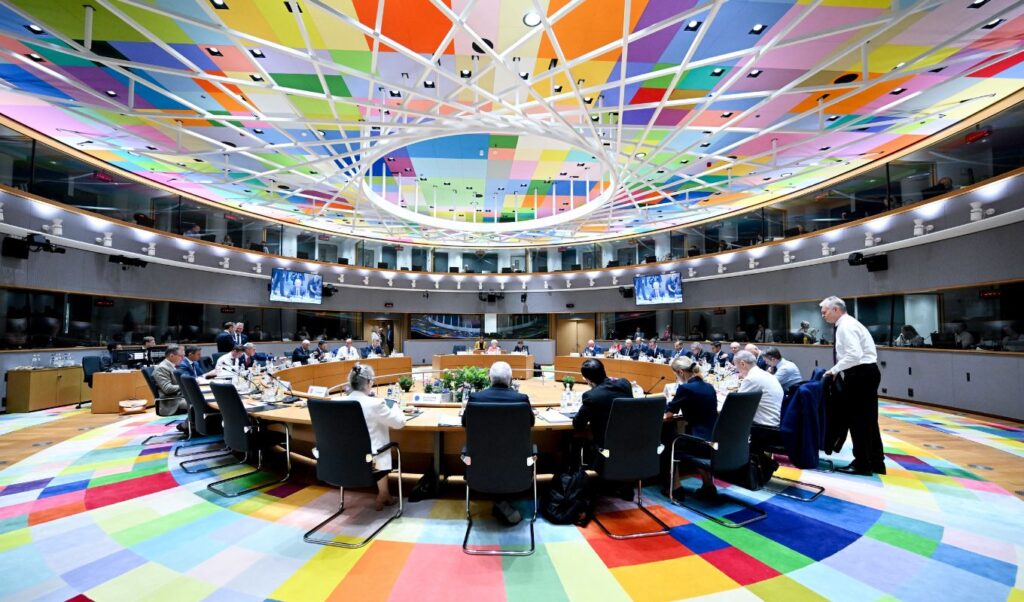
A full-blown internal war appears to have erupted in Brussels, as a recent late-night EU summit turned into a fierce battleground. According to a Politico report, the unprecedented clash involves French President Emmanuel Macron and German Chancellor Friedrich Merz, both of whom openly attacked the EU’s strategic approach toward Vladimir Putin.
Read also: G7: Macron’s behind-the-scenes moves that brought Trump closer to Ukraine (Images & Video)
Macron and Merz oppose direct contacts with Moscow
The source of the tension was the secret diplomatic contacts made by European Council President António Costa with Moscow. According to diplomatic sources, Costa’s office reached out to Russian officials on two separate occasions in recent weeks. The revelation triggered outrage among numerous leaders, many of whom only learned of the back-channel communications through the media.
The incident also drew a sharp response from the Estonian Prime Minister, who stated bluntly: “The European Union cannot take on the role of mediator in these negotiations.” He added: “Suggestions that alternative channels or covert diplomatic back-channels are needed are misguided… History offers a clear warning about attempts to pursue alternative negotiating frameworks with dictators,” said Kristen Michal.
Two rival camps emerge at the late-night EU summit
A two-hour extension of the closed-door session — during which even mobile phones were banned — exposed two opposing camps. On one side, France and Germany made clear that now is not the right time for talks with Vladimir Putin. Their position is unambiguous: when the moment comes, the reins must be held by the powerful “E3” trio (France, Germany, and the United Kingdom). On the other side, a large group of countries backed Costa, arguing that the EU must have an institutional role in any negotiations.
Costa’s conduct branded “highly unprofessional”
“The first question is whether Putin wants to negotiate at all. Until then… no one other than Costa can represent the European Union,” stressed Belgian Prime Minister Bart De Wever, adding: “If he shows a willingness to negotiate, then I believe we will need to decide again how to move forward.”
According to the report, the diplomatic thriller deepens as Italy and Poland feel sidelined by the E3 trio’s proceedings. Meanwhile, a diplomat from a major European country described Costa’s conduct as “highly unprofessional” for concealing his contacts with Russia.
For his part, Costa’s circle hit back, insisting that the calls “had the simple objective of establishing a communication channel so that, when the time comes, a diplomatic line with Russia exists to defend EU interests.” His team also clarified that the outreach took place at the request of President Zelensky, according to Politico.
Anxiety across Europe is reaching a peak as Donald Trump once again turns his attention to Ukraine, with the defining question still unanswered: who will ultimately speak on Europe’s behalf?