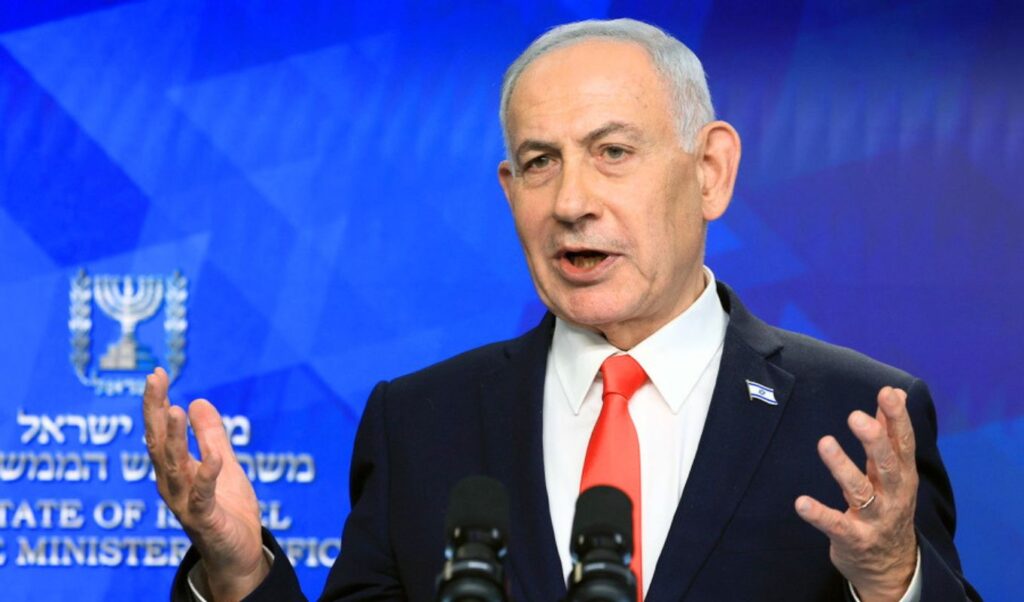
Israeli Prime Minister Benjamin Netanyahu is planning to leverage pro-Israel US senators and conservative commentators to influence the terms of a final agreement between the United States and Iran, according to a CNN report citing a source familiar with the matter. The leading American network reports that Netanyahu believes a definitive deal between the two countries is now highly likely — but expects Tehran to fall short of fully complying with the agreed terms.
Netanyahu’s plan
According to the same source, Netanyahu intends to use a network of political allies and commentators in the United States to relay his concerns directly to President Donald Trump. Among those reportedly involved is Fox News host Mark Levin, as well as a number of pro-Israel senators.
The apparent goal is to apply pressure during ongoing negotiations so that any final agreement includes stricter terms regarding Iran’s nuclear program. CNN noted that it reached out to the Israeli Prime Minister’s office for comment but received no response.
An “offensive” against the Trump administration
Meanwhile, media outlets aligned with Netanyahu — most of which had previously been strong supporters of Trump — have begun openly attacking Trump and his team. During a prime-time broadcast on Channel 14, a presenter close to Netanyahu called Vice President Vance a “scumbag” and used an antisemitic slur to accuse Trump’s envoys Steve Witkoff and Jared Kushner of selling out Israel for financial gain.
The full text of the agreement
The United States of America and the Islamic Republic of Iran have agreed, according to a draft Memorandum of Understanding (MOU), on a 14-point framework aimed at ending the conflict, restoring economic relations, and establishing a new regional security architecture.
In the first article, both countries — along with their respective allies in the current conflict — declare an immediate and permanent cessation of military operations on all fronts, including Lebanon. They also commit to refraining from initiating future wars or military operations against one another, to abstaining from threats or use of force, and to upholding Lebanon’s territorial integrity and sovereignty. The final agreement will permanently codify these provisions.
The second article calls for mutual respect for the sovereignty and territorial integrity of both states, as well as a commitment to non-interference in each other’s internal affairs.
In the third article, both sides undertake to negotiate and finalize a comprehensive agreement within 60 days, with any extension permitted only by mutual consent.
The fourth article stipulates that immediately upon signing the MOU, the United States will begin a phased lifting of the naval blockade and all other restrictions against Iran, with full removal within 30 days. During this period, maritime traffic is to gradually return to pre-war levels. Additionally, the US commits to withdrawing its forces from the proximity of the Islamic Republic of Iran within 30 days of the final agreement being reached.
According to the fifth article, Iran will make every effort to ensure the safe and fee-free passage of commercial vessels between the Persian Gulf and the Sea of Oman for a period of 60 days. Commercial shipping is to resume immediately, with full restoration completed within 30 days, taking into account the need for demining and the removal of technical and military obstacles. Tehran will also initiate dialogue with Oman and other Gulf coastal states regarding a future governance and maritime services framework for the Strait of Hormuz, in accordance with international law.
The sixth article provides that the United States, in cooperation with regional partners, will develop a financing plan of at least $300 billion for the reconstruction and economic development of Iran. The implementation mechanism will be finalized within the framework of the final agreement within 60 days, and the American side commits to issuing all necessary licenses and approvals for the relevant financial transactions.
In the seventh article, the United States undertakes to lift all forms of sanctions against the Islamic Republic of Iran. This commitment encompasses UN Security Council resolutions, decisions of the Board of Governors of the International Atomic Energy Agency, and all unilateral primary and secondary US sanctions. The implementation timeline will be determined within the final agreement.
The eighth article addresses Iran’s nuclear program. Tehran reaffirms that it will not acquire or develop nuclear weapons. Both countries also agree to jointly determine how to manage stockpiles of enriched nuclear material, with on-site dilution under IAEA supervision established as the minimum method. The two sides will further discuss uranium enrichment and other issues related to Iran’s civilian nuclear needs within an acceptable framework to be defined in the final agreement.
The ninth article provides that until the final agreement is concluded, both countries will maintain the current status quo. Iran will preserve its existing nuclear program at current levels, while the United States will neither impose new sanctions nor deploy additional military forces to the region.
According to the tenth article, immediately upon signing the MOU and until the sanctions-lifting process is complete, the US Treasury Department will issue waivers allowing the export of Iranian crude oil, petroleum products and their derivatives, as well as all related services, including banking transactions, insurance, and shipping.
The eleventh article provides that the United States will make Iran’s frozen or restricted funds and assets available for use immediately upon the MOU entering into force. The procedures for releasing these funds will be agreed upon during negotiations. The amounts will be fully accessible to the final beneficiaries designated by the Central Bank of Iran, and the American side commits to issuing all necessary licenses and approvals.
The twelfth article provides for the creation of an executive mechanism to monitor the implementation of the MOU and both parties’ compliance with the final agreement.
According to the thirteenth article, negotiations on the final agreement will commence after the MOU is signed and on the condition that implementation has begun on the articles concerning the cessation of hostilities, the lifting of the naval blockade, the functioning of the Strait of Hormuz, oil exports, and the release of Iranian funds.
Finally, the fourteenth article provides that the final agreement will be ratified through a binding UN Security Council resolution, conferring upon it full international legal force.