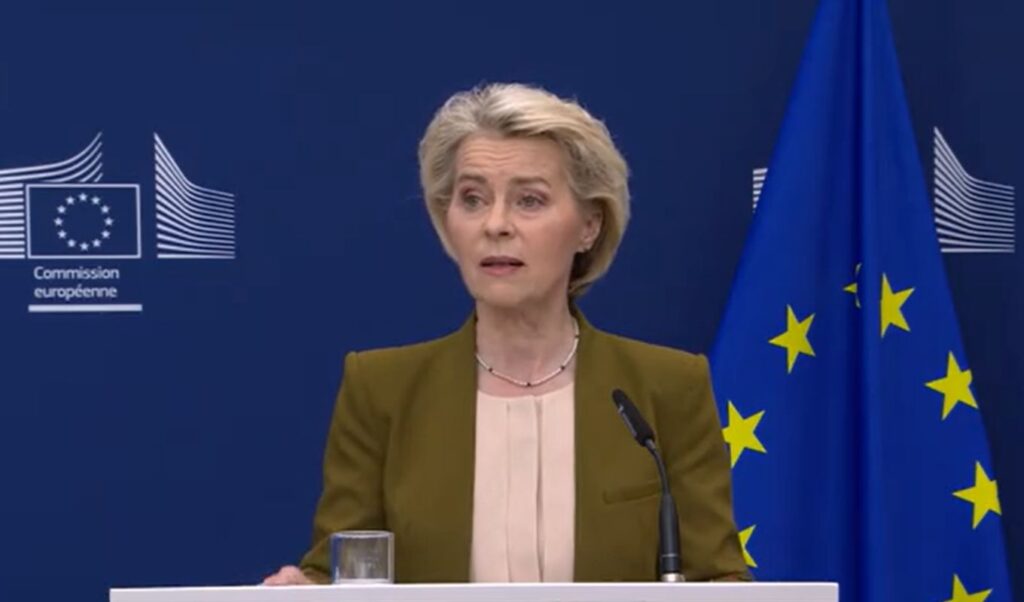
Europe continues to support Ukraine with loans and successive sanctions against Russia, and through Ursula von der Leyen, the European Commission has presented the restrictive measures it wants included in the 21st package. According to the head of the institution, there are three sectors on which it focuses to ensure the sanctions are not only effective but also disruptive to Russia. Europe, moreover, approved about a month ago – in a process that even revealed espionage by a Hungarian government minister – 90 billion euros as aid to Ukraine. This, of course, is considered an investment that needs to be maintained. Ursula von der Leyen presented the focus of the restrictive measures in three sectors: energy, financial services, and trade. Additionally, there is the fishing component, which the European Commission is dealing with punitively for the first time.
Read: Ursula von der Leyen: serious accusations against Moscow for destabilizing European democracies
Ursula von der Leyen: the energy sector
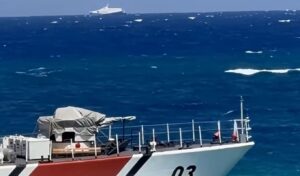
The Commission proposes, in the energy sector, the suspension of automatic price cap adjustments for Russian oil, citing disruptions in international energy markets due to the Middle East crisis and problems in global supply chains, at least until January 2027. This way, as its President von der Leyen stated, markets will stabilize and pressure on Russian revenues will be maintained. Additionally, it calls for sanctions on an additional 30 vessels of the so-called “shadow fleet” used to transport Russian oil, bringing the total number of targeted vessels to over 660. Indeed, the proposal includes vessels indirectly participating in the war, such as those providing fuel supplies. Measures are sought against ports, airports and refineries involved in the handling or processing of Russian oil, as well as restrictions on the sale of liquefied natural gas (LNG) tankers to Russia.
Trade measures
In the financial field, the European Commission recommends extending transaction restrictions to an additional 31 Russian banks, as well as to 20 banks, cryptocurrency companies, platforms and oil traders from third countries that, according to Brussels, facilitate Russia’s circumvention of Western sanctions. For the first time, the possibility of imposing a complete ban on cryptocurrency services from third-country entities is also provided, with the Commission estimating that the measure will act as a deterrent against platforms that facilitate Russian access to the international financial system.
In the trade sector, new restrictions are proposed on exports of technologies and materials used by the Russian defense industry, including metals and alloys for aerospace and defense production. Specifically for unmanned aircraft (drones), export bans are planned for ground support equipment, jamming systems and launch systems. At the same time, the Commission proposes new import bans on products worth a total of approximately 60 million euros, including certain metals, ores and car parts, aimed at further decoupling the European market from Russian imports.
Our sanctions are working.
They are weakening the economic foundations of Russia’s war effort.
Today we double down.
With a 21st package.
Covering energy, banks & crypto, trade including fisheries and visa for Russian soldiers ↓ https://t.co/fTIkATOSfN
— Ursula von der Leyen (@vonderleyen) June 9, 2026
Fishing restrictions
Particular emphasis is placed on the fishing sector for the first time. The proposal provides for significant restrictions on imports of certain fishing products and complete bans on others. Finally, von der Leyen announced that the Commission proposes banning entry to the EU for individuals who have served in the Russian armed forces since the start of the invasion of Ukraine. “Europe must remain closed to those who participated in the invasion of Ukraine,” she stated characteristically.
Ursula von der Leyen argued that “the consequences of the sanctions packages are bringing results” and EU sanctions continue to hit the Russian economy. As she noted, the cost of war for Russia is increasing daily and mainly burdens the Russian population, which “mourns losses” and faces deteriorating living standards, with inflation near 6% and interest rates at 14.5%. According to her, the sanctions “have essentially cut Russia off from international capital markets,” economic growth is slowing, fiscal margins are narrowing and energy revenues have decreased significantly.
The Commission President also emphasized the escalation of Russian attacks on Ukraine, as well as violations of European airspace, referring to drones that have entered Baltic regions and along the EU’s eastern borders. She also mentioned recent incidents, including a drone crash into a residential apartment building in Romania and an explosion at the port of Constanta. “Some call it Russian escalation. I see it differently. It’s simply failure,” she said characteristically, adding that, four years after the start of the full-scale invasion, “Russia has clearly failed to subjugate Ukraine.”
Nine billion by month’s end
Ursula von der Leyen referred to the EU’s continued support for Ukraine, which she characterized as a “brave neighbor, partner and future EU member.” As she stated on Monday, June 8, the EU allocated nearly 3 billion euros from the Ukraine Mechanism, while the first disbursement from the 90 billion euro loan to Kyiv is expected within June. In total, by the end of the month, the EU will have provided 6 billion euros for drones and over 3 billion euros in macroeconomic financial support, with new disbursements to follow in the coming period.
The Commission President finally announced that in the coming days the EU will open the first negotiating chapter with Ukraine and Moldova, marking the beginning of the next phase of their accession process. She emphasized that Ukraine is making “exceptional progress” in reforms and prerequisites and “now it’s time for us to respond too,” noting that “the Commission is fully ready to support Ukraine on its path to the EU, where it belongs.”