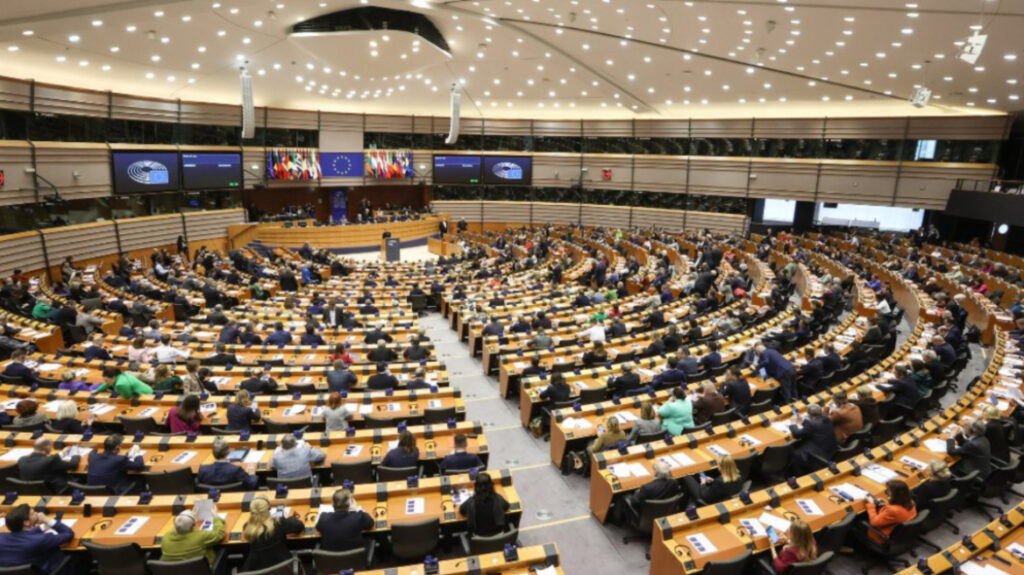
A new crash test for the European Parliament regarding the 2028-2034 budget, with the top European institution endorsing an ultimatum for an additional €200 billion. It should be noted that on April 28, the European Parliament had officially approved its position on the EU budget, the Multiannual Financial Framework (MFF), with 370 votes in favor, 201 against, and 84 abstentions. The MEPs had requested a 10% increase compared to the original proposal from the European Commission.
The European Parliament’s goal remains to distribute resources equally across the three main categories: cohesion and agriculture, competitiveness, and external action. At the same time, MEPs support the Commission’s plan for a “basket” of different revenue sources, but also demand additional sources, such as a digital services tax.
The critical moment is approaching and the hourglass for revealing the budget’s winners is running out. On May 18, the European Parliament endorses an ultimatum for an additional €200 billion in the 2028-2034 budget.
European Parliament: Budget points that trigger EU conflict
This specific demand triggers intense conflict between the European Parliament and the Commission’s strict spending ceiling, which has set a maximum cap at 1.26% of Gross National Income (GNI). This limit restricts the EU’s total public spending as a percentage of European income. Net contributor countries, such as Germany and the Netherlands, argue that this level is already excessively high.
The European Commission proposes financing new priorities, such as defense and artificial intelligence, through redistribution of existing funds. In contrast, Parliament insists that these new needs should not come at the expense of agriculture or regional policy. After a vote (370 in favor versus 201 against), MEPs demand a 10% budget increase to 1.27% of GNI, excluding the cost of pandemic debt repayment, which they believe should be calculated separately to avoid “suffocating” future development.
If the majority of MEPs reject the current direction of the proposal, there is a possibility of effectively “freezing” the overall plan worth approximately €2 trillion, which could delay the start of the new funding cycle in 2028.
The Multiannual Financial Framework determines the total funds allocated to EU individual policies. It finances programs affecting all European citizens, such as research, climate, agriculture, culture, defense, and environment.
EU Treaties form the basis of the budgetary process, determining how the budget is designed, negotiated, and approved, with transparency as the goal.
Unlike national states, the EU does not impose direct taxes on citizens and businesses, but is funded through so-called “own resources.” These include contributions based on GNI, VAT, customs duties, and revenues from non-recycled plastic waste. To cover increased needs, the Commission has proposed new revenues estimated at €58.2 billion annually from 2028.
The proposed budget for 2028–2034 amounts to approximately €1.816 trillion (current prices) and is presented by the Commission as “bigger, smarter, and more targeted.” It provides for reducing individual programs from 52 to 16, aiming to simplify and better target European priorities.
Parliament supports simplification but opposes weakening regional and local governance.
The “winners” of the new budget
The new proposal places greater emphasis on defense and the EU’s industrial power. The first pillar of the budget allocates approximately €409 billion to national and regional schemes, merging policies such as cohesion and CAP into a unified framework.
The second pillar includes €409 billion for competitiveness and research, emphasizing energy autonomy and green transition. Meanwhile, defense is significantly strengthened, with funds increasing up to ten times for military mobility and rapid force deployment.
Significant increases are also planned for artificial intelligence and innovation, with approximately €200 billion for research and development, including through the “AI Factories” initiative.
The third pillar concerns EU external action, with €200 billion for diplomacy, enlargement, migration, and support for Ukraine.
The discussion about budget allocation has created intense disagreements among member states. Eastern European countries demand strong funding for cohesion and security, while “frugal” countries like Germany, the Netherlands, Sweden, and Austria seek spending limits close to 1.1% of GNI.
At the same time, Southern countries and smaller states fear that fund merging will weaken the role of local authorities.
MEPs also support creating new revenue sources, such as taxes on large corporations, tobacco, digital services, and cryptocurrencies, to strengthen the EU’s financial autonomy.