Washington is closely monitoring developments in the Middle East as tensions with Tehran remain heightened and diplomatic balances continue to be fragile. Donald Trump appeared determined to intensify pressure on Iran, while simultaneously leaving open the possibility of new interventions in the Strait of Hormuz region.
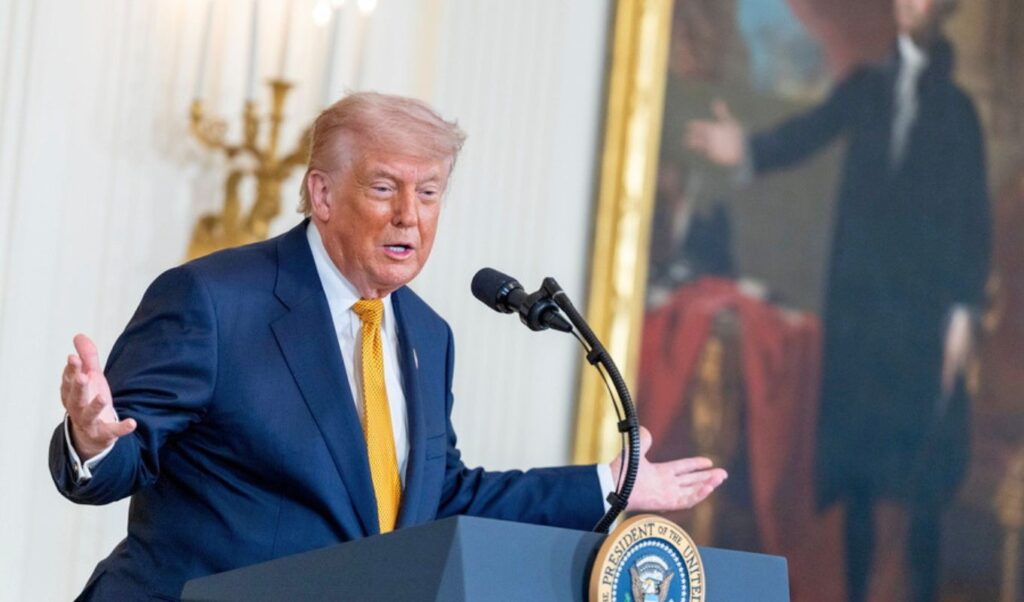
The American president stated on Friday that he expects Tehran’s official response to the latest United States proposal, which aims to de-escalate tensions and end the Middle East crisis. At the same time, he hinted that reactivating “Project Freedom,” a plan designed to secure navigation in the Strait of Hormuz, is being considered.
REPORTER: Do you think Iran is intentionally slow rolling the process?@POTUS: “We’ll find out soon enough.” pic.twitter.com/j1y0L7cijS
— Rapid Response 47 (@RapidResponse47) May 8, 2026
“I’m expecting a letter from Iran tonight, we’ll see how that goes,” Trump told reporters in Washington.
Donald Trump: US reconsidering all options around “Project Freedom” operation
Although talks between the two sides appear to be progressing slowly, Trump made clear that the US is reconsidering all options around “Project Freedom.” This particular mission had been temporarily suspended in recent days, despite being created specifically to protect commercial and military vessels moving through the critical maritime passage of Hormuz.
“I think ‘Project Freedom’ is good, but we have other ways to do it. Maybe we’ll return to the operation if things don’t progress, but it will be something more,” Trump stated as he departed the White House.
.@POTUS on Project Freedom: “We’ll go a different route if everything doesn’t get signed up, buttoned up… We may go back to Project Freedom if things don’t happen — but it’ll be Project Freedom Plus, meaning Project Freedom plus other things.” pic.twitter.com/QpKc78vo6p
— Rapid Response 47 (@RapidResponse47) May 8, 2026
It’s worth noting that while the American side initially appeared determined to continue the operation dynamically, Trump surprisingly announced its temporary suspension last Tuesday. Through a Truth Social post, he claimed “significant progress” had been made in ongoing contacts for a possible agreement that could lead to ending the crisis that has seriously affected navigation in the region.
He also clarified that the operation’s pause would last “for a short period, to determine if the agreement can be completed and signed.”
So far, however, there has been no definitive conclusion to the consultations, with the American government awaiting a new official proposal from the Iranian side. “Only fools don’t respond when they’re shot at,” Rubio said regarding yesterday’s firing at Iranians in Hormuz.
Iran’s response
Iran’s Foreign Ministry spokesperson Esmaeil Baghaei responded with a sharp post to Donald Trump’s warning about Iran’s nuclear program. He sarcastically used a scene from the 1964 anti-war film “Dr. Strangelove,” mocking the American president’s threat.
Shortly after Donald Trump’s warning that time is running out for Iran to respond to the new American proposal, Esmaeil Baghaei characterized as “absurd” Trump’s claim that he prevents a nuclear crisis with strategies like bombing. In his post, Baghaei used an excerpt from Stanley Kubrick’s classic anti-war film “Dr. Strangelove,” commenting on Trump’s statement that if the ceasefire with Iran fails, “it’s just one big glow.”
It is a grotesque absurdity that they claim to seek peace and prevent a nuclear crisis, yet their proposed solution is “one big glow.”
HOWEVER… (just watch 🎬 Stanley Kubrick’s Dr. Strangelove or: How I Learned to Stop Worrying and Love the Bomb, 1964). pic.twitter.com/WKWFLTh2el
— Esmaeil Baqaei (@IRIMFA_SPOX) May 8, 2026
“It is a grotesque absurdity that they claim to seek peace and prevent a nuclear crisis, yet their proposed solution is ‘one big glow.’ HOWEVER… (just watch Stanley Kubrick’s Dr. Strangelove or: How I Learned to Stop Worrying and Love the Bomb, 1964),” states Iran’s Foreign Ministry spokesperson.
Baghaei’s post referencing the 1964 film, which satirizes the nuclear threats of the Cold War, shows the continuing tension in relations between the two countries.
Trump, for his part, has set limiting Iran’s nuclear program as a condition for ending the war with Iran, something Iran repeatedly rejects, maintaining that the program serves exclusively peaceful purposes.