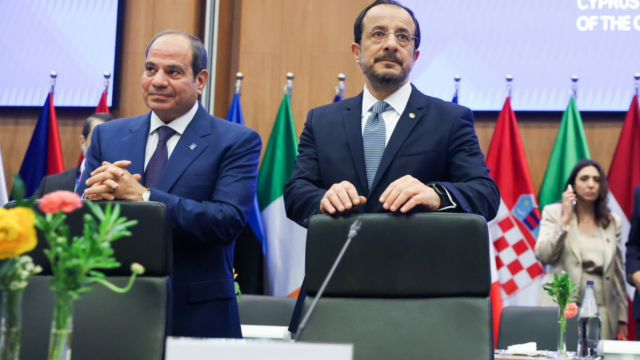
In a move that escalates its aggressive rhetoric and underlines its expansionist ambitions in the Eastern Mediterranean, Turkey is attempting to challenge the strategic cooperation between Cyprus and Egypt. Through an official letter to the UN, Ankara is once again “instrumentalizing” the illegal regime, trying to obstruct the exploitation of the region’s energy resources and impose its own agenda.
Turkey targets Cyprus-Egypt natural gas agreement
Ankara’s target is the Framework Agreement signed on March 30, 2026, on the sidelines of the international “EGYPES 2026” conference in Cairo, between the Republic of Cyprus and Egypt. This agreement provides a clear framework for the development, commercialization and potential export of natural gas discovered in the Cypriot EEZ after years of research and exploratory drilling. Turkey, however, refuses to recognize the sovereign rights of the Republic of Cyprus, using the argument that this agreement violates the “inalienable rights” of Turkish Cypriots, whom it presents as “co-owners” of the natural wealth with rights that exist “ipso facto and ab initio”.
The Turkish side is proceeding with an undisguised blackmail of the international community. The letter cynically states that any exclusion of Turkey from the region’s energy forums is “counterproductive” and will cause further “tensions.” At the same time, Ankara sends warning messages to third countries and international energy giants, emphasizing that their involvement in exploration or exploitation without the “consent” of the Turkish Cypriot people constitutes a violation of legitimate rights. This is a clear attempt to intimidate investors and challenge the delimitations of the Republic of Cyprus.
The extent of Turkish provocation is highlighted by the proposal for an “Eastern Mediterranean Conference,” through which Ankara seeks the political upgrading of the illegal regime as an equal interlocutor with the Republic of Cyprus.
Kostas Yfantis: “Moves that try to adapt international law to something that doesn’t exist”
Professor of International Relations at Panteion University, Kostas Yfantis, argues to parapolitika.gr that Turkey’s maneuvers will not succeed in legitimizing the illegal regime through indirect means. “These are moves that essentially try to adapt international law to something that doesn’t exist. It’s more about recording certain positions rather than Ankara itself being able to hope that something can change. There is already UN Security Council Resolution 186 from the 1960s (from 1964) that recognizes the statehood of the Republic of Cyprus. And it’s not just the Security Council resolution, it’s everything that has followed. The Republic of Cyprus is a UN member state. The Republic of Cyprus is a European Union member state. The Republic of Cyprus is a member of every international organization. So Turkey’s moves are really desperate moves that don’t touch international law at all. They won’t have results. Ankara is trying to open a conversation, but it has no legal or even political possibility. Here it hasn’t managed to convince the Central Asian states, with which it supposedly shares common origin, to recognize the occupied territories, let alone de-recognize the Republic of Cyprus.”
It’s worth noting that Turkey has previously proceeded with illegal delimitations and has issued licenses to the state company TRAO for illegal hydrocarbon exploration even in areas south of the island. Furthermore, the Erdogan government, despite the diplomatic normalization it has achieved with Al-Sisi’s government in Egypt, appears unable to exercise the influence it would like in relation to Cairo’s alliance with Athens. As Mr. Yfantis argues, Turkey doesn’t influence Egypt’s decisions: “Egypt, like every state, has delimited with the Republic of Cyprus, has delimited with Greece. It won’t go further, meaning it won’t delimit in areas where Turkey could legitimately or seemingly legitimately have rights, such as east of Rhodes. But this is a commitment that applies to Greece anyway from Egypt. That is, it cannot do anything without prior consultation.”
This new Turkish intervention at the UN is interpreted as the Turkish government’s pursuit of complete dismantling of Cyprus’s energy program and preventing any agreement that strengthens Nicosia’s role, rather than protecting Turkish Cypriots whom it tries once again to instrumentalize for its regional ambitions.