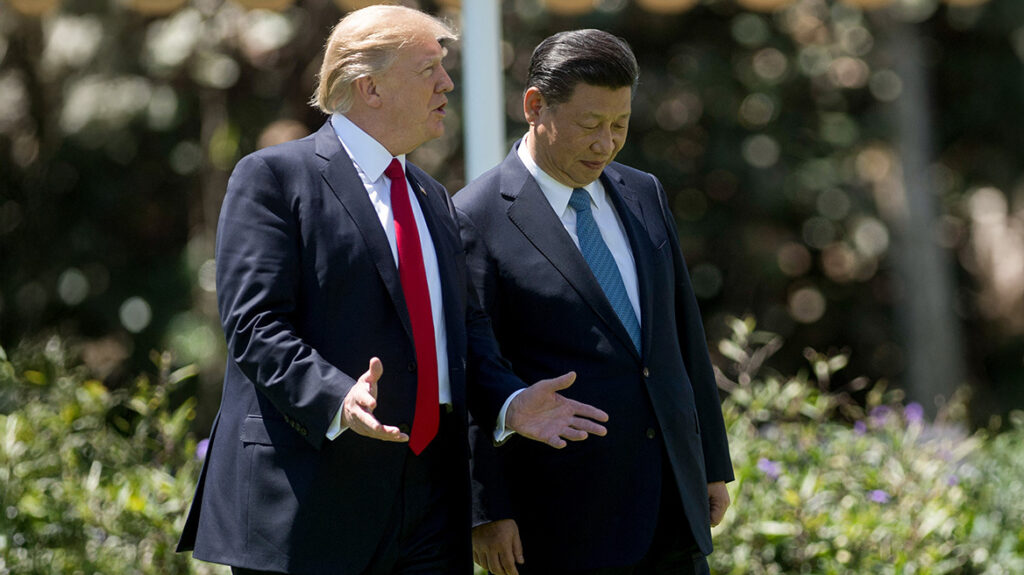
American President Donald Trump is preparing to meet with his Chinese counterpart, Xi Jinping, next week in Beijing. China, along with Russia, is one of Iran’s key allies. Before the Middle East war, China absorbed 80% of Iranian oil exports and since the conflict began has continuously condemned the American-Israeli offensive against Iran. Donald Trump’s visit to Beijing was originally scheduled for March and was postponed to May 14-15 following the outbreak of the conflict. Trump insisted at the time on his promise that it would be a short-duration military operation, lasting four to six weeks.
But instead of arriving victorious and triumphant as he had imagined, Donald Trump appears destabilized and even weakened when he reaches China, notes Agence France-Presse. The outcome of the conflict remains uncertain and the American president’s strategy, which alternates between apocalyptic threats and promises of diplomatic settlement, is at least difficult to read.
“The reality is that today Iran is an extremely important issue for the United States and the Chinese know it,” comments Edgar Kagan of the Center for Strategic and International Studies (CSIS).
The world’s second-largest power could consequently exploit the confusion and sell its influence over Tehran to obtain concessions regarding trade or even Taiwan.
Moreover, Trump’s visit was preceded just days earlier by a visit to Beijing by Iranian Foreign Minister Abbas Araghchi. “Beijing can activate many levers,” comments Patricia Kim of Washington’s Brookings Institution. “Trump is seeking a victory. And there haven’t been many in recent weeks as the war in Iran continues.”
Trump & Xi summit: Awaiting announcement of major contracts
Trump, who wants to project an image of strength on the international stage, will consequently be particularly vulnerable to the display of grandeur that China will deploy during his visit, the first since 2017.
He constantly boasts about his “very good relationship” with Xi Jinping and insists that the war in Iran has not affected it.
For example, Donald Trump suggested that China helped Iran replenish its weapons stockpiles, but without making it a major issue.
The most tangible result of the trip to China could be an extension of the fragile trade truce agreed between the two leaders during a meeting in South Korea last October.
Beijing has no intention of giving up much ground in trade and showed this by rejecting sanctions imposed by the United States on companies buying Iranian oil.
The Sino-American summit will also result in the announcement of major contracts, as usually happens with this type of visit.
The Semafor website reported that the heads of Apple, Exxon, Nvidia and Boeing were invited by the White House to participate in Trump’s visit to China and also mentioned the possibility of Chinese orders for Boeing.
China & Taiwan relations
Beijing “will try to buy time and room for maneuver against the US,” explains Jonathan Jin, a China specialist at the Brookings Institution.
Some analysts also expect Xi Jinping to try to secure concessions from Donald Trump regarding Taiwan, particularly concerning American arms sales to Taipei.
American presidents have always been careful to weigh their words in public statements about Taiwan, which the US does not officially recognize but remains its main ally.
From Donald Trump’s side, known for his impulsive, crude statements, a transactional approach to providing American military aid to foreign partners is a given.