Information regarding the operation codenamed “Project Freedom,” announced by Donald Trump concerning the Strait of Hormuz, has come to light. Specifically, according to a post by Axios journalist Barak Ravid on X early Monday morning, the new initiative for the Strait of Hormuz will not necessarily include mandatory escort of commercial ships by the U.S. Navy.
According to Ravid, U.S. ships will remain “in the vicinity” so that, if necessary, they can prevent potential attacks by Iranian military forces against commercial ships passing through the Straits.
The journalist, citing two officials, reports that the U.S. Navy will provide commercial ships with information about safer maritime routes, emphasizing lanes that have not been mined by the Iranian military.
🚢The new Hormuz Strait initiative will not necessarily include U.S. Navy ships escorting commercial ships, according to two U.S. officials
🚢One of the officials said U.S. Navy ships will be “in the vicinity” in case they need to prevent Iran’s military from attacking commercial… https://t.co/motz3sd7DF— Barak Ravid (@BarakRavid) May 4, 2026
Iran’s reaction: Any American involvement in Strait of Hormuz violates ceasefire
New tensions are emerging in the Middle East as a senior Iranian official warned that any American involvement in the Strait of Hormuz would be considered a violation of the ceasefire, at a time when Washington is activating what appears to be a military operation to free trapped ships.
A clear message to the United States was sent by Ebrahim Azizi, chairman of the national security committee of the Iranian parliament, warning of consequences in case of American involvement.
In his post on platform X, in both English and Persian, he emphasized: “Warning: Any American interference in the new maritime regime in the Strait of Hormuz will be considered a violation of the ceasefire.”
⚠ WARNING
Any American interference in the new maritime regime of the Strait of Hormuz will be considered a violation of the ceasefire.
The Strait of Hormuz and the Persian Gulf would not be managed by Trump’s delusional posts!
No one would believe Blame Game scenarios!
— ابراهیم عزیزی (@Ebrahimazizi33) May 3, 2026
Tanker hit by “unknown projectiles” in Strait of Hormuz off UAE waters
Meanwhile, a tanker was hit by “unknown projectiles” in the Strait of Hormuz, in waters off the United Arab Emirates, with no casualties reported, announced today the British maritime security service UKMTO.
“UKMTO received a report of an incident 78 nautical miles (145 kilometers) north of Fujairah, United Arab Emirates,” the service, which falls under the British Ministry of Defense, reported via X, clarifying that this “incident” was reported to them yesterday Sunday at 22:40 (Greek time).
“Tanker reported being hit by unknown projectiles,” it noted, adding that all crew members are safe and there was no environmental impact.
It did not provide other clarifications, particularly about where the targeted vessel had departed from.
The American “Project Freedom” operation
The warning from the Iranian side comes after U.S. President Donald Trump’s announcement of the start of “Project Freedom” operation, aimed at removing ships that have been trapped in the Strait of Hormuz.
The operation begins Monday and, according to the U.S. Central Command (CENTCOM), will support commercial ships seeking to pass through the critical maritime corridor.
A U.S. official clarified that this is not a ship escort mission.
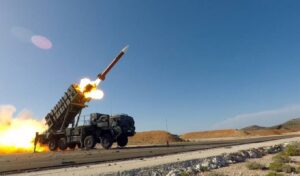
U.S. military support includes guided missile destroyers, more than 100 land and sea aircraft, as well as approximately 15,000 military personnel.
CENTCOM commander Admiral Brad Cooper stated that the operation is critical for regional security and the global economy, noting that the U.S. maintains the naval blockade in parallel.
In the same framework, the State Department’s “Maritime Freedom Construct” initiative is also being activated, which combines diplomatic actions with military coordination for security in the region.
Trump’s position and the “humanitarian” dimension
Donald Trump presented the operation as a humanitarian initiative, arguing that it concerns neutral countries that are not involved in the conflict.
In his post he mentioned that the U.S. will safely guide ships out of the restricted waterways so they can continue their activities, emphasizing that this is help for “innocent observers” of the conflict.
He warned, however, that any obstruction of the operation “will be dealt with forcefully.”
Trump’s statement
“Countries from around the world, almost all of which are not involved in the Middle East conflict that is unfolding so clearly and violently before everyone’s eyes, have asked the United States to help free their ships, which have been trapped in the Strait of Hormuz, in a situation they have absolutely nothing to do with — they are simply neutral and innocent observers.
For the good of Iran, the Middle East, and the United States, we have informed these countries that we will safely guide their ships out of these restricted waterways, so they can continue their activities unimpeded. These are ships from regions of the world that have no involvement in what is happening right now in the Middle East.
I have instructed my representatives to inform them that we will make every possible effort to safely remove the ships and their crews from the Straits. In all cases, they have informed us that they will not return until the area becomes safe for navigation and every other activity.
This process, ‘Project Freedom,’ will begin Monday morning, Middle East time. I am fully aware that my representatives are having very positive discussions with Iran and that these discussions could lead to something particularly positive for everyone.
The movement of ships is aimed exclusively at freeing people, companies and countries that have done absolutely nothing wrong — they are victims of circumstances. This is a humanitarian initiative on behalf of the United States, Middle Eastern countries, but especially Iran.
Many of these ships are already facing shortages in food and basic goods that are essential for maintaining the health and hygiene of their large crews.
I believe this move will substantially contribute to demonstrating good will from all sides that have been so intensely involved in their conflicts in recent months.
In case this humanitarian process is obstructed in any way, this obstruction will, unfortunately, have to be dealt with decisively and with force.”
“I have all the cards”: White House message to Iran with Trump and UNO cards
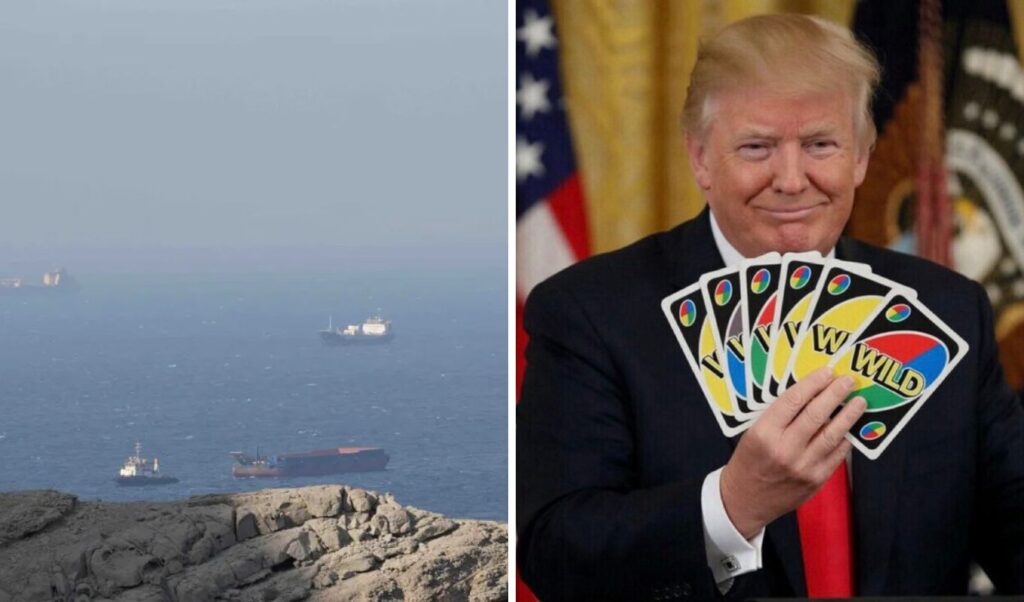
Meanwhile, the White House published on platform X a photo of Donald Trump holding UNO game cards, accompanied by the phrase “I have all the cards.”
The post was made without additional comments, but is interpreted as a message to Iran, amid discussions about ending the conflict, the nuclear program, as well as the Strait of Hormuz issue.
— The White House (@WhiteHouse) May 3, 2026
Iran received U.S. response to 14-point proposal
Iran announced it received the American response to its 14-point proposal and is in the process of evaluating it. The transmission was made through Pakistan, within the framework of indirect diplomatic contacts, while Tehran has not yet expressed an opinion on the content of the response.
According to the semi-official Tasnim agency, the 14-point plan includes:
- Non-aggression guarantees from the U.S.
- Withdrawal of American forces from areas around Iran
- Lifting of U.S. naval blockade in the Strait of Hormuz
- Creation of a new mechanism for managing the Straits
- End of Israel-Hezbollah conflict in Lebanon
- Release of frozen Iranian assets
- End of war within 30 days (as opposed to American proposal for two-month ceasefire)
According to Axios, the proposal includes a condition that negotiations on Iran’s nuclear program should begin only after the end of the war.
U.S. & Iran talks continue
Iran’s Foreign Ministry spokesman Esmail Baghaei emphasized: “At this stage there are no nuclear negotiations,” adding that the proposal focuses exclusively on ending the war.
On the other hand, Trump characterized Iran’s 14-point proposal as “unacceptable,” considering that it does not serve American interests.
U.S. special envoy Steve Witkoff stated that talks with Iran continue, leaving open the possibility of a diplomatic solution, despite tensions in the region.