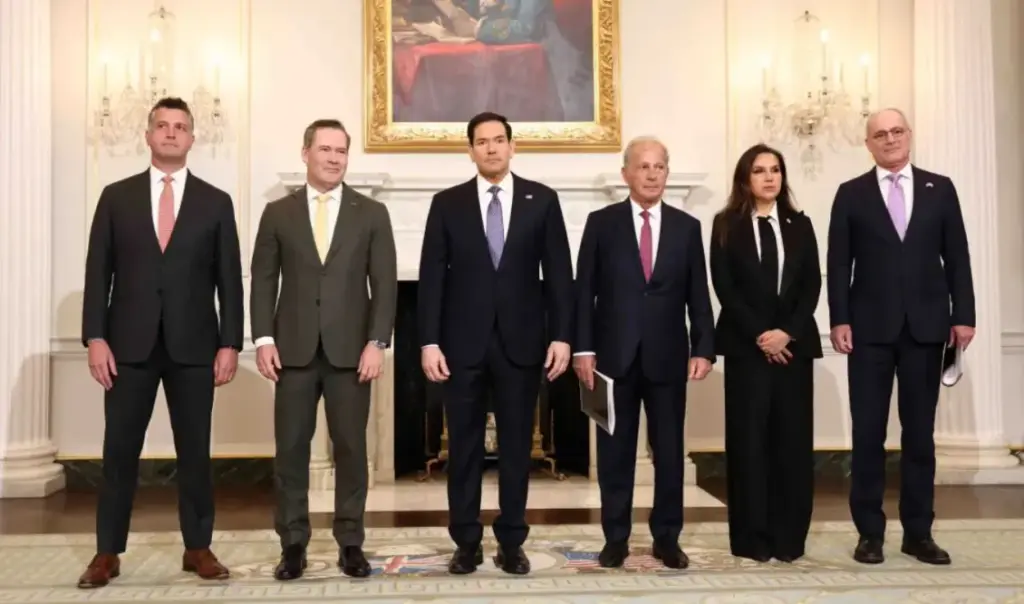
After two hours of consultations in Washington, the meeting between ambassadors from Israel and Lebanon has concluded, in an attempt to restart dialogue between the two countries under United States guidance. At the center of these contacts were Israeli Ambassador Yechiel Leiter and Lebanese representative Nada Hamadeh Moavad, with US Secretary of State Marco Rubio taking on a mediating role. This initiative is part of broader diplomatic efforts attempting to reduce tensions in the wider Middle East region. The head of American diplomacy characterized the talks as a “historic opportunity”, emphasizing however that the complexity of the issues doesn’t allow for immediate solutions. As he noted, this process is not expected to lead to a comprehensive settlement within a few hours, but could mark the beginning of gradual progress. UN Secretary-General Antonio Guterres moved along similar lines, stressing the importance of the initiative. As he pointed out, there’s no expectation for immediate resolution of all differences, however such contacts are crucial for creating appropriate conditions that will enable future developments.
Read: Rubio on Israel & Lebanon talks: “Historic opportunity – Everything won’t be solved in six hours”
Israel & Lebanon talks in Washington: What Tel Aviv proposes, the “yellow line” and the “clearing”
What Israel presented during the first round of talks was proposed by former Israeli Minister of Strategic Affairs, Ron Dermer, who refused to lead ceasefire negotiations in Lebanon but submitted a proposal aimed at promoting a settlement in the region, which was discussed based on Middle East developments and war discussions. Dermer’s proposal is based on dividing Lebanon into three zones and ensuring prolonged Israeli military presence in southern areas. According to the plan, in the first zone, the Israeli army would maintain control from the border area to the so-called “yellow line,” approximately 8 kilometers deep from the border, with significant forces stationed there for an extended period under the pretext of completing Hezbollah’s disarmament.
In the second zone, between the “yellow line” and the Litani River, the Israeli army would continue what Dermer described as “clearing” the area of Hezbollah fighters and infrastructure. As this objective is gradually achieved, Israeli forces would withdraw from areas where operations are completed, allowing the Lebanese army to deploy and assume security responsibilities. The third zone is located north of the Litani River. According to Dermer, full responsibility for Hezbollah’s disarmament in this area would belong to the Lebanese army. To implement the three-point plan, approval from the Lebanese government is required for continued Israeli presence in the southern security zone. Consequently, Dermer is cautiously optimistic about the possibility of achieving a temporary settlement with Lebanon. Israel negotiates with a clear condition: No complete withdrawal and no full implementation of the plan until the Hezbollah weapons issue in Lebanon is fully resolved.
Trump on second round of negotiations with Iran: “Could happen within the next 48 hours”
US President Donald Trump told the New York Post that negotiations with Iran “could take place within the next two days” in Pakistan. Four sources speaking to Reuters reported that Washington and Tehran negotiating teams may return to Islamabad this week, following the weekend breakdown. Earlier, US Vice President J.D. Vance accused Iran of “economic terrorism.” “Something could really happen in the next two days, and we’re more willing to go there,” Trump said according to reports. Meanwhile, the United States and Iran continue to communicate, according to a US official’s statement to CNN, following the failure of peace talks in Islamabad. American officials are discussing a possible second face-to-face meeting with the Iranians in Pakistan, according to sources.