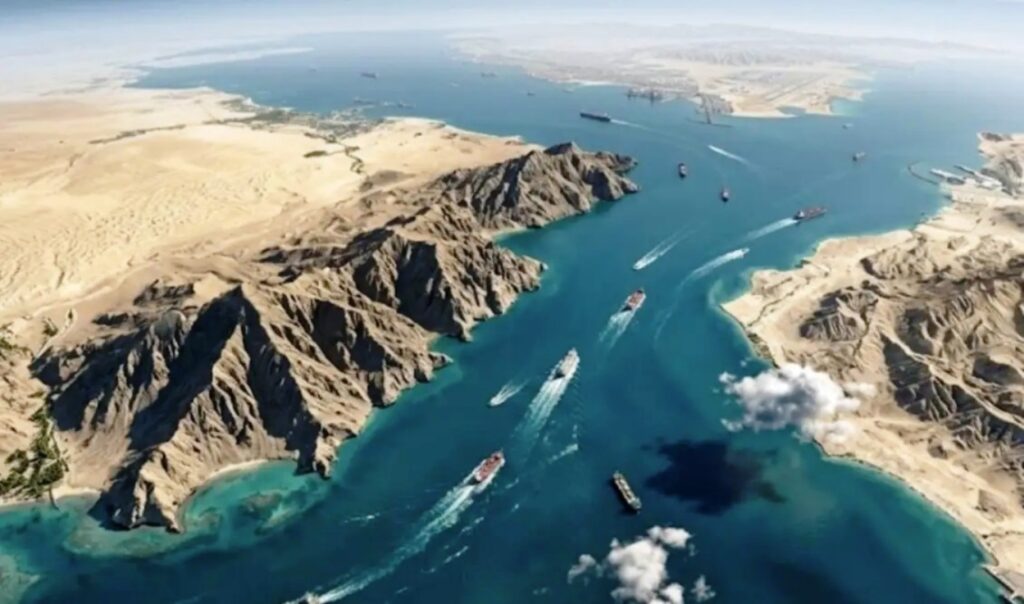
The diplomatic temperature is rising sharply regarding the Strait of Hormuz, with Iran threatening to implement special control mechanisms while American President Donald Trump insists that the blockade regime will remain. Specifically, Trump warned that “anyone Iranian who opens fire on us or peaceful ships will be destroyed,” while Iran’s Revolutionary Guards warned that any military vessel approaching the Straits will be considered a violation of the ceasefire and will be dealt with “harshly and decisively,” highlighting the danger of a perilous escalation.
Strait of Hormuz: Iran’s message
A spokesperson for Iranian forces (Khatam al-Anbiya) announced Monday that US restrictions on ships in international waters are illegal and “amount to piracy,” stating that Iran will decisively implement a “permanent mechanism” to control the Strait of Hormuz, defying Donald Trump’s threats of naval blockade.
A spokesperson for Iranian forces (Khatam al-Anbiya) announced Monday that US restrictions on ships in international waters are illegal and “amount to piracy,” stating that Iran will decisively implement a “permanent mechanism” to control the Strait of Hormuz, defying Donald Trump’s threats of naval blockade.
Earlier, the Islamic Revolutionary Guard Corps (IRGC) announced that the movement of military vessels near the Strait of Hormuz constitutes a violation of the ceasefire.
The IRGC Navy, in its latest statement, noted that “contrary to the baseless claims of the American-Zionist enemy, the passage of civilian ships through the Strait of Hormuz is permitted under intelligent management and control, according to specific regulations.
“However, any military vessels intending to approach the Strait of Hormuz under any pretext will be considered a violation of the ceasefire and will be dealt with strictly and harshly.”
“We were just inches away from the ‘Islamabad Cooperation Memorandum,'” Iranian Foreign Minister Abbas Araghchi said in a new overnight post, referring to talks held in the Pakistani capital.
Reuters: Massive military operation for US naval blockade of Iran
A naval blockade of Iran by the United States, Reuters reports, constitutes a large-scale, open-ended military operation that could trigger new retaliation from Tehran and further burden an already fragile ceasefire, experts warn.
President Donald Trump, in a social media post following the deadlock in peace talks held over the weekend in Islamabad, stated that the US Navy “will begin the process of BLOCKING every ship attempting to enter or exit the Strait of Hormuz.”
However, US Central Command (CENTCOM) later clarified that the blockade would only apply to ships bound for or originating from Iran, including all Iranian ports in the Persian Gulf and Gulf of Oman. According to the same announcement, the measure will take effect Monday at 10:00 AM Washington time (14:00 GMT).
Trump also stated that US forces will intercept ships that have paid transit fees to Iran, even if they are in international waters. “No one paying illegal fees will have safe passage on the high seas,” he wrote on Truth Social platform.
As he emphasized, the ultimate goal is to pressure Iran to end its effective blockade of the Straits – a crucial channel through which approximately 20% of global oil passes – to all countries that have not secured safe passage from Tehran.
If this strategy succeeds, it could deprive Iran of its main negotiating advantage against the US and restore global trade flow, potentially leading to lower oil prices. However, according to experts, such a blockade constitutes an act of war and requires long-term commitment of significant naval forces.
“Trump seeks a quick solution. In reality, this is a mission that is difficult to implement unilaterally and probably unsustainable in the medium or long term,” said Dana Stroul, former senior Pentagon official.
How the US military will move
The US military has not yet provided key details on how the blockade will be implemented, such as the number of warships that will participate, the use of aircraft, or the contribution of Gulf allies. CENTCOM did not respond to requests for comment.
According to analysts, with sufficient warships, the US Navy could enforce a blockade that would discourage many commercial tankers from attempting to transport Iranian oil.
However, critical questions remain: Are the US willing to board and seize – or even strike or sink – ships attempting to break the blockade? What will happen if these ships carry oil for major powers like China or US allies like India and South Korea?