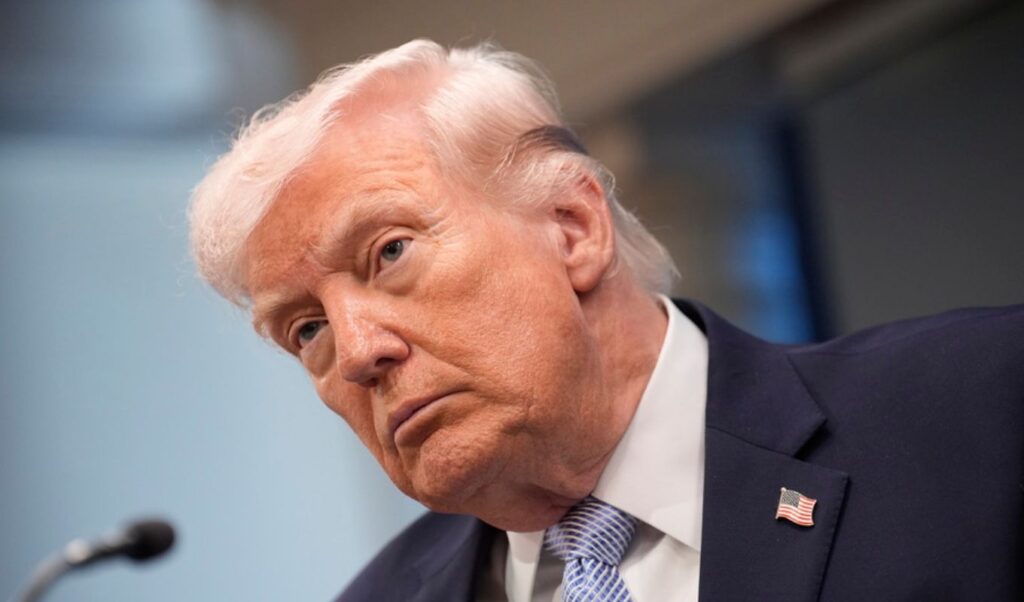
With Donald Trump’s ultimatum expiring in the early hours of Wednesday (03:00 Greek time, 20:00 Tuesday evening Eastern Time), the American president reportedly faces a dilemma: Strike Iran’s energy infrastructure immediately or withdraw the ultimatum if he sees signs of agreement from the other side. This is reported by the American website Axios, as ceasefire attempts continue behind the scenes with three main countries (Pakistan, Egypt, Turkey) pushing in that direction.
It should be recalled that yesterday a two-phase plan was leaked involving an initial ceasefire followed by a possible peace agreement, with Pakistan’s role emerging as key, though not accepted by either side. Iran, for its part, submitted its own 10-point plan according to the New York Times, in which Tehran reportedly demands guarantees that it will not face attack again, the lifting of all sanctions, and cessation of Israeli strikes against Hezbollah in Lebanon. In exchange, Iran would lift the blockade of the Strait of Hormuz while maintaining tolls of $2 million, which would be shared with neighboring Oman. These resources would be directed toward rebuilding the country instead of demanding reparations, according to the published plan. Trump characterized this proposal yesterday as a “significant step” but not “good enough.”
Pakistan’s efforts to end the war reach “critical and sensitive stage”
Meanwhile, Pakistan’s efforts to end the war are reaching a “critical and sensitive” stage, says Iranian ambassador to Islamabad, Reza Amiri Moghadam. Specifically, he stated in an X post that Pakistan’s “positive and productive” efforts to end the US-Israel war with Iran are approaching a “critical and sensitive” stage, sending the message to “stay tuned” for further developments.
Pakistan positive and productive endeavours in Good Will and Good Office to stop the war is approaching a critical, sensitive stage …
Stay Tuned for more
— Reza Amiri Moghadam (@IranAmbPak) April 7, 2026
“Trump appears to be the most determined hawk in the war against Iran” – The two “camps”
It should be noted that behind the scenes, the White House decision-making team appears divided, according to Axios: On one side, there are American officials like JD Vance, Steve Witkoff, and Jared Kushner pushing for successful completion of negotiations, but on the other, Israeli Prime Minister Benjamin Netanyahu, the monarchies of Saudi Arabia and the United Arab Emirates, as well as influential Republican Senator Lindsey Graham are pushing Trump to strike Iran hard unless it makes concessions that don’t appear on the horizon, such as opening the Strait of Hormuz and surrendering all enriched uranium.
Notably, according to the same source, perhaps the most determined “hawk” on the White House staff is Donald Trump himself, with an official cited by Axios noting that more “dovish” are Defense Secretary Pete Hegseth and Secretary of State Marco Rubio, contrary to reports suggesting the opposite.
Iran responds to Trump’s threats: He has about 20 hours to surrender
Trump “has about 20 hours” to surrender to Iran “or his allies will return to the stone age,” declared a top adviser to the President of the Iranian Parliament, Mohammad Bagher Ghalibaf, mirroring the American president’s rhetoric. “We will not back down!” wrote Mahdi Mohammadi, who is also a national security analyst, on X. “Iran has clearly and openly won the war and will only accept an end that consolidates its gains and creates a new regional security regime,” Mohammadi added.
The spokesman for Iran’s Khatam al-Anbiya Central Military Command characterized Donald Trump’s threats as “delusional,” arguing they cannot compensate for the “shame and humiliation” that, according to Tehran, the United States has suffered in the region.
The American president is demanding that Tehran open the Strait of Hormuz and avoid further escalation, warning that the United States could destroy “every energy production facility and every bridge” in Iran in just four hours if Tehran does not comply. Meanwhile, Trump emphasized that he does not desire complete destruction but stressed that Iranians are willing to suffer for their freedom.
Trump characteristically said he would destroy “every energy production facility” and “every bridge” in Iran within four hours of the ultimatum’s expiration. The deadline he set on Sunday expires at 8 PM Tuesday (Eastern Time in the US, 3:00 AM Wednesday in Greece).
“All of Iran’s bridges will be destroyed by midnight tomorrow, all energy production facilities will be put out of operation (…) and cannot be used again,” Trump stated emphatically. “And it will be done within four hours, if we want it,” he added.
Iran could be neutralized “overnight,” President Trump emphasized, adding that “this night could be tomorrow night.” He stressed, however, that “we don’t want that,” instead the US could help Iranians “rebuild their nation.”
Israeli army warning to Iran: “Don’t use trains until 9:00 PM”
The Israeli military issued an urgent warning to train users and passengers in Iran with a post in Farsi on X.
According to this warning, citizens are called for “security reasons” to avoid “using trains or traveling by train anywhere in Iran from now until 21:00 Iran time.” “Your presence on trains and near railway lines endangers your life,” it adds.
‼️ هشدار فوری به استفادهکنندگان و مسافران قطارها در کشور ایران.
⭕️ شهروندان گرامی، به منظور امنیت شما، خواهشمندیم از این لحظه تا ساعت ۲۱:۰۰ به وقت ایران، از استفاده و سفر با قطار در سراسر ایران خودداری نمایید.
⭕️ حضور شما در قطارها و در مجاورت خطوط راهآهن جانتان را به خطر می… pic.twitter.com/Fm3BAAEFra
— ارتش دفاعی اسرائیل | IDF Farsi (@IDFFarsi) April 7, 2026
Nighttime Iranian attack hits petrochemical plant in Saudi Arabia
Overnight attacks in Saudi Arabia struck a petrochemical complex in a major industrial area in the eastern city of Jubail, according to a source at the scene who spoke to AFP, hours after similar facilities were hit in Iran.
“An attack caused a fire at SABIC factories in Jubail. The explosion sounds were very loud,” the source told AFP, referring to the Saudi Basic Industries Corporation.
An Iranian ballistic missile struck the SABIC petrochemical plant in Saudi Arabia, resulting in a large fire breaking out.
This is the larger petrochemical plant in the Middle east and the fourth largest in the world. pic.twitter.com/ookobNVSNe
— AMK Mapping 🇳🇿 (@AMK_Mapping_) April 7, 2026
Jubail in eastern Saudi Arabia hosts one of the world’s largest industrial cities, producing steel, gasoline, petrochemicals, lubricants, and chemical fertilizers.
Iranian media report synagogue in Tehran damaged by US-Israeli raid
A synagogue in central Tehran suffered serious damage from a US-Israeli strike today, according to the semi-official Mehr news agency. The Israeli military did not immediately comment on the matter.
JUST IN 🇮🇷🇺🇸: U.S. and Israel Strike and Destroy Jewish Synagogue in Tehran, Iran
Rescue crews are in the area.
Reporter: “The Zionist regime, which calls itself a Jewish state, showed by attacking this site that it has a problem with all Iranians—it makes no distinction… https://t.co/HMZS0BVzQc pic.twitter.com/pORfY8Fljr
— Ryan Rozbiani (@RyanRozbiani) April 7, 2026
5 killed in Israeli raids in Lebanon
Meanwhile, the death toll from the Israeli airstrike that targeted a residential area in Shahriar, west of Tehran province, has now risen to nine, according to the semi-official Mehr news agency. Citing the deputy governor, the agency reported that another 15 people were injured in the raid. It should be recalled that Israel carried out a new wave of airstrikes targeting Iran’s infrastructure at dawn, while two separate Israeli airstrikes in southern Lebanon killed five people and wounded several others, according to Lebanon’s National News Agency (NNA).
Two people were killed when their home was hit in the town of Maarakeh, the NNA reports. The attack also left several others wounded. In a separate overnight airstrike in the town of Tayr Debba, three people were killed and two wounded, according to reports.