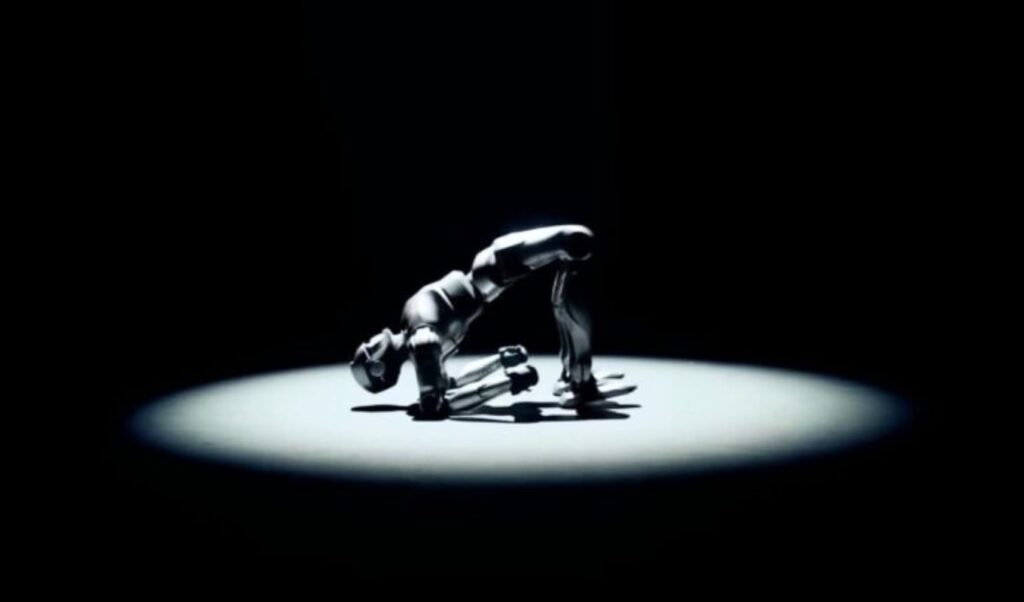
The Chinese company manufacturing humanoid robots Engine AI has announced its plans to send a humanoid robot to space, aiming to create the world’s first robotic astronaut. The Shenzhen-based company announced a partnership with Beijing Interstellar Human Spaceflight Technology—a commercial space missions company—to implement the Humanoid Robot Astronaut Exploration Program.
Read: End of ironing and mopping – The affordable price for the robot that does all your chores
According to Interesting Engineering, the mission will utilize Engine AI’s humanoid platform PM01, a multifunctional artificial intelligence system featuring high-precision sensors, exceptionally fast motor response, and autonomous decision-making capabilities. It’s worth noting that last year, Engine AI announced that PM01 became the first humanoid robot to successfully perform a backflip.
China’s robotic astronaut
Engine AI stated that space exploration demands much more than any terrestrial application, requiring exceptional performance stability, environmental adaptability, and autonomous decision-making. Unlike Earth-based conditions, space missions expose machines to vacuum, microgravity, extreme temperature fluctuations, and high radiation levels, pushing robotic systems beyond their conventional operational limits.
To meet these specific challenges, the startup announced it will work closely with commercial space company Interstellor, aiming to enhance PM01’s reliability in space conditions. The partnership will focus on improving the system’s adaptability, durability, and operational capabilities, with the ultimate goal of enabling PM01 to autonomously execute complex space missions.
According to Engine AI, humanoid robots like PM01 could surpass human capabilities in certain space missions, taking on dangerous roles such as external space station maintenance, exploration of hazardous areas, and long-duration monitoring that would endanger astronauts. By developing humanoid robots for these tasks, the company estimates that risks to human crew members will be significantly reduced.
Engine AI and Interstellor stated they plan to jointly address key technical challenges to establish PM01 as the world’s first humanoid robotic astronaut. This initiative represents a significant step in China’s effort to integrate embodied artificial intelligence into space exploration.
Artificial intelligence in space
PM01 is a compact humanoid robot designed for researchers seeking to combine human movements with advanced robotic intelligence capabilities. It’s equipped with an interactive central screen, biomimetic architecture that replicates human movement, and a torso capable of rotating up to 320 degrees. Additionally, it features an exoskeleton made from durable aluminum alloy, offering a balance between robustness and flexibility.
Compared to Engine AI’s full-size humanoid SE01, PM01 is significantly smaller and lighter. It stands 1.38 meters tall and weighs approximately 40 kilograms, making it 27 centimeters shorter and 8 kilograms lighter than the previous model.
Meanwhile, Interstellor is advancing its own space ambitions. On January 22, the company hosted the global “Next Stop, Space” event, presenting plans for commercial crewed flights and space tourism. According to the plan, the CYZ1 vehicle could launch as early as 2028, offering passengers a brief zero-gravity experience at an altitude of 100 kilometers.
Source: Interesting Engineering