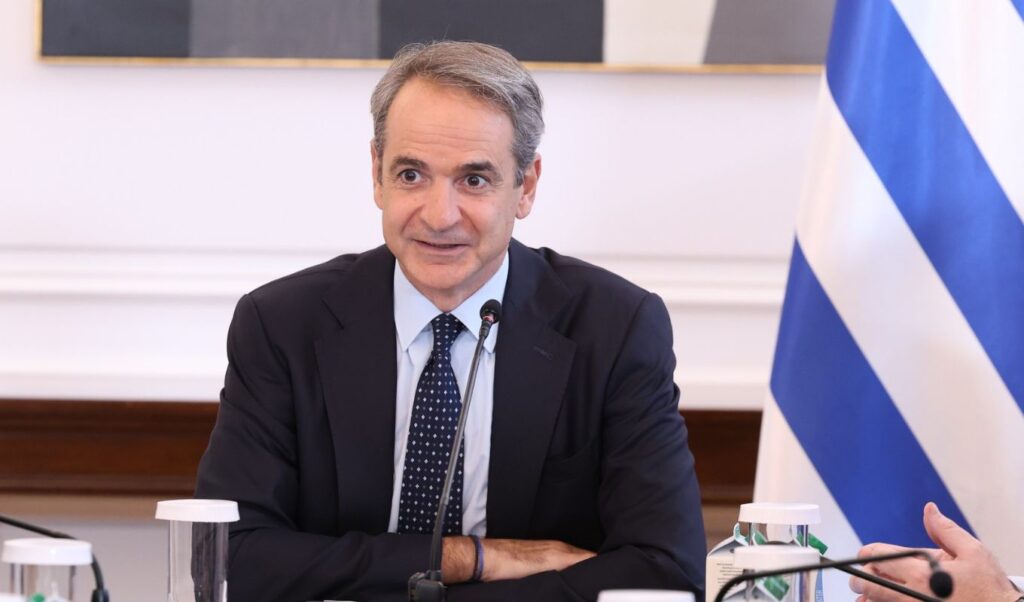
Kyriakos Mitsotakis sent a pre-election message in his weekly review, published on Sunday morning (22/11). The Prime Minister, using the occasion of the new state budget’s submission to Parliament this week, stated that “in 2027, the year of national elections, citizens will be called upon to decide whether we continue on this path,” adding that “it is everyone’s responsibility to ensure that what we have achieved with such effort is not lost.”
Mitsotakis went on to say that “it is also worth noting how we manage to collect more revenue without raising taxes,” explaining: “One of the reasons is that for the first time, the VAT gap has fallen below 10%, converging for the first time with the EU average. What does this mean in practice? In 2019, for every 100 euros of VAT we should have collected, we were losing 24. In 2024, according to preliminary estimates from the European Commission, we were losing around 9. Digitization, myDATA, and the integration of cash registers with POS systems have all contributed to this change. It doesn’t mean that tax evasion has disappeared. It does mean, however, that it is becoming increasingly difficult.”
He further emphasized that “we want and must return this money to society,” providing specific examples: “The most recent example: these days, pensioners over 65 are receiving the annual permanent benefit of 400 euros, net and tax-free. Last year it was 250 euros and was received by 1.24 million pensioners. This year we have abolished the income criteria, leaving only the age threshold of 65, or 60 for those receiving only a widow’s pension. As a result, the number of beneficiaries reaches 2.12 million — nearly 900,000 more than last year. Depending on the bank, the funds were deposited into accounts on Friday, while some will see the money on Monday. People with disabilities and uninsured elderly individuals will receive the benefit from OPEKA on November 30. It is not a solution to everything, but it is a breath of relief in a demanding month.”
The Prime Minister also announced an extension of fuel subsidies until November 30, noting that “prices have started to ease, but the market remains unstable. Combined with refinery discounts, the relief amounts to 40 cents per liter on heating oil, 20 cents on diesel, and 10 cents on unleaded petrol.”
Mitsotakis: Respecting the message of the Athens Polytechnic uprising means universities open to knowledge and dialogue, but closed to violence and lawlessness
Kyriakos Mitsotakis also addressed the topic of universities, on the occasion of the commemoration of the Athens Polytechnic uprising. As he stated: “Although the Polytechnic campus has been designated a historic site, three of its most iconic landmarks had not been individually recognized as monuments. The Central Archaeological Council and the Central Council of Modern Monuments voted unanimously in favor of designating the main gate on Patission Street — through which the tank broke in on the night of November 17, 1973 — the crushed iron gate, and Memos Makris’ bronze sculpture ‘In Honor of the Fallen’ as modern monuments. Three symbols inextricably linked to the resistance against the dictatorship and the struggle for democracy. Their protection is an act of respect for our history. And respecting the message of the Polytechnic means universities open to knowledge and dialogue, but closed to violence and lawlessness.”
Kyriakos Mitsotakis’ post
“Good morning! The weather bears no resemblance to the fact that we are approaching the end of November. There are, however, certain things that remind us that time moves forward as usual, such as the submission of the new state budget to Parliament this week. At a time when international uncertainty continues to affect economies across Europe, our country cannot remain unaffected. It is, however, on a trajectory of progress, with prospects that are continuously improving. In 2027, the year of national elections, citizens will be called upon to decide whether we continue on this path. It is everyone’s responsibility to ensure that what we have achieved with such effort is not lost.
That we are standing on solid ground is also demonstrated by this year’s budget execution. In the ten-month period from January to October, the primary surplus reached 7.78 billion euros — nearly 3 billion above target. Even excluding time-shifted payments, the surplus exceeds 1 billion euros. At the same time, investment expenditure reached 11.5 billion euros, 2.17 billion more than last year.
It is also worth noting how we manage to collect more revenue without raising taxes. One of the reasons is that for the first time, the VAT gap has fallen below 10%, converging for the first time with the EU average. What does this mean in practice? In 2019, for every 100 euros of VAT we should have collected, we were losing 24. In 2024, according to preliminary estimates from the European Commission, we were losing around 9. Digitization, myDATA, and the integration of cash registers with POS systems have all contributed to this change. It doesn’t mean that tax evasion has disappeared. It does mean, however, that it is becoming increasingly difficult.
And we want and must return this money to society. The most recent example: these days, pensioners over 65 are receiving the annual permanent benefit of 400 euros, net and tax-free. Last year it was 250 euros and was received by 1.24 million pensioners. This year we have abolished the income criteria, leaving only the age threshold of 65, or 60 for those receiving only a widow’s pension. As a result, the number of beneficiaries reaches 2.12 million — nearly 900,000 more than last year. Depending on the bank, the funds were deposited into accounts on Friday, while some will see the money on Monday. People with disabilities and uninsured elderly individuals will receive the benefit from OPEKA on November 30. It is not a solution to everything, but it is a breath of relief in a demanding month.
I am of course aware that the high cost of living continues to pressure many households and that income increases are not always enough to cover everyday needs. That is why we are extending fuel subsidies until November 30. Prices have started to ease, but the market remains unstable. Combined with refinery discounts, the relief amounts to 40 cents per liter on heating oil, 20 cents on diesel, and 10 cents on unleaded petrol. A private initiative is moving in the same direction: Eurobank is offering 10% cashback to customers who purchase heating oil from EKO using their Eurobank debit or credit card, nationwide, until January 15. Accordingly, based on the Liquid Fuel Price Observatory, average prices currently stand at 1.94 euros per liter for unleaded petrol, 2.02 euros for diesel, and 1.44 euros for heating oil. With the additional 14-cent discount from Eurobank, the price of heating oil could drop to just below 1.30 euros per liter.
And since cities are beginning to light up with Christmas decorations, here is some practical news for the holiday season. From December 18 to 31, supermarkets will feature the “Holidays for Everyone” list, with over 300 product codes across 25 categories and discounts of up to 25%, covering everything from olive oil, milk, and eggs to meat, cheeses, sweet breads, and New Year’s cakes. The goal is to make the festive table more affordable.
Moving on to the other topics of the week:
1. The European Commission has approved the final Greek payment requests from the Recovery Fund, totaling 11.32 billion euros. Having fulfilled all 376 milestones and targets of our plan, we are now one step away from receiving the full 35.95 billion euros allocated to us. It was not a given that we would get this far. But we did. From the very beginning, we sought to make use of every available euro for projects the country needs, for upgrading public services, and for new investments. This effort continues, with many projects already underway.
2. I met with the seven mayors of the northern suburbs regarding the transfer of building coefficients, an issue that is of great concern to local communities. I want to clarify two things. No transfer of building coefficients will take place from one municipality to another and, if necessary, we will enshrine this in legislation. And no decision will be made without the agreement of the municipalities. Any municipality that does not wish to have the measure applied will not have it imposed upon them. And wherever there are objections to the ongoing studies, we will continue consultations until a mutually acceptable solution is found.
3. The platform has opened for the second phase of applications for childcare vouchers for infant, toddler, and preschool nurseries, giving more families the opportunity to benefit from the program. The increased benefit amounts and expanded income thresholds I mentioned in a previous review naturally apply. Those who did not receive a voucher in the first phase can submit an application until Thursday, November 26, at eetaa.gr.
4. An important development on gender equality: Greece rose to 16th place in the European Gender Equality Index this year, up from 21st last year, recording its highest-ever ranking. Moreover, since 2020, we have shown the greatest improvement in the EU, and our gap from the European average has been nearly halved.
5. We continue to renew the fleet of our Fire Service. Through the “AEGIS” program, 742 new vehicles and equipment worth approximately 79 million euros have already been delivered, with a further 503 to follow. Upon completion of the program, our firefighters will have more than 1,320 new vehicles at their disposal for responding to fires, floods, and other emergencies.
6. On migration, we are moving forward in cooperation with Austria, Germany, Denmark, and the Netherlands to establish a joint returns center in Rwanda. The five countries are exploring the conditions for an agreement, with the aim of beginning the first transfers by 2027. The initiative exclusively concerns those who are not entitled to international protection and have an enforceable return decision. There, they will be able to either integrate into the local community or voluntarily return to a country where they have the right of legal residence. Of course, full compliance with European and international law and human rights is a fundamental prerequisite for the implementation of the plan.
In closing, I want to return briefly to the anniversary of the Polytechnic uprising and to an oversight of decades that was corrected shortly before November 17. Although the Polytechnic campus has been designated a historic site, three of its most iconic landmarks had not been individually recognized as monuments. The Central Archaeological Council and the Central Council of Modern Monuments voted unanimously in favor of designating the main gate on Patission Street — through which the tank broke in on the night of November 17, 1973 — the crushed iron gate, and Memos Makris’ bronze sculpture ‘In Honor of the Fallen’ as modern monuments. Three symbols inextricably linked to the resistance against the dictatorship and the struggle for democracy. Their protection is an act of respect for our history. And respecting the message of the Polytechnic means universities open to knowledge and dialogue, but closed to violence and lawlessness.
We’ll talk again next week. Have a wonderful Sunday, everyone!”